The Death of Hard-Coded Glue and the Rise of AI Orchestration
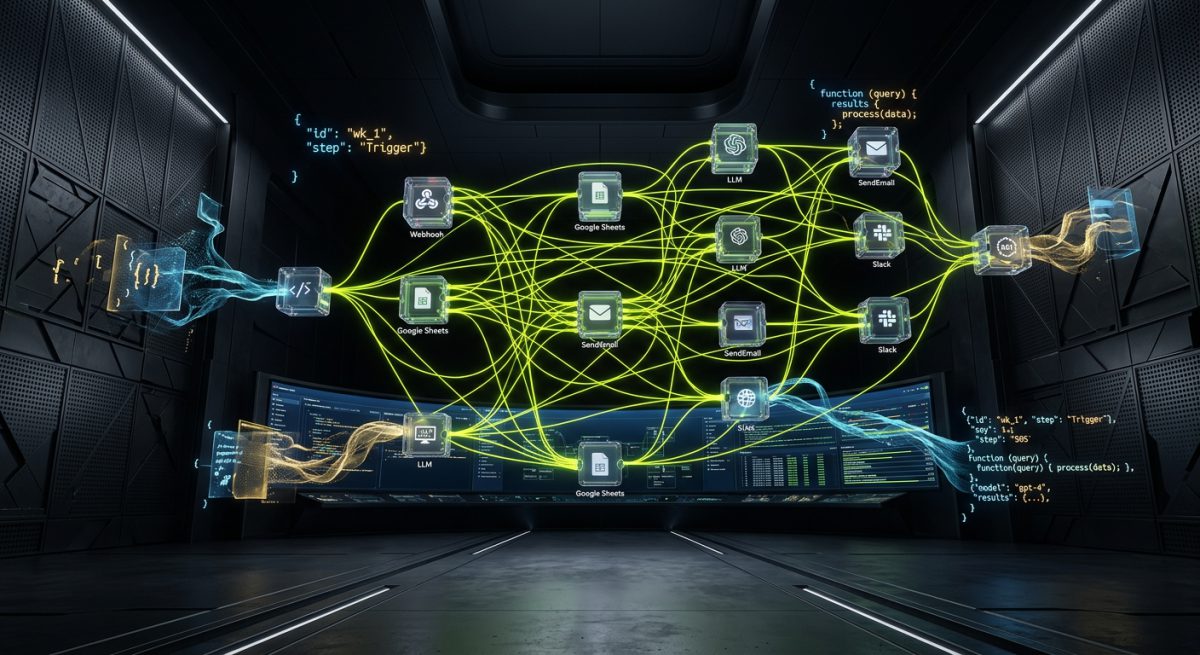
For years, the biggest bottleneck in B2B web development wasn't building the frontend or the database—it was the "glue code." Glue code is the fragile, custom-written middleware designed to make two disparate systems talk to each other. Whether you were syncing a Webflow lead form to a legacy CRM or trying to push Shopify order data into a custom ERP, developers spent nearly 30% of their time writing scripts that did nothing but map JSON fields from one API to another. This approach is not only time-consuming but creates a massive maintenance burden. If one API changes a single field name, the entire integration breaks, often silently. At werun.dev, we have shifted away from this fragile architecture toward visual orchestration using n8n, combined with the transformative power of Large Language Models (LLMs).
n8n is an extendable, "fair-code" workflow automation tool that allows us to build complex logic visually while maintaining the ability to drop into JavaScript when necessary. However, the real game-changer is the recent integration of AI nodes directly into the n8n ecosystem. By leveraging LangChain-powered nodes, we can now create workflows that don't just move data—they understand it. Instead of writing hundreds of lines of if/else statements to handle different customer inquiries, we can use an AI agent to categorize, prioritize, and route data based on semantic meaning. This eliminates the need for rigid, hard-coded logic and allows for a more fluid, "intelligent" middleware that adapts to the data it receives.
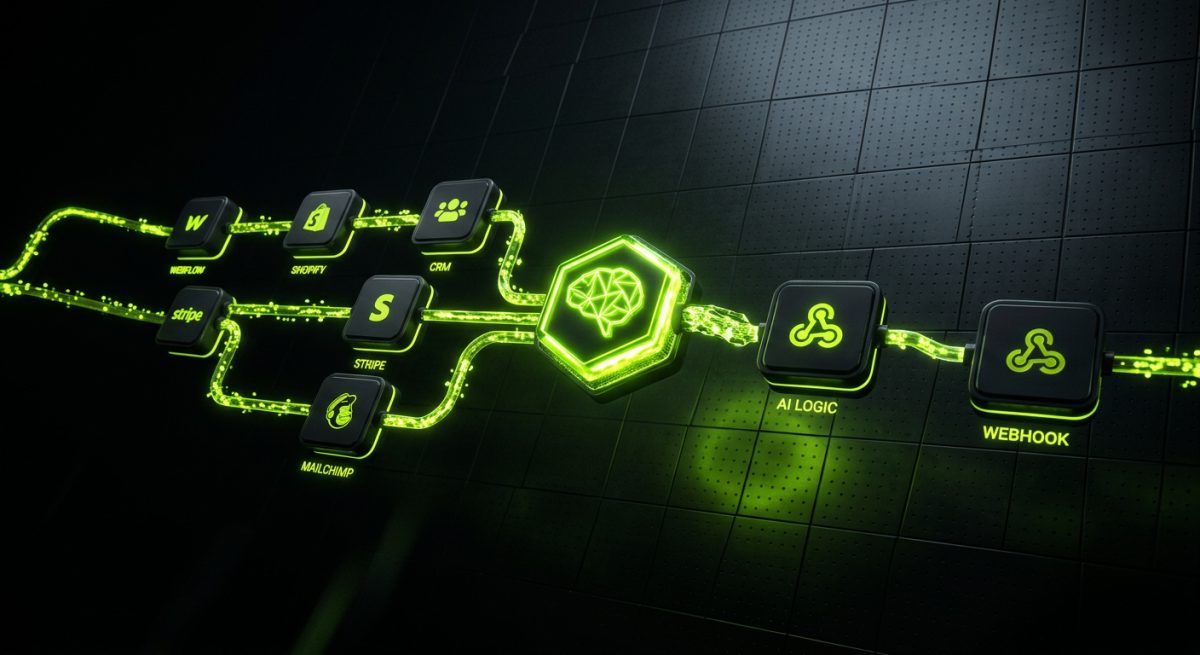
When we design AI & Automation services for our clients, we focus on modularity. By using n8n as the central nervous system, we connect platforms like WordPress, Shopify, and Webflow to advanced AI models like Claude 3.5 Sonnet or GPT-4o. This setup allows a business to automate tasks that previously required human intervention, such as analyzing the sentiment of support tickets or extracting structured data from unstructured emails. The beauty of this approach is that the "glue" is no longer a static script; it is a dynamic, AI-driven process that can be updated or scaled without rebuilding the entire integration from scratch. This shift significantly reduces technical debt and allows B2B companies to move from experimental AI to production-ready systems in a fraction of the time.
Architecting Self-Healing B2B Workflows with Intelligent Middleware
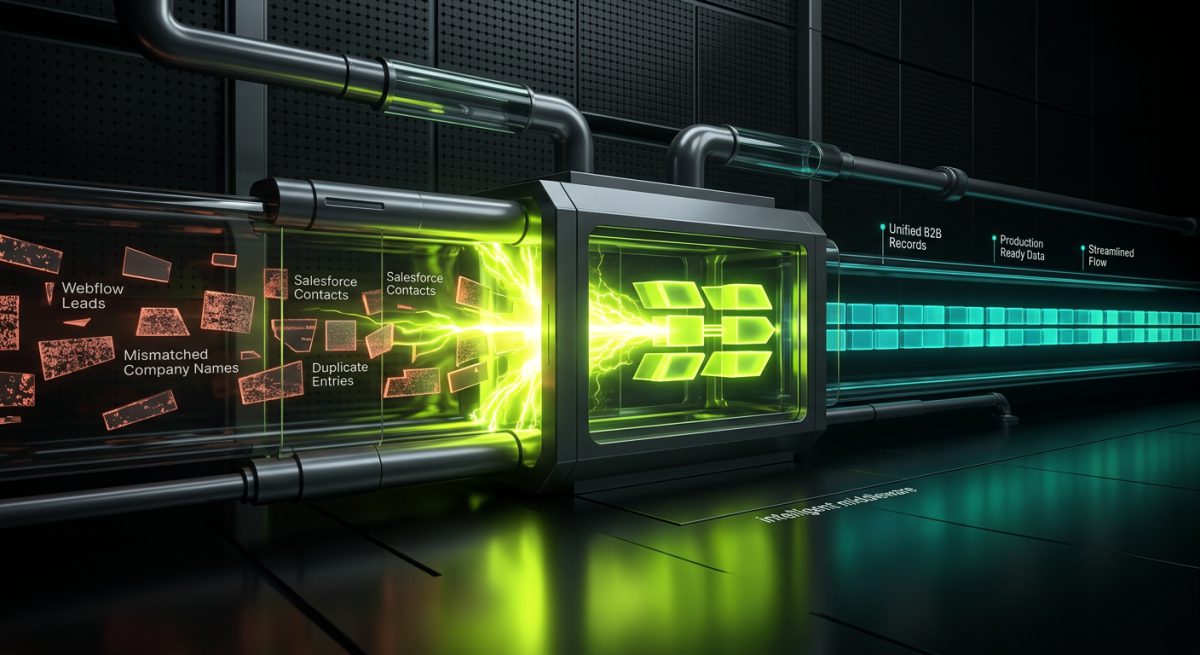
One of the primary challenges in B2B environments is data inconsistency. A lead might enter their information in a Webflow form using a personal email, while their record in Salesforce uses a corporate domain. Traditional glue code struggles with these discrepancies, often resulting in duplicate records or failed syncs. By architecting n8n workflows with embedded AI nodes, we can build "self-healing" pipelines. These workflows use LLMs to perform data normalization and entity resolution in real-time. For example, an AI node can look at a company name like "Apple Inc." and "Apple" and recognize they are the same entity, automatically merging the data before it ever hits the CRM. This level of sophistication used to require enterprise-grade ETL tools; now, it can be handled within a visual n8n workflow.
At werun.dev, we frequently implement these systems to bridge the gap between marketing sites and backend operations. For instance, we might build a custom WordPress plugin that acts as a webhook trigger. When a specific event occurs—such as a high-value WooCommerce purchase—the webhook fires to an n8n instance. From there, the workflow doesn't just send a Slack notification; it triggers an AI agent to research the buyer's LinkedIn profile, summarize their recent company news, and append that context to the deal record in HubSpot. This is the difference between simple automation and intelligent orchestration. We are no longer just moving bits; we are adding value to the data as it travels between systems.
Technical credibility in these workflows comes from how we handle the "edge cases." While n8n provides a visual interface, we often utilize the "Code Node" to execute complex JavaScript or Python logic that interacts with WordPress Integrations & REST API endpoints. This hybrid approach—visual for the flow, code for the heavy lifting, and AI for the decision-making—is the gold standard for modern B2B integrations. It ensures that the system is robust enough to handle high transaction volumes while remaining flexible enough for non-technical stakeholders to understand the business logic. Furthermore, because n8n can be self-hosted, we can ensure that sensitive B2B data never leaves a controlled environment, meeting strict security and compliance requirements that third-party SaaS integrators often fail to satisfy.
Moving from Experimentation to Production-Ready AI Agents
Most companies are currently stuck in the "AI playground" phase—using ChatGPT for one-off tasks but failing to integrate AI into their core business processes. The bridge to production-ready AI lies in autonomous agents built within n8n. A production-ready agent isn't just a chatbot; it is a workflow that has access to tools, memory, and data sources. For a Shopify merchant, this might look like an automated returns assistant. When a customer requests a return via a Shopify Plus solution, the n8n workflow can trigger an AI agent to check the return policy, verify the purchase date via the Shopify Admin API, assess the customer's lifetime value, and either approve the return automatically or flag it for human review with a suggested resolution.
To make these agents reliable, we implement Retrieval-Augmented Generation (RAG). Instead of relying on the general knowledge of an LLM, we connect the n8n workflow to a vector database like Pinecone or Supabase. This allows the AI to "read" the company’s specific documentation, internal SOPs, or product manuals before generating a response. For a Webflow-based client portal, this means providing users with an AI assistant that can answer technical questions about their specific contract or project status by querying live data. This moves the needle from generic automation to a bespoke digital experience that scales without increasing headcount.
Our approach at werun.dev is to build these systems with a focus on measurable impact. We don't just deploy n8n workflows; we build in comprehensive error handling, retry logic, and execution logs. If an LLM API experiences latency or a downstream CRM is down for maintenance, our workflows are designed to queue the data and retry according to exponential backoff strategies. This level of operational rigor is what separates a hobbyist project from a professional B2B system. We help companies navigate the transition from manual, error-prone processes to automated, AI-augmented ecosystems that run 24/7 without supervision. By eliminating the need for brittle glue code, we allow our clients to focus on their core business while their technology stack works harder and smarter.