The Evolution of CRM: From Data Repositories to Intelligent Engines

The landscape of Customer Relationship Management (CRM) has undergone a radical transformation. Historically, these platforms served as glorified digital Rolodexes—static repositories where sales teams manually logged interactions, updated contact details, and tracked deal stages. However, the modern B2B environment demands more than just record-keeping. The volume of data generated across touchpoints—email, LinkedIn, web analytics, and support tickets—has surpassed human capacity for manual processing. This is where the shift toward AI-powered CRM systems becomes a competitive necessity rather than a luxury. By integrating artificial intelligence into the core of the CRM, businesses can move from reactive data entry to proactive strategic insight.
A robust SaaS architecture is the foundation of this evolution. Without a scalable, cloud-native infrastructure, AI models lack the high-quality, real-time data required to generate accurate predictions. At werun.dev, we emphasize the importance of data normalization and deduplication. Many legacy systems suffer from "data silos," where marketing data lives in one place and sales data in another. AI bridges these gaps by utilizing advanced data pipelines to ingest information from disparate sources, cleaning it through automated ETL (Extract, Transform, Load) processes, and making it accessible for machine learning models. This architectural integrity ensures that the insights generated are based on a "Single Source of Truth," reducing the risk of hallucination or inaccurate forecasting.
Furthermore, the technical implementation of AI in CRMs often involves the use of Large Language Models (LLMs) to perform sentiment analysis on customer communications. For example, by connecting a CRM to an LLM via a secure API, a system can automatically flag an account as "at risk" if the tone of recent support tickets shifts from neutral to frustrated. This level of automated monitoring allows B2B firms to address churn before it happens. One of the most significant technical advancements in this space is the implementation of Retrieval-Augmented Generation (RAG). In a standard CRM setup, an AI might only have access to the data currently visible in a specific record. With RAG, the AI can "retrieve" relevant information from a vast internal knowledge base—such as technical documentation, previous contract terms, or internal Slack discussions—and "augment" its response to a sales query. This requires a sophisticated data architecture where unstructured data is converted into vector format and indexed for high-speed retrieval. By building these capabilities into our clients' core infrastructure, we empower B2B teams to have highly informed, context-aware conversations with prospects, significantly reducing the time spent on internal research.
Implementing AI-Driven Automation in B2B Workflows
Moving from the theoretical benefits of AI to real-world application requires a structured technical approach. At werun.dev, our methodology for AI integrations focuses on creating production-ready systems that integrate seamlessly with existing tech stacks. A common scenario we encounter involves mid-market B2B companies that have a wealth of historical data but no way to extract actionable patterns from it. For instance, consider a specialized manufacturing firm that manages hundreds of long-term contracts. Their sales team often spends hours manually reviewing past orders to identify upsell opportunities.
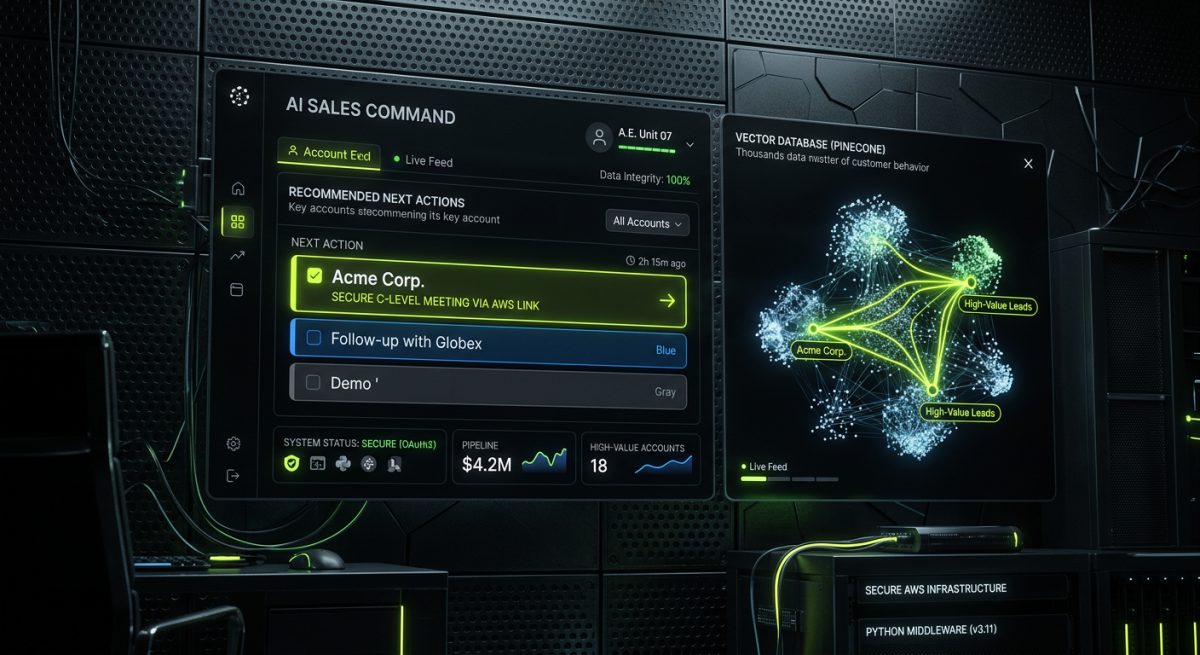
To solve this, we implemented a custom AI-driven recommendation engine within their existing CRM environment. The technical stack included a Python-based middleware layer hosted on AWS, which communicated with the CRM's RESTful API. We utilized vector databases, such as Pinecone, to store "embeddings" of customer behavior patterns. This allowed the AI to perform similarity searches—identifying current customers whose behavior mirrored that of previous high-value expansion accounts. By embedding these automation workflows directly into the sales dashboard, the AI could automatically populate a "Recommended Next Action" field for every account executive. This moved the company from experimentation to a production-ready AI system that actively drives revenue.
This implementation highlights our commitment to secure, scalable integration. When dealing with sensitive B2B client data, security is paramount. We implement strict OAuth2 authentication protocols and ensure that data sent to third-party AI providers is anonymized or processed within a private VPC (Virtual Private Cloud) whenever possible. Furthermore, we focus on the reliability of the data pipeline. If an API endpoint fails or a data sync is delayed, the system must have built-in redundancy and error-handling mechanisms to prevent data corruption. This rigorous technical standard is what differentiates an "experimental" AI tool from a business-critical system. Our goal is always to move clients away from fragile, "no-code" patches toward robust, custom-engineered solutions that can scale as the business grows. By leveraging modern cloud infrastructure and serverless functions, we build systems that handle complex computations without compromising the performance of the core CRM platform.
Driving Measurable Impact through Predictive Sales Intelligence
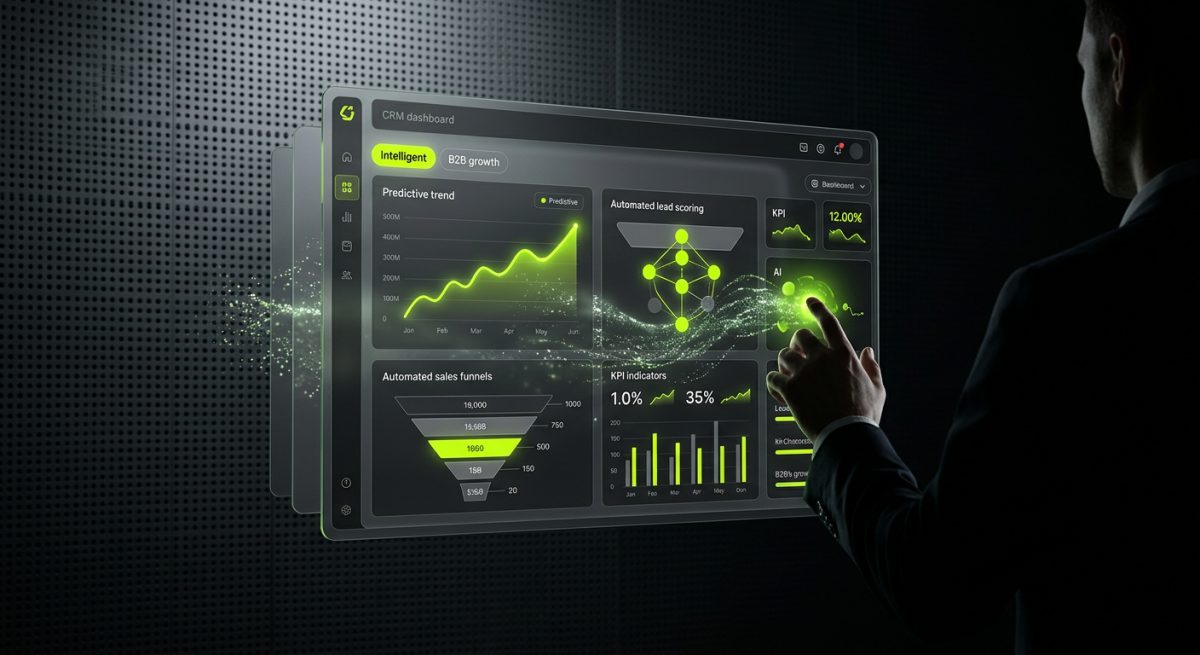
The ultimate goal of any AI-powered CRM is to drive measurable business impact. In the B2B sector, where sales cycles are long and decision-makers are numerous, the ability to predict outcomes is a game-changer. Predictive lead scoring is one of the most effective applications of this technology. Unlike traditional rule-based scoring (e.g., "add 10 points if they downloaded a whitepaper"), AI-driven scoring analyzes thousands of variables simultaneously. It looks at firmographics, technographics, and even the velocity of engagement to provide a probability-based score. This allows sales teams to prioritize their time on the leads most likely to close, which typically results in a 45% increase in lead conversion rates for companies that adopt these tools early.
Moreover, the synergy between CRM data and eCommerce development is becoming increasingly important for B2B brands. As wholesale and bulk ordering move online, the CRM must capture every interaction on the digital storefront. By integrating AI across both platforms, businesses can gain a 360-degree view of the customer journey. For example, if a B2B buyer repeatedly views a specific product category on a Shopify Plus store but hasn't placed an order, the AI can trigger an automated, personalized outreach email through the CRM. This proactive engagement has been shown to reduce churn by up to 30% while accelerating the overall sales cycle by 20%.
Furthermore, the architectural choice between REST and GraphQL plays a vital role in how efficiently AI can consume CRM data. While REST is the industry standard, GraphQL allows for more precise data fetching, which is critical when training or fine-tuning models on specific subsets of customer data. At werun.dev, we often implement GraphQL layers over legacy CRM systems to facilitate faster, more efficient data access for AI agents. This technical nuance ensures that the system remains performant even as the volume of data grows. By combining this with advanced eCommerce development strategies, we create a unified ecosystem where data flows seamlessly between the storefront, the CRM, and the AI engine, providing a truly holistic view of the B2B customer.
At werun.dev, we approach AI integration with a focus on these tangible results. We don't just "plug in" AI; we architect systems that align with your specific business logic and growth goals. Whether you are looking to optimize your sales pipeline, automate complex customer service workflows, or build a custom dashboard that visualizes predictive trends, our team provides the technical expertise to make it happen. We specialize in navigating the complexities of modern API ecosystems and data infrastructure to ensure your AI investment delivers a high ROI. To see how we can transform your B2B operations with intelligent automation, we invite you to explore our technical case studies or book a consultation with our senior engineering team to discuss your specific requirements.