The Paradigm Shift: From Chatbots to MCP-Enabled Autonomous Agents
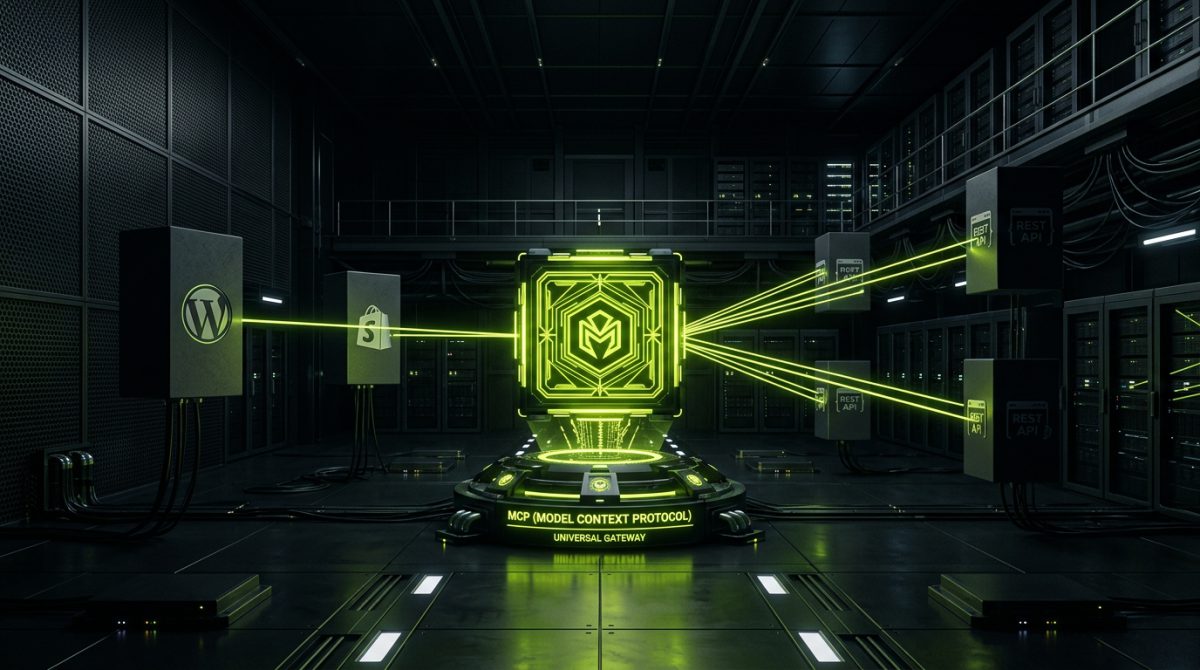
The evolution of Large Language Models (LLMs) has reached a critical inflection point where the focus is shifting from conversational interfaces to agentic workflows. In a professional B2B environment, a standalone chatbot is often a siloed utility. However, an autonomous agent—capable of reading database schemas, executing code, and interacting with third-party APIs—becomes a force multiplier for technical teams. The catalyst for this transformation is the Model Context Protocol (MCP), an open standard that enables developers to provide a secure, standardized way for AI models to access data and tools.
At werun.dev, we view MCP as the bridge between raw intelligence and actionable utility. When building AI & Automation systems, the challenge has traditionally been the fragmented nature of data sources. A WordPress site has its own REST API, a Shopify store uses GraphQL, and internal CRM systems might use legacy SOAP or proprietary JSON-RPC. Historically, developers had to write custom "glue code" for every single integration. MCP replaces this brittle approach by providing a universal interface. By implementing an MCP server, a business can expose its entire tech stack—from custom WordPress plugins to complex ERP databases—to an LLM in a way that the model can discover and utilize autonomously.
This shift is particularly relevant for companies managing complex ecosystems. Consider a B2B enterprise running a WordPress multisite architecture. An autonomous agent equipped with MCP can navigate the network, identify plugin version mismatches across dozens of sites, and suggest (or even execute) updates based on compatibility logs. This isn't just automation; it is context-aware reasoning. The agent understands the environment because the protocol provides the necessary metadata, constraints, and schemas. This reduces the "hallucination" risk significantly, as the model no longer guesses how an API works; it reads the live definition provided by the MCP host.
Implementing these agents requires a deep understanding of both the LLM's reasoning capabilities and the underlying infrastructure. We focus on building secure MCP servers that act as gatekeepers. Instead of giving an AI model full access to a server, we define specific "tools" within the protocol. For example, a tool might allow the agent to "Fetch WooCommerce orders from the last 24 hours" or "Update a Webflow CMS item." By restricting the agent to these defined tools, we maintain the security standards required for enterprise-grade Shopify Plus enterprise architecture and other sensitive environments. This granular control is what allows us to move AI from a playground experiment into a production-ready tool that runs unsupervised.
Multi-Tool Orchestration and the Logic of Agentic Reasoning
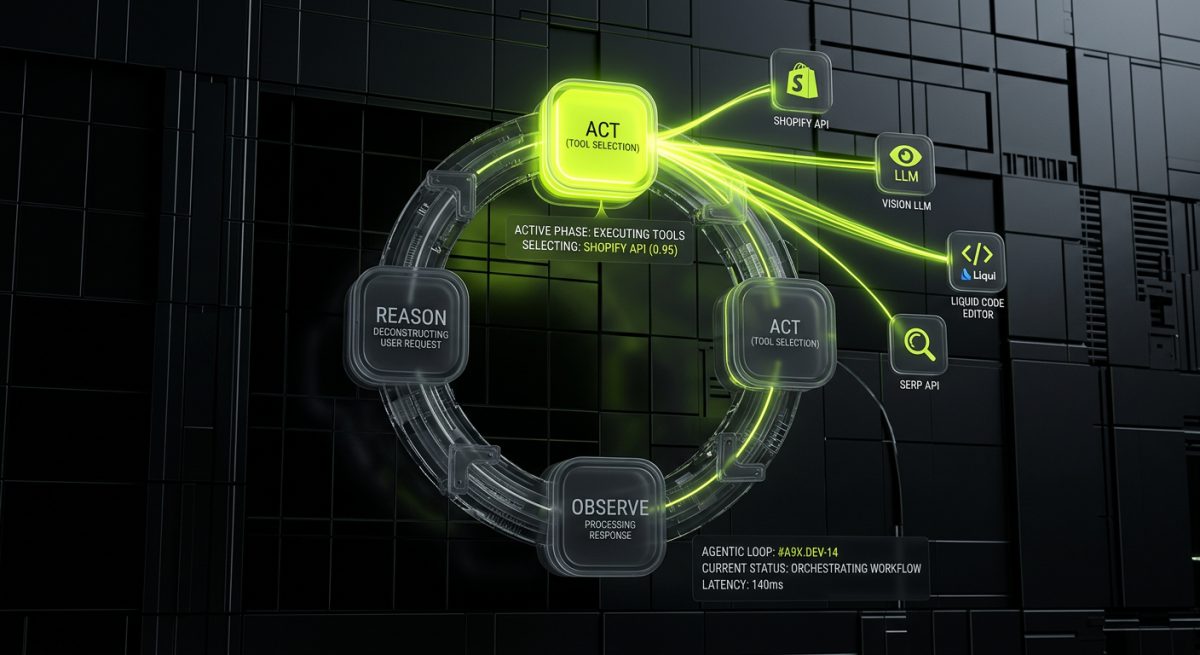
While MCP provides the connection, orchestration defines the execution. Building an autonomous agent isn't just about connecting a model to a tool; it is about creating a reasoning loop where the agent can decide which tool to use, in what order, and how to handle the output of one tool as the input for the next. This is known as multi-tool orchestration. In a typical werun.dev implementation, we often use orchestration layers like n8n or custom-built middleware to manage these complex sequences. For instance, an agent tasked with "Optimizing a product catalog" might need to query a Shopify API for low-performing items, use a vision-capable LLM to analyze product images, and then update the custom Liquid theme metadata to improve SEO.
To achieve this, we implement a "Reason-Act-Observe" cycle. The agent receives a high-level goal, breaks it down into sub-tasks, and selects the appropriate tool from its MCP-provided toolkit. If a tool execution fails, the agent doesn't simply crash; it observes the error, adjusts its strategy, and tries an alternative approach. This level of autonomy is what differentiates a simple script from a true dev agent. When we build custom REST API endpoints for our clients, we ensure they are "agent-friendly." This means providing clear documentation, consistent error codes, and idempotent operations so that an autonomous agent can interact with them reliably without causing data corruption or infinite loops.
Advanced Tool Selection and Function Calling
Modern LLMs like Claude 3.5 Sonnet or GPT-4o have become exceptionally good at function calling, but they still require a well-architected environment to perform at 95% accuracy or higher. Multi-tool orchestration involves managing the "context window" effectively. If you provide an agent with 100 different tools, the model may become confused or "distracted," leading to poor decision-making. We solve this by implementing dynamic tool injection. Based on the initial user prompt, our orchestration layer identifies the most relevant subset of tools and only exposes those to the agent.
For example, if an agent is performing a migration from WooCommerce to Shopify, it doesn't need access to the company's Slack notification tools until the final summary report is ready. By narrowing the focus, we increase the reliability of the autonomous workflow. This is a core part of how we handle integrations and APIs for businesses that cannot afford downtime. We also implement "Human-in-the-Loop" (HITL) checkpoints for high-stakes actions. An agent might be autonomous in its research and drafting phases, but it will pause and request authorization before executing a bulk database update or a significant financial transaction. This balance of autonomy and oversight is essential for B2B trust.
Real-World Scenario: The Self-Healing Web Ecosystem
Imagine a scenario where a high-traffic e-commerce site experiences a sudden spike in checkout errors. A traditional monitoring system would alert a human developer, who might take hours to diagnose the issue. An autonomous dev agent, connected via MCP to the server logs, the WooCommerce subscription system, and the payment gateway API, can act immediately. It can pull the recent error logs, identify that a specific plugin update caused a conflict with the gateway, and autonomously roll back the plugin to the previous version stored in the GitHub-powered auto-update system. It then sends a detailed report to the dev team via Slack, explaining exactly what happened and what was done to fix it. This is the level of operational excellence we aim for at werun.dev, moving away from reactive maintenance toward proactive, autonomous site management.
Security, Scalability, and Production-Ready Deployment
Transitioning from a local agent prototype to a production-grade autonomous system requires a rigorous focus on security and scalability. When an agent has the power to execute code or modify data, the traditional security perimeter is no longer sufficient. At werun.dev, we treat AI agents as "non-human users" with their own set of permissions and audit trails. Every action taken by an agent must be logged, reversible, and authenticated. We utilize JWT and OAuth 2.0 authentication for all agent-to-API communication, ensuring that the agent only has access to the specific resources it needs to complete its task.
Scalability is the next major hurdle. Autonomous agents can be resource-intensive, especially when performing long-running tasks that involve multiple LLM calls and API interactions. To prevent these processes from timing out or crashing the main web server, we offload agent execution to background workers using tools like WP Cron, Action Scheduler, or dedicated cloud functions. This ensures that a complex automation running in the background doesn't impact the Core Web Vitals or the user experience of a Webflow site or a Shopify storefront. By decoupling the "thinking" (LLM) from the "doing" (API execution), we create a resilient architecture that can handle multiple agents working in parallel.
Building for the Long Term with Maintainable Code
One of the biggest risks in the current AI boom is the creation of "spaghetti AI"—unstructured prompts and brittle scripts that are impossible to maintain. We apply the same professional coding standards to our AI integrations as we do to our custom plugin development. This includes using proper hooks, filters, and documented schemas for all MCP servers. We ensure that our agents are "model-agnostic" whenever possible. While Claude might be the best model for reasoning today, the landscape changes monthly. Our orchestration layer is built so that the underlying LLM can be swapped out without rewriting the entire toolset or integration logic.
Furthermore, we focus on the data pipeline. An autonomous agent is only as good as the data it can access. We help our clients build "Knowledge-Base Agents" using Retrieval-Augmented Generation (RAG) and vector search. This allows an agent to reference internal documentation, past support tickets, or technical specs before taking action. For a B2B company, this means the agent isn't just a generic coder; it is a specialized assistant that understands the unique business logic of their specific Shopify Plus or WordPress environment. This bespoke approach ensures that the automation provides actual business value rather than just technical novelty.
From Experimentation to Operational Reality
The goal of implementing MCP and multi-tool orchestration is to move beyond the "wow factor" of AI and into measurable business impact. Whether it is reducing the time spent on manual data entry between a CRM and a website, or creating a self-healing infrastructure that monitors and fixes performance bottlenecks, the value lies in the autonomy. At werun.dev, we partner with businesses to identify these high-impact use cases and build the custom bridges needed to make them a reality. We don't just launch these systems; we run them, ensuring they stay secure, updated, and aligned with the evolving needs of the business. The future of web development isn't just about building pages; it's about building the intelligent systems that operate them.