Architecting the Serverless AI Logic with n8n
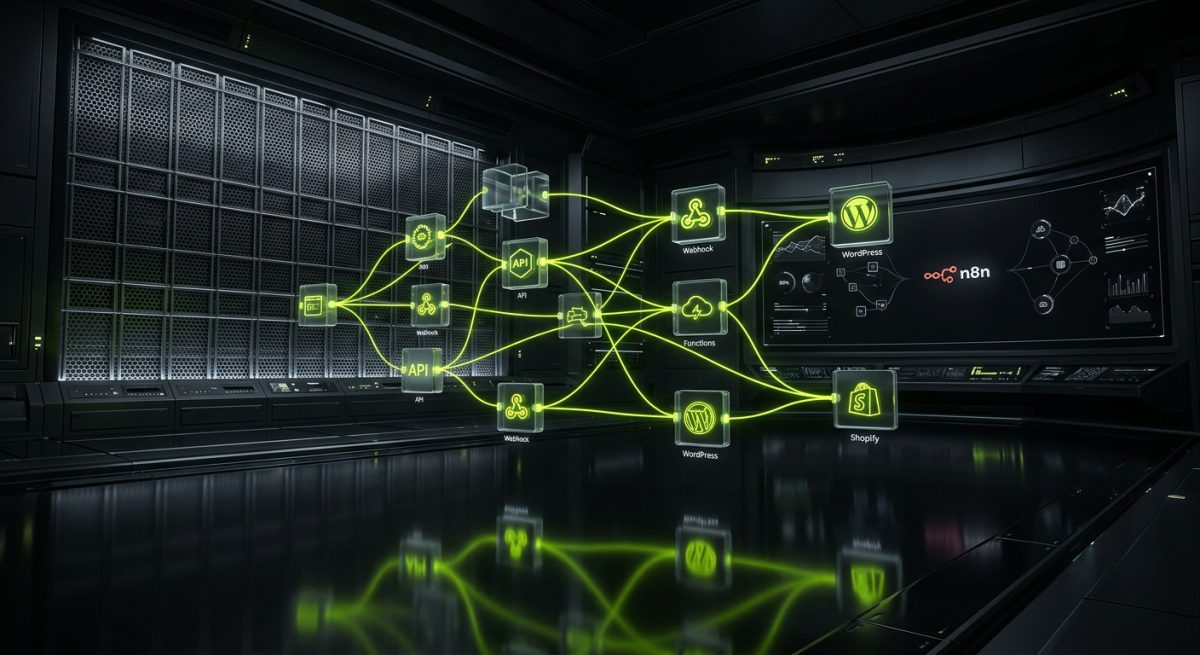
The paradigm shift in modern web development has moved away from monolithic backends toward decoupled, modular architectures. For B2B enterprises using WordPress, Webflow, or Shopify, the challenge often lies in adding intelligent processing—such as AI-driven data analysis or automated customer support—without bloating the core CMS or store. This is where n8n serves as a powerful middleware. Unlike traditional automation tools like Zapier, which operate on a linear logic, n8n provides a node-based visual programming environment that allows for complex branching, state management, and custom code execution. At werun.dev, we leverage n8n to build serverless backends that handle the heavy lifting of AI workflows, ensuring that the primary site remains fast and secure.
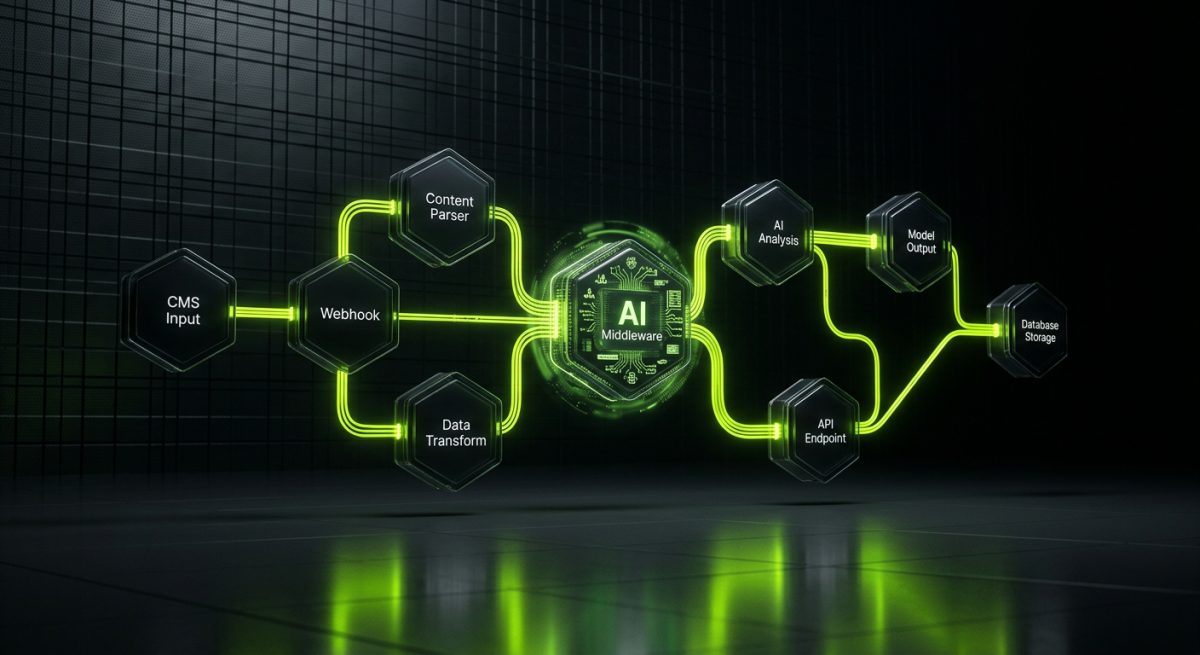
Building a serverless AI backend starts with the design of the workflow trigger. Typically, this involves a webhook listener that accepts requests from a Webflow Logic flow, a WordPress REST API endpoint, or a Shopify Flow trigger. Once the data enters the n8n ecosystem, it can be routed through various nodes for sanitization and enrichment. One of the primary advantages of n8n for B2B applications is its ability to be self-hosted. By deploying n8n on your own infrastructure—a service we provide as part of our maintenance and security retainers—you maintain full control over your data sovereignty. This is critical when dealing with sensitive CRM data from platforms like Salesforce or HubSpot, as the data never leaves your controlled environment except to interact with the LLM (Large Language Model) via encrypted API calls.
Inside the n8n workflow, the "Code Node" is your most versatile tool. While n8n offers hundreds of pre-built integrations, complex B2B logic often requires custom JavaScript or Python to transform data payloads before they reach the AI nodes. For instance, if you are sending a customer's purchase history from Shopify to an AI agent to generate a personalized discount offer, you must first calculate the customer's lifetime value (LTV) and segment them accordingly. Writing this logic in a custom node ensures that the AI receives a clean, context-rich prompt, which significantly reduces token consumption and improves the accuracy of the response. This approach aligns with our "built to last" philosophy, as it centralizes business logic in a maintainable, version-controlled environment rather than scattering it across various CMS plugins or disparate scripts.
Implementing Advanced RAG and Vector Databases

Retrieval-Augmented Generation (RAG) is the gold standard for building AI agents that actually understand your business data. A common mistake in AI implementation is feeding an LLM too much raw data, which leads to hallucinations and high costs. Instead, a professional serverless backend uses a vector database to store and retrieve only the most relevant information for any given query. Within n8n, you can architect a sophisticated RAG pipeline using the specialized AI nodes for embeddings and vector store connectors. We frequently implement solutions using Pinecone, Milvus, or Supabase as the vector backend, connecting them to n8n to create a dynamic knowledge base. When a user asks a question on a WordPress site or a Webflow portal, n8n intercepts the query, converts it into a vector embedding, searches the database for the most relevant documentation or product specs, and then passes that specific context to the LLM (OpenAI GPT-4 or Anthropic Claude).
Managing memory is another technical hurdle that n8n handles elegantly. In a standard stateless API call, the AI forgets the previous interaction immediately. For B2B tools like customer support bots or internal sales assistants, maintaining context is non-negotiable. n8n allows you to implement "Window Buffer Memory" or "Database Memory" nodes that store the conversation history in a Redis instance or a traditional SQL database. This ensures that the serverless backend can handle multi-turn conversations without losing the thread of the user's intent. When we build these systems at werun.dev, we focus on the "Agent" node, which acts as the brain of the operation. By giving the agent "Tools"—which are essentially other n8n workflows—the AI can proactively fetch data from an ERP like SAP or Odoo, check inventory levels in WooCommerce, or even update a deal status in HubSpot based on the conversation's outcome.
Security and error handling are paramount in these AI-powered pipelines. A robust serverless backend must account for LLM timeouts, rate limits, and malformed inputs. We implement comprehensive error-handling branches in n8n that use "Wait" nodes for retries or "Filter" nodes to validate the AI's output before it is sent back to the frontend. For example, if an AI agent is tasked with generating a JSON response for a Shopify app block, we use a custom JavaScript node to parse and validate that JSON. If the validation fails, the workflow can automatically re-trigger the AI with a corrective prompt or alert a developer via Slack. This level of resilience is what separates a hobbyist automation from an enterprise-grade backend that maintains our 99.97% uptime standard. By offloading this complexity to n8n, the frontend remains a lightweight presentation layer, while the intelligence is centralized in a scalable, serverless environment.
Bridging the Gap: Integrating n8n with WordPress, Webflow, and Shopify
The final piece of the serverless puzzle is the seamless integration between the n8n backend and your chosen CMS or e-commerce platform. For WordPress, this often involves creating custom REST API endpoints using our specialized plugin development services. Instead of the site calling an LLM directly, it sends a request to a custom endpoint like /wp-json/werun/v1/ai-process. This endpoint acts as a secure gateway, adding necessary authentication headers and nonces before forwarding the request to n8n. This architecture prevents your API keys from being exposed in the frontend and allows you to implement server-side rate limiting to protect your LLM budget. Once n8n processes the request, it can either return the data synchronously or, for longer tasks like generating a full report, send a webhook back to the WordPress site to update a Custom Post Type once the work is complete.
In the Webflow ecosystem, n8n bridges the gap where native features or basic Zapier integrations fall short. For complex Webflow builds involving Memberstack or Outseta, n8n can act as the logic engine that syncs user data across multiple platforms while simultaneously running AI-driven content moderation or personalization. For instance, when a new user signs up on a Webflow site, n8n can trigger a workflow that scrapes the user's company website, uses Claude to summarize their business model, and then populates their Webflow CMS profile with a tailored onboarding experience. This creates a high-touch, personalized feel that is entirely automated. Because n8n handles the API interactions with Webflow's CMS API, we can build sophisticated content architectures that go far beyond the limitations of the standard Webflow Designer.
Shopify Plus merchants benefit significantly from this serverless approach, particularly when it comes to B2B and wholesale operations. We use n8n to extend Shopify's functionality by connecting it to external ERPs and adding AI-driven logic to the checkout or post-purchase experience. Using Shopify Webhooks, n8n can monitor for specific events—like a large wholesale order—and trigger a custom logic flow that checks the buyer's credit limit in an external database and uses an AI agent to draft a personalized thank-you email or a follow-up task for the sales team. This "Middle-man" architecture ensures that the Shopify store remains focused on conversion, while n8n manages the complex, multi-platform logic required for enterprise operations. By choosing n8n as your serverless backend, you are investing in a flexible infrastructure that grows with your business, supported by a partner like werun.dev that understands the technical nuances of all three major web platforms.