
Hyperautomation is no longer a buzzword confined to enterprise whitepapers. It is actively reshaping how digital businesses operate, scale, and compete. At its core, hyperautomation is the disciplined, business-driven approach of identifying, vetting, and automating as many business and IT processes as possible using a combination of technologies — including AI, machine learning, robotic process automation (RPA), low-code platforms, and process mining tools.
Gartner identified hyperautomation as one of the top strategic technology trends, and the market for technology enabling it is projected to reach $596.6 billion by 2027. For B2B companies running on platforms like WordPress, Webflow, or Shopify, understanding hyperautomation is not optional — it is a competitive necessity.
What Hyperautomation Actually Means for Digital Operations
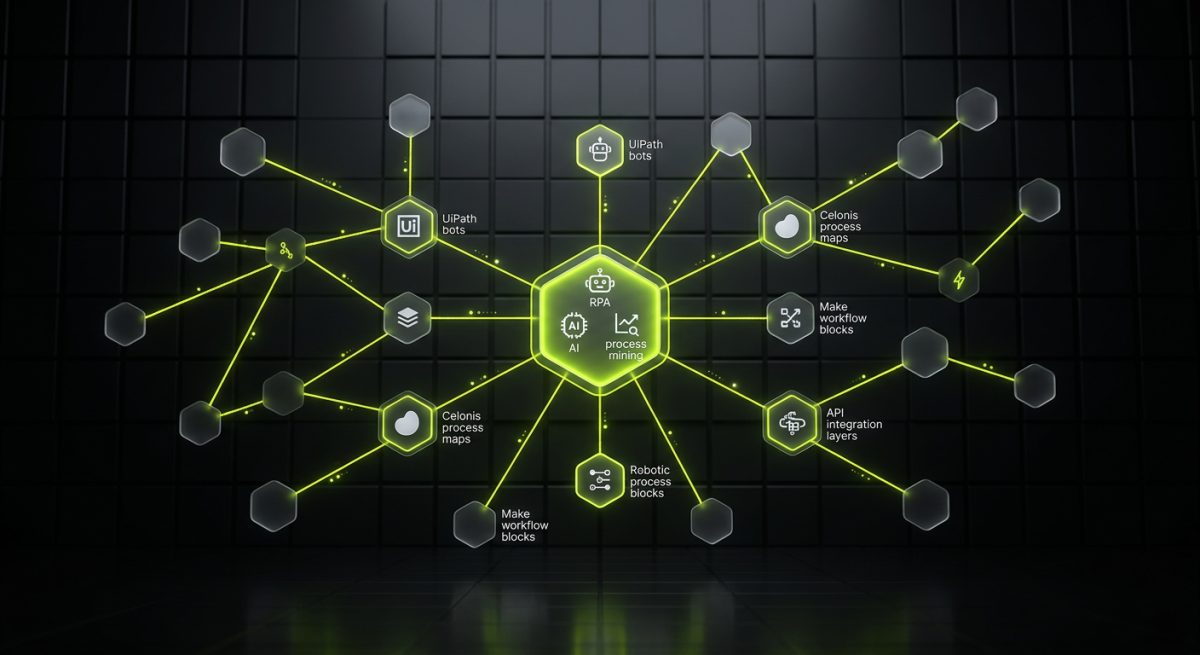
Many businesses confuse hyperautomation with simple task automation — scheduling social posts, triggering email sequences, or auto-generating invoices. Those are automation. Hyperautomation is the orchestration layer above all of that: a strategic framework that connects disparate automated systems, applies intelligence to decision-making, and continuously discovers new automation opportunities.
The key distinction is scope and intelligence. Traditional automation handles a defined, repetitive task. Hyperautomation handles entire workflows, adapts to exceptions, learns from outcomes, and feeds insights back into the business.
The Technology Stack Behind Hyperautomation
Hyperautomation is not a single product. It is an ecosystem of complementary technologies working in concert:
- Robotic Process Automation (RPA): Software bots that mimic human interactions with digital interfaces — filling forms, extracting data, moving files. Tools like UiPath, Automation Anywhere, and Microsoft Power Automate lead this space.
- AI and Machine Learning: Adds cognitive capability — natural language processing, image recognition, predictive analytics — so automated systems can handle unstructured data and make judgment-based decisions.
- Process Mining: Tools like Celonis or Minit analyze event logs from existing systems to map actual workflows, identify bottlenecks, and surface automation candidates that humans might miss.
- Low-Code/No-Code Platforms: Enable non-technical teams to build and modify automation workflows without engineering support. Platforms like Make (formerly Integromat), Zapier, and n8n democratize automation deployment.
- API Integration Layers: The connective tissue that allows all these tools — plus your CMS, CRM, ERP, and e-commerce platform — to exchange data in real time.
For a business running a Shopify storefront, a WordPress content hub, and a Webflow marketing site simultaneously, hyperautomation means those three platforms stop operating in silos. Inventory updates propagate instantly. Lead data captured on Webflow flows directly into the CRM and triggers a personalized nurture sequence. Content published on WordPress automatically syncs metadata to the analytics stack.
Why Incremental Automation Falls Short
The problem with most digital businesses is not a lack of automation tools — it is a lack of automation architecture. Teams adopt point solutions: one tool for email, another for reporting, another for customer support. Each works in isolation. Data is duplicated, errors compound, and human intervention is still required at every handoff.
Hyperautomation addresses this by treating automation as an enterprise-wide capability rather than a departmental convenience. According to Gartner, organizations that fail to adopt hyperautomation will face a 30% increase in operational costs by 2025 compared to competitors who do. That gap is already materializing in sectors like e-commerce, SaaS, and digital services — exactly where werun.dev clients operate.
The operational cost of manual handoffs is measurable. A content team that manually uploads blog posts, resizes images, updates metadata, and notifies the distribution list is spending 3–5 hours per publication cycle on tasks that a properly architected hyperautomation pipeline can reduce to under 15 minutes — with fewer errors and full audit logging.
Implementing Hyperautomation in WordPress, Webflow, and Shopify Environments
Implementing hyperautomation in a multi-platform web environment requires a phased, architecture-first approach. Jumping straight to tooling without mapping existing workflows is the most common failure mode. The right sequence is: discover → design → automate → monitor → optimize.
Phase 1: Process Discovery and Mapping
Before automating anything, document every repeatable process that touches your web platforms. For a typical B2B digital business, this includes:
- Content creation and publishing workflows (WordPress/Webflow)
- Product catalog updates and inventory synchronization (Shopify)
- Lead capture, qualification, and CRM entry
- Customer onboarding and support ticket routing
- Reporting and analytics aggregation
- Invoice generation and payment reconciliation
Process mining tools can accelerate this phase significantly by analyzing system logs and visualizing actual workflow patterns — not the idealized versions teams describe in meetings.
Phase 2: Automation Architecture Design
With processes mapped, the next step is designing an automation architecture that treats each workflow as a node in a connected graph rather than an isolated script.
A practical architecture for a Shopify + WordPress environment might look like this:
[Shopify Order Event]
        |
   [Webhook Trigger]
        |
   [Make/n8n Workflow]
    /          \
[Update CRM]  [Trigger Fulfillment]
    |                  |
[Segment Lead]   [Notify 3PL API]
    |
[Personalized Email Sequence]
Every node in this graph is independently auditable, replaceable, and extensible. Adding a new step — say, triggering a review request 14 days post-delivery — requires inserting one node, not rebuilding the entire workflow.
Phase 3: Tooling Selection and Integration
For most B2B digital businesses, the following stack covers 80% of hyperautomation use cases without requiring enterprise-level investment:
- n8n or Make for workflow orchestration
- Zapier for rapid prototyping and simple integrations
- HubSpot or ActiveCampaign for CRM and marketing automation
- Airtable or Notion as a lightweight operational database
- Datadog or Grafana for monitoring automation health
- OpenAI API for AI-augmented decision nodes (content classification, sentiment analysis, dynamic personalization)
WordPress integrates with this stack via REST API and webhooks. Webflow exposes a robust API for CMS items, form submissions, and e-commerce events. Shopify's webhook system and Admin API are among the most developer-friendly in the e-commerce space, making it the natural anchor for commerce-driven hyperautomation pipelines.
Governance and Error Handling
One aspect teams consistently underestimate is governance. Hyperautomation pipelines fail silently unless you build explicit error handling and alerting into every workflow. Every automation node should:
- Log inputs and outputs to a centralized store
- Define failure behavior (retry, escalate, halt)
- Send alerts to a monitoring channel (Slack, PagerDuty) on exception
- Maintain an audit trail for compliance-sensitive operations
Without governance, hyperautomation creates a different kind of operational risk: automated errors that propagate at machine speed before anyone notices.
The Business Impact of Hyperautomation at Scale

The ROI case for hyperautomation is well-documented across industries. Deloitte's Global RPA Survey found that 78% of organizations that have already implemented RPA expect to significantly increase their investment in automation over the next three years. McKinsey estimates that 45% of work activities across industries could be automated using currently available technology — not future technology, but tools that exist today.
For digital businesses specifically, the impact concentrates in three areas: operational efficiency, customer experience quality, and data integrity.
Operational Efficiency Gains
The most immediate and measurable impact is time reclamation. When routine workflows — publishing, reporting, order processing, lead routing — are fully automated, skilled team members redirect their attention to high-judgment work: strategy, creative development, client relationships, and product innovation.
A mid-sized e-commerce brand processing 500 orders per day can eliminate 15–20 hours of manual order management per week through a well-implemented Shopify automation pipeline. At an average fully-loaded labor cost of $35/hour, that is $27,000–$36,000 in annual savings from a single workflow. Multiply that across five to ten automated workflows and the financial case is unambiguous.
Customer Experience Quality
Hyperautomation enables consistency at scale. When a human handles a process, quality varies with fatigue, workload, and attention. When an automated system handles it, every customer receives the same response time, the same data accuracy, and the same follow-up sequence — regardless of whether it is 9 AM on Monday or 2 AM on Sunday.
For B2B clients, this consistency translates directly to trust. A prospect who submits a contact form on a Webflow site and receives a personalized, contextually relevant response within 90 seconds — rather than a generic auto-reply followed by a two-day wait — is measurably more likely to convert. Automated personalization, powered by CRM data and AI-generated content variants, makes this possible without proportional increases in headcount.
Data Integrity and Decision Intelligence
Perhaps the most underappreciated benefit of hyperautomation is what it does to data quality. Manual data entry introduces errors. Copy-paste operations between systems create version conflicts. Delayed syncs mean decisions get made on stale information.
A hyperautomation architecture where data flows automatically from source systems to analytics dashboards in real time eliminates these failure modes. Product managers can trust their Shopify conversion data. Marketing teams can rely on their lead attribution reports. Executives can make resource allocation decisions based on current, accurate operational metrics rather than last week's export.
This data integrity compounds over time. Clean historical data trains better ML models. Better models power smarter automation decisions. Smarter automation decisions generate cleaner data. The flywheel accelerates.
Hyperautomation as a Competitive Moat
For digital agencies and their clients, hyperautomation is increasingly a source of durable competitive advantage. A business that has invested in a well-architected automation infrastructure can launch new products faster, onboard clients more efficiently, respond to market changes with greater agility, and operate at lower marginal cost than competitors who are still managing processes manually.
The barrier to entry for hyperautomation has dropped dramatically. The tools are accessible, the integration ecosystems are mature, and the implementation knowledge is available. What separates businesses that capture the value from those that do not is not access to technology — it is the discipline to approach automation architecturally, with governance, measurement, and continuous optimization built in from the start.