
Why Spain and LATAM Are Building One of Tech's Most Powerful Talent Corridors
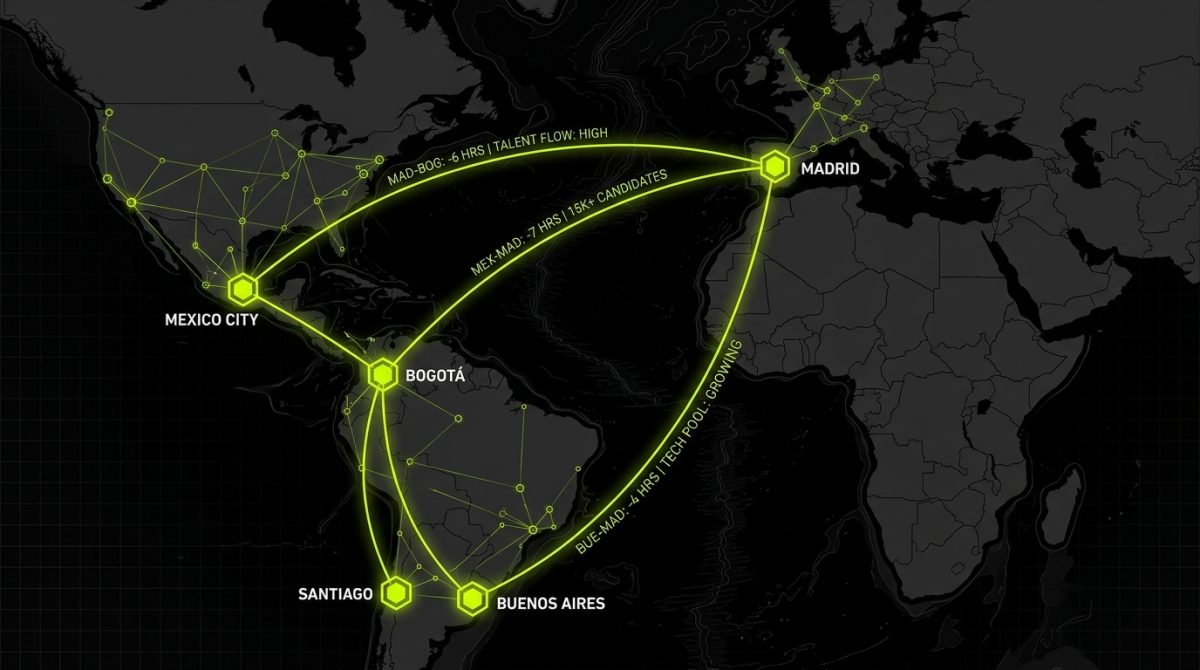
The relationship between Spain and Latin America has always been shaped by shared language, cultural affinity, and historical ties. But in the last five years, something far more commercially significant has emerged: a mature, scalable tech talent corridor that B2B companies on both sides of the Atlantic are using to build competitive digital products at a fraction of the cost of purely domestic hiring.
Nearshoring — the practice of outsourcing work to geographically or culturally proximate regions — has exploded in popularity as European companies face mounting pressure to reduce development costs without sacrificing quality. Spain, sitting at the intersection of European regulatory standards and Latin American cultural fluency, has become a natural hub for orchestrating these arrangements.
According to a 2023 report by CBRE, Spain attracted over €2.1 billion in tech investment, with a growing share tied to nearshore delivery models involving LATAM talent. Meanwhile, countries like Colombia, Mexico, Argentina, and Chile have been consistently ranked among the top nearshoring destinations globally by Gartner and Everest Group, with Argentina alone producing over 115,000 IT graduates annually.
For B2B companies operating WordPress, Webflow, or Shopify-based digital infrastructure, this corridor represents a concrete operational opportunity — not just a theoretical cost arbitrage. The time zone overlap between Spain (CET) and Latin America (ranging from UTC-3 to UTC-6) is manageable, typically allowing for four to six hours of shared working time per day. That's enough for daily standups, sprint reviews, and real-time collaboration without the friction that plagues traditional offshore models involving Asia-Pacific teams.
What Makes This Different From Traditional Offshore Outsourcing
Traditional offshore outsourcing — typically involving India or Eastern Europe — often introduces communication overhead, cultural friction, and quality inconsistencies that erode the projected cost savings. The Spain-LATAM model sidesteps many of these issues for several structural reasons:
- Shared language: Spanish is the working language across the entire corridor, eliminating translation layers and reducing documentation ambiguity.
- Cultural alignment: Business norms, communication styles, and professional expectations are far more aligned between Spain and LATAM than between Western Europe and Southeast Asia.
- Legal frameworks: Many LATAM countries have modernized their digital labor laws, and Spain's experience operating within EU regulatory frameworks (GDPR, NIS2) makes compliance handoffs cleaner when data flows between regions.
- Talent depth: The LATAM tech talent pool is not homogeneous. Argentina excels in backend engineering and data science; Colombia has a growing UX and frontend ecosystem; Mexico is strong in enterprise software and Salesforce/Shopify implementations; Brazil (Portuguese-speaking but increasingly bilingual in Spanish) leads in fintech and mobile development.
For a B2B agency or mid-market company evaluating this model, the question isn't whether to engage LATAM talent — it's how to structure the engagement to maximize output quality and minimize coordination costs.
Structuring a Nearshore Tech Partnership: Models, Contracts, and Team Architecture
The operational success of a Spain-LATAM nearshore arrangement depends almost entirely on how the engagement is structured from day one. There are three primary models companies use, each with distinct tradeoffs in terms of control, cost, and scalability.
Model 1: Staff Augmentation
In this model, individual developers or designers are embedded directly into the client's existing team. They work under the client's project management tools, follow the client's sprint cadence, and report to the client's internal leads. This is the most common entry point for companies new to nearshoring.
Best for: Companies with existing engineering leadership that need to scale capacity quickly without restructuring their org chart.
Typical cost range (2024): Senior WordPress or Webflow developer from Colombia or Argentina: €2,800–€4,500/month via a nearshore agency, compared to €6,000–€9,000/month for equivalent talent in Spain or Germany.
Key risks: Without strong internal project management, augmented staff can become bottlenecked waiting for decisions from the client side. Velocity drops if the client team isn't structured to absorb external contributors efficiently.
Model 2: Dedicated Development Team
Here, the nearshore partner assembles a full squad — typically a tech lead, two to four developers, a QA engineer, and sometimes a project manager — that operates as a semi-autonomous unit. The client sets strategic direction and reviews deliverables, but day-to-day execution is managed by the nearshore team lead.
Best for: Companies building or maintaining complex digital platforms (multi-region Shopify stores, headless WordPress architectures, Webflow enterprise sites) where continuity and domain knowledge accumulation matter.
Contract structure considerations:
- Define SLAs for response time, bug resolution, and deployment windows
- Establish IP ownership clauses explicitly — especially critical for custom theme development and proprietary plugin work
- Include data processing agreements (DPAs) if any EU user data is handled by the LATAM team, to maintain GDPR compliance
Model 3: Project-Based Outsourcing
A fixed-scope, fixed-price engagement where the nearshore partner takes full ownership of delivery. Common for website redesigns, platform migrations, or specific feature builds.
Best for: Companies with well-defined requirements and limited appetite for ongoing vendor management.
Critical success factor: Requirement documentation quality. Vague briefs produce vague outputs. Before engaging a LATAM team on a project basis, invest time in writing detailed functional specifications, user stories, and acceptance criteria. Tools like Notion, Linear, or Confluence work well for this across time zones.
Setting Up the Technical Infrastructure
Regardless of model, the following stack consistently produces the smoothest cross-border collaboration:
Project Management: Linear or Jira
Communication: Slack (async-first culture)
Code Repository: GitHub with branch protection rules
CI/CD: GitHub Actions or Bitbucket Pipelines
Staging Environments: WP Engine (WordPress), Webflow Staging, Shopify Development stores
Time Tracking: Toggl or Harvest
Documentation: Notion
Video Async: Loom (for reducing synchronous meeting load)
Establishing these tools before onboarding a nearshore team — not after — is the single most impactful operational decision a company can make. Teams that inherit chaotic tooling environments lose two to three weeks of productive output just establishing basic workflows.
Evaluating LATAM Tech Hubs: Country-by-Country Analysis for Web Development Projects
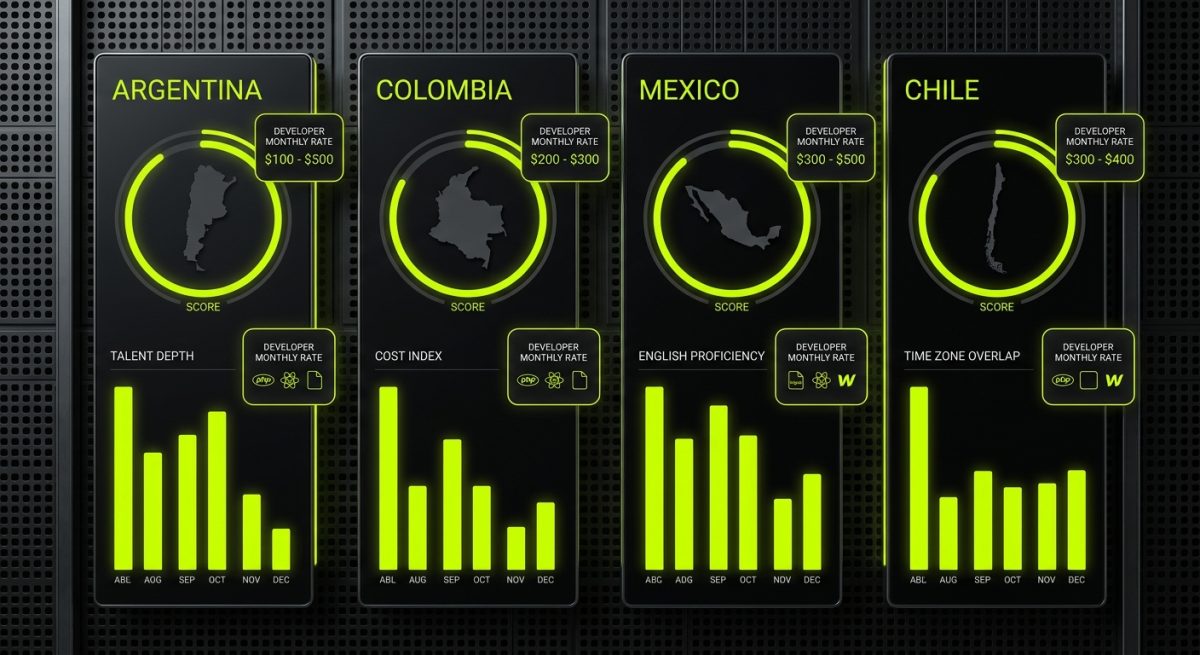
Not all LATAM markets offer the same value proposition for web development outsourcing. The right country depends on the specific technical stack, budget constraints, required English proficiency, and time zone needs of the hiring company. Here is a structured breakdown of the four most relevant markets for Spain-based B2B companies working in WordPress, Webflow, and Shopify.
Argentina: Deep Technical Talent, Volatile Economics
Argentina consistently ranks as one of the highest-quality tech talent markets in Latin America. The country produces a disproportionately large number of senior engineers relative to its population, and Argentine developers are well-represented in open-source communities, Shopify Partner directories, and Webflow Expert listings.
Strengths:
- Strong backend and full-stack capabilities (PHP, Node.js, React, Python)
- High English proficiency in the tech sector
- Cultural alignment with European work norms
- UTC-3 time zone — good overlap with Spain mornings
Challenges:
- Economic instability and currency volatility complicate long-term contract pricing
- Brain drain is a real concern; top Argentine developers are frequently recruited by US and European companies directly
- Contracts should be denominated in USD or EUR, not ARS, to protect both parties
Recommended engagement: Dedicated teams or senior staff augmentation for complex WordPress multisite or headless Shopify builds.
Colombia: Growing Ecosystem, Government-Backed Investment
Colombia has made deliberate national investments in its tech sector, and Medellín in particular has emerged as one of Latin America's most dynamic startup and tech service hubs. The Colombian government's MinTIC initiative has funded coding bootcamps and university programs specifically targeting software exports.
Strengths:
- UTC-5 time zone — maximum overlap with Spain (five to six shared hours)
- Strong UX/UI design talent alongside frontend development
- Lower cost than Argentina for comparable mid-level skills
- Growing Webflow and no-code ecosystem
Challenges:
- Senior talent is increasingly competitive and harder to retain as the market matures
- English proficiency varies more widely than in Argentina
Recommended engagement: Frontend development, Webflow projects, design systems work, and QA engineering.
Mexico: Enterprise-Scale Capacity and North American Alignment
Mexico's tech sector is massive — Guadalajara is sometimes called the Silicon Valley of Latin America — and the country has deep experience serving North American enterprise clients. This means Mexican development firms often operate with mature project management processes and are accustomed to formal documentation requirements.
Strengths:
- Largest tech talent pool in the Spanish-speaking world
- Strong Shopify Plus and Salesforce Commerce Cloud expertise
- Mature agency ecosystem with established nearshore delivery processes
- UTC-6 (Central) — workable overlap with Spain
Challenges:
- Higher rates than Colombia or Argentina for equivalent seniority levels
- Large agencies may assign junior resources to accounts that were sold by senior staff
Recommended engagement: Shopify Plus implementations, enterprise WordPress builds, and long-term platform maintenance contracts.
Chile: Premium Quality, Premium Pricing
Chile offers perhaps the most stable operating environment in Latin America, with strong rule of law, reliable infrastructure, and a tech workforce that skews toward quality over volume. Chilean developers often have experience working with European clients and understand EU compliance requirements.
Strengths:
- Highest English proficiency in the region
- Strong data privacy and security culture
- UTC-3 or UTC-4 — good Spain overlap
- Excellent for fintech, e-commerce, and regulated industry projects
Challenges:
- Most expensive LATAM market — rates approach 60–70% of Spanish domestic rates
- Smaller talent pool limits scalability for large team builds
Recommended engagement: Security-sensitive projects, fintech-adjacent e-commerce, or engagements requiring strong GDPR awareness on the delivery side.
Making the Final Selection
When evaluating which market to engage, run a structured scorecard against these criteria:
- Required tech stack depth (WordPress PHP expertise vs. Webflow visual development vs. Shopify Liquid)
- Budget ceiling per developer per month
- Minimum acceptable English proficiency level
- Time zone overlap requirements (minimum four shared hours recommended)
- Project sensitivity and data handling requirements
- Desired contract flexibility (staff aug vs. dedicated team vs. project-based)
No single LATAM market dominates across all criteria. The most sophisticated Spain-based companies are building blended teams — Argentine backend engineers, Colombian frontend developers, and Mexican project managers — coordinated through a single nearshore partner or managed in-house through a multi-vendor model.
Managing Quality, Compliance, and IP in Cross-Border Web Development
The commercial logic of Spain-LATAM nearshoring is straightforward. The operational complexity lives in the details of quality assurance, intellectual property protection, and regulatory compliance — areas where many companies underinvest until a problem forces their hand.
Quality Assurance Across Time Zones
The four-to-six-hour daily overlap between Spain and most LATAM markets is sufficient for synchronous collaboration, but it requires deliberate process design. Teams that default to a meeting-heavy culture will find the overlap exhausted by standups and reviews, leaving no time for actual problem-solving discussions.
A more effective approach is an async-first, sync-selective model:
- Daily written standups posted in Slack by 9:00 AM local time for each team member
- Synchronous sprint planning and retrospectives (60–90 minutes maximum, scheduled during the overlap window)
- Loom videos for complex technical explanations that would otherwise require a meeting
- GitHub pull request reviews with written comments as the primary code quality gate
- Automated testing pipelines that catch regressions before human review — reducing the review burden during overlap hours
For WordPress projects specifically, establishing a mandatory local development environment standard (Local by Flywheel or DevKinsta) and a staging-to-production deployment checklist eliminates an entire category of quality issues that stem from environment inconsistencies between Spain-based reviewers and LATAM-based developers.
For Shopify builds, Shopify's development store model and GitHub integration (via Shopify CLI 3.x) make it straightforward to maintain clean separation between development, staging, and production environments across distributed teams.
For Webflow projects, the built-in staging/publish model is simpler, but teams should establish clear conventions around who has publish rights and how design changes are communicated before implementation begins.
Intellectual Property Protection
IP ownership in cross-border software development is not automatic. In many LATAM jurisdictions, the default legal position on work-for-hire is less clearly defined than in EU law. Contracts must explicitly state:
- All code, designs, and deliverables produced under the engagement are the exclusive property of the client upon full payment
- The contractor waives any moral rights claims to the extent permitted by local law
- The contractor may not reuse, resell, or repurpose client-specific code, configurations, or proprietary logic for other clients
- Source code must be delivered to the client repository — not held in a contractor-owned account
For WordPress plugin or theme development, this includes not just the PHP code but also any associated JavaScript, CSS, configuration files, and database schemas. For Shopify, it includes Liquid templates, custom app code, and any metafield structures built specifically for the client's store.
GDPR Compliance When LATAM Teams Handle EU Data
This is the area most frequently overlooked in Spain-LATAM nearshore arrangements, and it carries real legal risk. If a LATAM-based developer has access to a WordPress database containing EU user data — even just for debugging purposes — that constitutes a data transfer outside the EEA under GDPR.
The compliance path requires:
- Data Processing Agreement (DPA): A formal contract between the Spanish company (data controller) and the LATAM partner (data processor) specifying the nature, purpose, and duration of data processing.
- Standard Contractual Clauses (SCCs): The EU's approved mechanism for authorizing data transfers to third countries without an adequacy decision. As of 2024, no LATAM country has an EU adequacy decision, making SCCs mandatory.
- Access minimization: LATAM developers should access production databases only when strictly necessary, with anonymized or synthetic data used for development and testing wherever possible.
- Audit logging: Maintain logs of who accessed what data and when, to demonstrate compliance in the event of a supervisory authority inquiry.
Many smaller companies skip these steps because they seem bureaucratic. The risk calculus changes quickly when a data breach or a competitor complaint triggers a GDPR investigation — at which point the absence of SCCs and DPAs becomes a significant aggravating factor in any regulatory assessment.
Building a Vendor Evaluation Framework
Before signing any nearshore contract, conduct a structured vendor assessment covering:
Technical Assessment:
□ Code sample review (GitHub profile or test project)
□ Stack-specific certification verification (Shopify Partner, Webflow Expert, WP Engine Agency)
□ Security practices questionnaire (password management, VPN usage, device encryption)

Operational Assessment:
□ Reference calls with two to three existing clients in similar time zones
□ Trial sprint (two-week paid engagement before full contract commitment)
□ Communication responsiveness test during pre-sales phase

Legal Assessment:
□ Business registration verification in country of operation
□ Review of standard contract terms for IP and confidentiality clauses
□ Confirmation of professional liability insurance coverage
Companies that invest two to three weeks in rigorous vendor evaluation consistently report faster project velocity and fewer quality escalations than those that prioritize speed-to-contract over due diligence. The Spain-LATAM corridor offers genuine competitive advantages — but realizing them requires treating nearshore partnerships with the same rigor applied to any other critical business relationship.