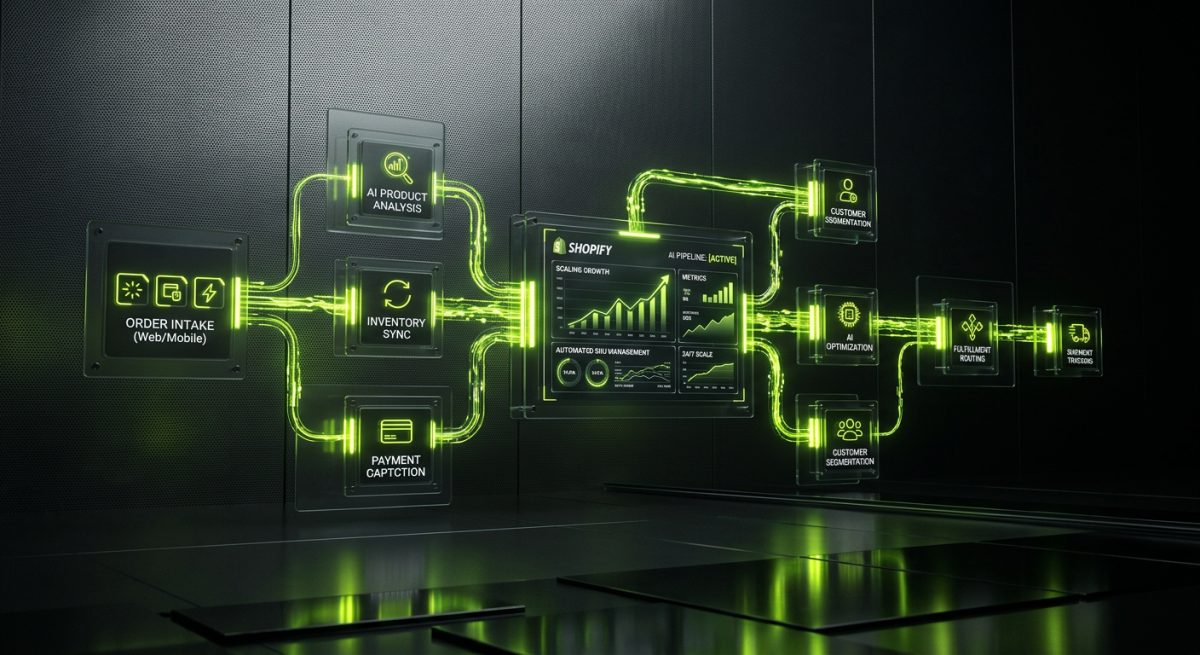
Scaling an ecommerce operation used to mean a straightforward equation: more orders, more staff. More SKUs, more catalog managers. More customer queries, more support agents. That equation is breaking down — and for Shopify merchants, it's breaking down fast.
AI-powered automation is rewriting the math. Stores processing thousands of orders monthly are doing it with the same headcount they had at a few hundred. Not because they're cutting corners, but because the repetitive, rules-based work that once consumed entire job roles is now handled by intelligent systems that run 24/7, make decisions in milliseconds, and connect every layer of the business stack.
This is not a theoretical future. The infrastructure exists today — n8n workflows, LLM APIs, Shopify's Admin and Storefront APIs, Flow automations — and the merchants who are deploying it now are building a compounding operational advantage that will be very difficult for slower competitors to close.
What AI Automation Actually Means for a Shopify Store
Before getting into implementation specifics, it's worth being precise about what "AI automation" means in a Shopify context, because the term gets applied to everything from basic if-this-then-that rules to genuinely intelligent decision-making systems.
At the simpler end, you have rule-based automation — Shopify Flow triggers, webhook-driven actions, scheduled jobs. These are powerful and underused by most merchants, but they don't involve AI in any meaningful sense. They execute predefined logic.
At the more sophisticated end, you have AI-augmented workflows — systems where a language model (GPT-4, Claude) is embedded inside an automation pipeline to interpret unstructured data, generate content, classify intent, or make contextual decisions that a rigid rule set couldn't handle.
The most effective Shopify automation strategies layer both. You use rule-based automation for the deterministic stuff — inventory threshold alerts, order routing, tag assignment — and you bring in AI where judgment or language understanding is required.
The Shopify API Surface That Makes This Possible
Shopify's platform is unusually well-suited to deep automation because of the breadth of its API surface:
- Admin API — Read and write access to orders, products, customers, inventory, metafields, discounts, fulfillments
- Storefront API — Headless commerce capabilities, cart manipulation, customer account data
- Webhooks — Real-time event triggers for order creation, payment capture, inventory updates, customer events
- Shopify Flow — Native automation builder for Plus merchants with triggers, conditions, and actions across the Shopify ecosystem
- Functions API — Custom server-side logic for discounts, shipping, and payment customization
- Checkout Extensibility — UI extensions and custom logic at the checkout layer
When you combine this API surface with an orchestration layer like n8n — which can connect Shopify to your CRM, ERP, fulfillment platform, email marketing stack, and AI models — you have the foundation for automation that genuinely replaces manual operational work.
Where Merchants Are Actually Losing Hours Every Week
The highest-value automation targets in a typical Shopify operation are rarely the glamorous ones. They're the unglamorous, repetitive tasks that nobody thinks to question because they've always been done manually:
- Product catalog management — Writing and updating product descriptions, SEO metadata, alt text across hundreds or thousands of SKUs
- Customer support triage — Reading incoming tickets, classifying intent, routing to the right team or drafting initial responses
- Order exception handling — Identifying orders that need manual review (fraud signals, address issues, out-of-stock items) and routing them appropriately
- Inventory reordering — Monitoring stock levels against sales velocity and triggering purchase orders or supplier notifications
- Review and UGC management — Collecting, moderating, and responding to customer reviews across platforms
- Reporting and analytics — Pulling data from multiple sources and assembling it into actionable summaries for leadership
Each of these is a candidate for partial or full automation. None of them require a human to be involved in every instance — they require a human to design the system that handles them.
Building AI-Powered Workflows on Top of Shopify
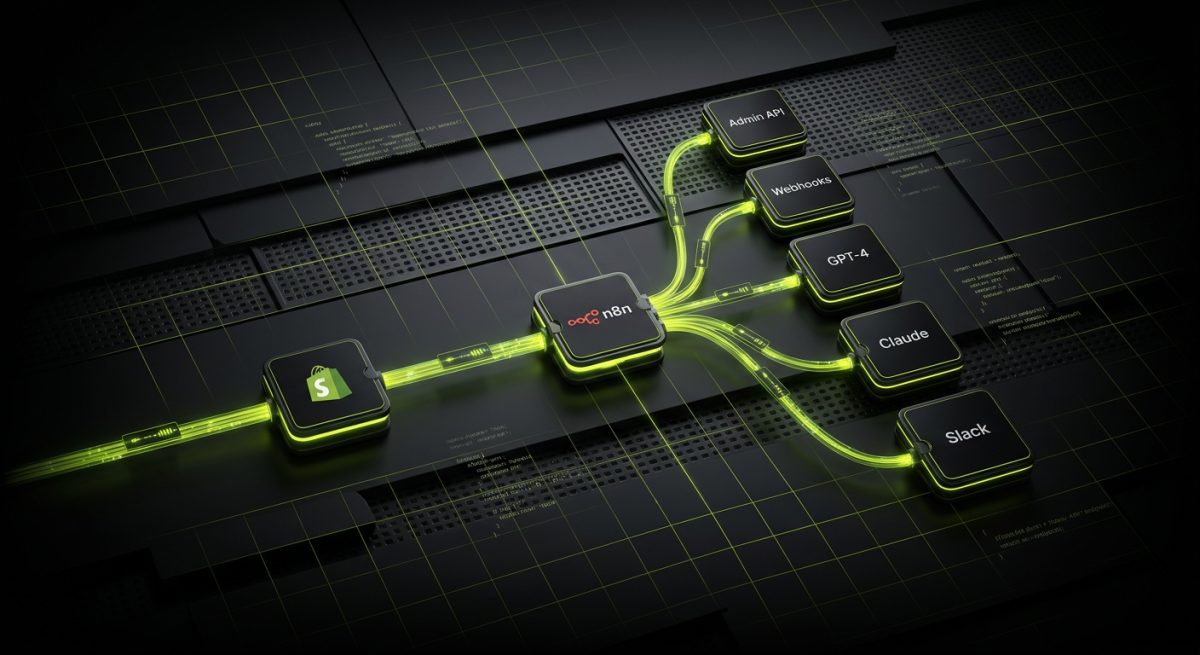
The architecture for serious Shopify automation typically involves three layers: the Shopify platform itself, an orchestration layer that connects systems and executes logic, and AI models that handle the parts requiring language understanding or contextual judgment.
n8n is the orchestration layer we use at werun.dev for most of these implementations. It's self-hostable, has native Shopify nodes, supports custom JavaScript and Python code nodes, and can call any LLM API directly. It gives you the flexibility of custom code with the maintainability of a visual workflow builder — and critically, it runs on your infrastructure, so your data doesn't pass through third-party servers you don't control.
Automated Product Description Generation at Scale
One of the most immediately impactful applications for merchants with large catalogs is AI-assisted product content generation. The workflow looks like this:
Trigger: New product created in Shopify (webhook)
  → Fetch product data via Admin API
    (title, vendor, product type, tags, metafields)
  → Send structured prompt to GPT-4 or Claude
    (include brand voice guidelines, SEO targets, character limits)
  → Parse AI response
  → Write generated description back to Shopify via Admin API
  → Write SEO meta title and description to metafields
  → Notify content team via Slack for review
The result is a first draft that's already SEO-structured and brand-consistent, ready for a human editor to review rather than write from scratch. For a merchant adding 50 new products per week, this can eliminate 10-15 hours of copywriting time weekly.
Intelligent Customer Support Triage
Customer support is where AI automation delivers some of its most dramatic operational improvements. Rather than replacing your support team, the goal is to eliminate the work of reading, classifying, and routing every incoming ticket — and to handle the subset of queries that are genuinely simple enough to resolve without human involvement.
A typical implementation:
- Incoming email or form submission triggers an n8n workflow via webhook
- The message content is sent to Claude with a classification prompt that identifies: intent category (order status, return request, product question, complaint), urgency level, and whether the query can be resolved with data from the Shopify Admin API
- If the query is an order status check and the customer email matches an order in Shopify, the workflow fetches the order data and generates a personalized response
- If the query requires human judgment, it's routed to the appropriate support queue with a pre-populated summary, the customer's order history, and a suggested response draft
This architecture means your support team spends their time on conversations that actually require empathy and judgment — not copy-pasting tracking numbers.
Shopify Flow for Native Automation
For Shopify Plus merchants, Flow provides a native automation layer that doesn't require external infrastructure for simpler use cases. Flow is particularly effective for:
- Tagging customers based on purchase behavior (e.g., tag as "VIP" after third purchase or after lifetime value exceeds a threshold)
- Hiding out-of-stock products automatically when inventory hits zero
- Sending internal alerts when high-value orders are placed
- Triggering fulfillment workflows based on product type or shipping method
- Applying discount logic based on customer tags or order attributes
Flow's limitation is that it operates within Shopify's ecosystem. When you need to connect to external systems — your 3PL, your ERP, your marketing platform — you need the external orchestration layer that n8n provides.
Scaling Catalog Operations with AI and Metafields
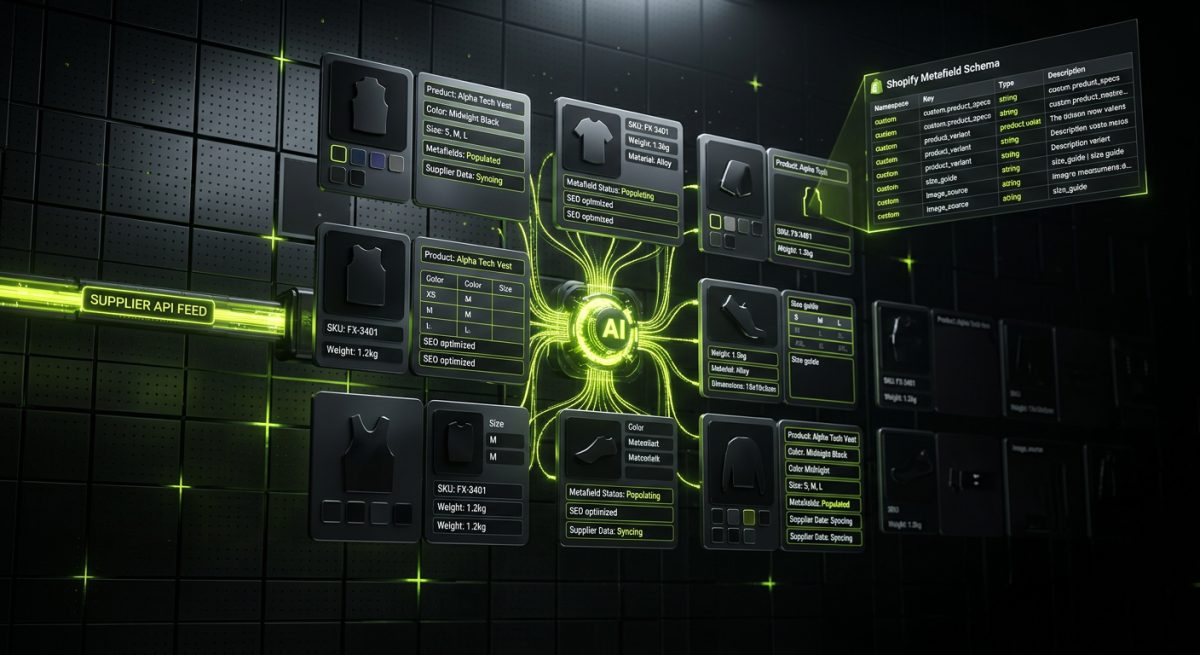
For merchants with complex product catalogs — multiple variants, technical specifications, compatibility data, size guides — the operational overhead of keeping product data accurate and complete is enormous. This is an area where AI automation combined with Shopify's metafield architecture can deliver substantial leverage.
Shopify's metafield system allows you to attach structured data to products, variants, customers, and orders beyond the standard fields. When you build an automation layer on top of this, you can create systems that:
- Enrich product data automatically from supplier feeds, scraping manufacturer specifications, or processing uploaded data sheets
- Maintain consistency across related products (ensuring all products in a collection have complete size guide data, for example)
- Generate structured content — comparison tables, feature lists, technical specification blocks — from raw metafield data
- Sync catalog data bidirectionally between Shopify and your ERP or PIM system
A Practical Metafield Enrichment Pipeline
Trigger: Scheduled cron (daily at 2am)
  → Query Shopify Admin API for products
    where metafield "specifications_complete" = false
  → For each incomplete product:
    → Fetch product title, vendor, product type
    → Query supplier API or internal database for spec data
    → If spec data found:
      → Send to Claude with structured extraction prompt
      → Parse response into metafield schema
      → Write metafields to Shopify via Admin API
      → Set "specifications_complete" = true
    → If spec data not found:
      → Add to Slack alert batch for manual review
  → Send daily summary report
This kind of pipeline runs overnight, requires zero manual intervention for the majority of products, and surfaces only the genuine exceptions that need human attention.
AI-Powered Inventory Forecasting Signals
Inventory management is another high-leverage automation target. While sophisticated demand forecasting is a complex data science problem, there are simpler AI-augmented approaches that deliver real value for growing merchants:
- Sales velocity monitoring — Track units sold per day per SKU and compare against current stock levels to calculate days-of-stock-remaining
- Reorder trigger workflows — When days-of-stock-remaining falls below a threshold, trigger a purchase order draft or supplier notification automatically
- Seasonal pattern alerts — Use historical order data to identify SKUs that are trending above their baseline and flag them for proactive restocking
- Stockout impact reports — When a product goes out of stock, automatically calculate estimated lost revenue based on recent sales velocity and include it in a weekly operations report
None of these require machine learning models. They require clean data pipelines, reliable API connections, and well-designed automation logic — which is exactly what a properly architected n8n workflow provides.
Connecting Shopify to Your Entire Business Stack
The real multiplier effect of automation comes when Shopify stops being a silo and starts being one node in a fully connected business stack. The integrations that deliver the most operational value for scaling merchants:
Shopify ↔ CRM (HubSpot, Salesforce)
- Sync customer purchase history to CRM contact records
- Create deals or opportunities for high-value customers
- Trigger sales team outreach for B2B customers based on order patterns
Shopify ↔ ERP / Accounting
- Push order data to accounting systems in real time
- Sync inventory levels bidirectionally
- Automate invoice generation and payment reconciliation
Shopify ↔ 3PL / Fulfillment
- Route orders to the correct fulfillment center based on product type, customer location, or shipping method
- Receive tracking data back from the 3PL and update Shopify order records automatically
- Handle exception cases (damaged goods, failed deliveries) with automated workflow routing
Shopify ↔ Marketing Platforms
- Segment customers based on purchase behavior and sync segments to email marketing platforms
- Trigger post-purchase sequences based on specific product categories
- Feed conversion data back from Shopify to ad platforms for accurate ROAS reporting
At werun.dev, we build these integration layers using n8n as the orchestration backbone, with custom Shopify apps built on the Admin API and Storefront API where the integration requires persistent functionality or storefront-level access. Every workflow we build includes error handling, retry logic, execution logging, and Slack or email alerting for failures — because an automation that fails silently is worse than no automation at all.
The Operational Model That Makes This Sustainable
Implementing AI automation on Shopify isn't a one-time project — it's an ongoing capability that compounds over time. The merchants who get the most out of it treat it as infrastructure, not a feature.
That means:
- Documenting every workflow so that when a connected system changes its API, you can update the integration without rebuilding from scratch
- Monitoring execution logs so you catch failures before they become operational problems
- Iterating on AI prompts as your catalog, brand voice, and customer base evolve
- Expanding automation coverage systematically — starting with the highest-volume, lowest-complexity tasks and working toward more sophisticated decision-making over time
The Build vs. Buy Decision
For most of the automation use cases described here, you have three options: use a native Shopify app, use a general-purpose automation platform like Zapier, or build custom workflows.
Native apps are fast to implement but limited in flexibility and often expensive at scale. Zapier is accessible but becomes costly quickly and has meaningful limitations on data volume and custom logic. Custom n8n workflows require more upfront investment but give you complete control, run on your infrastructure, and scale without per-task pricing.
The right answer depends on the complexity of what you're automating and how central it is to your operations. For mission-critical workflows — order processing, inventory management, customer data sync — custom-built infrastructure on n8n is almost always the right choice. For peripheral tasks with lower stakes, a native app or Zapier integration may be sufficient.
Measuring Automation ROI
The metrics that matter for Shopify automation aren't always immediately obvious. Beyond the direct time savings, the compounding benefits include:
- Error reduction — Manual data entry mistakes eliminated, order routing errors caught before they reach fulfillment
- Response time improvement — Customer queries handled in seconds rather than hours
- Catalog completeness — Higher percentage of products with complete, optimized content, which directly impacts search visibility and conversion rate
- Team capacity — Existing team members freed from repetitive work to focus on higher-value activities — merchandising strategy, customer relationships, creative work
- Scalability ceiling raised — The point at which you actually need to hire additional operational staff moves significantly further out
For a merchant processing 500 orders per month, the ROI calculation is different than for one processing 5,000. But the architecture is the same — and the merchants who build it at 500 orders are the ones who can handle 5,000 without a proportional increase in operational costs.
The infrastructure for this exists. The Shopify APIs are mature. The AI models are capable. The orchestration tools are production-ready. What's required now is the expertise to design systems that are reliable, maintainable, and genuinely connected to how your specific business operates — not generic templates, but automation built around your catalog structure, your customer base, your fulfillment model, and your growth trajectory.