The Infrastructure of Automated Data Collection and Synthesis

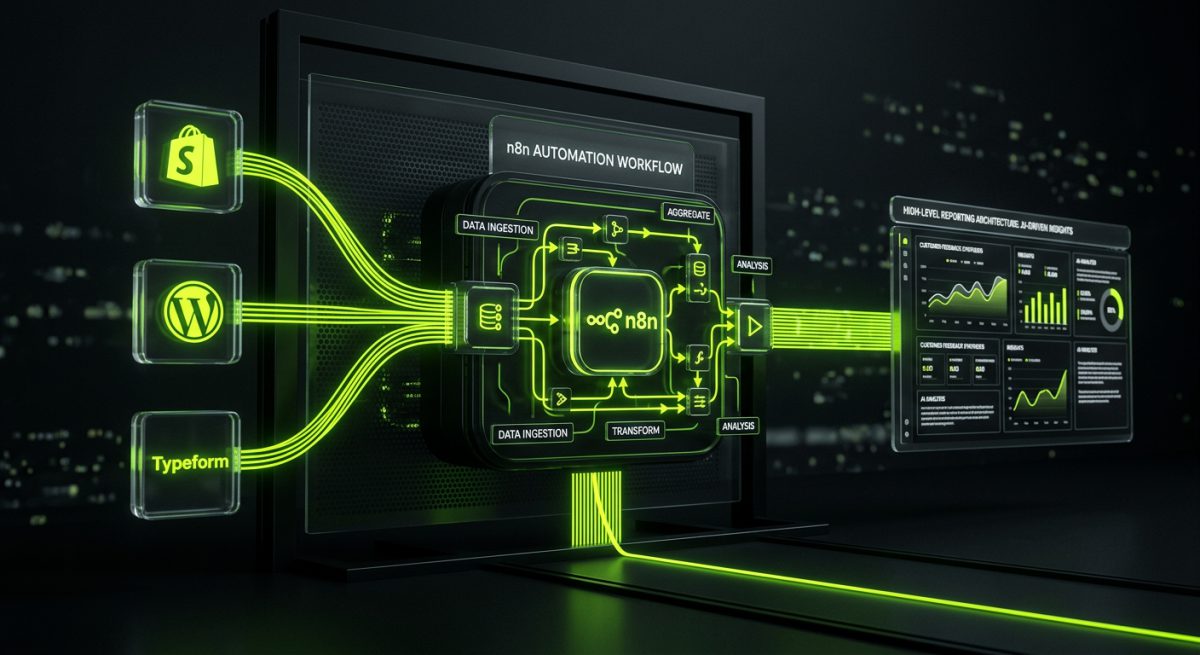
Modern B2B enterprises often struggle with fragmented data silos that prevent a holistic view of the customer experience. When customer feedback is scattered across Typeform surveys, WordPress contact forms, Shopify order reviews, and direct emails, the manual effort required to aggregate this information into a coherent report is staggering. At werun.dev, we solve this by architecting robust data ingestion pipelines using n8n. These workflows serve as the central nervous system for your customer satisfaction reporting, connecting disparate APIs and transforming raw input into structured data in real-time. By utilizing self-hosted n8n instances, we ensure that your data remains within your controlled infrastructure, maintaining high security standards while providing the flexibility of custom JavaScript nodes for complex data transformations.
The process begins with multi-trigger workflows. For instance, a webhook from a custom-built WordPress form or a Shopify 'order fulfilled' event can trigger a sequence that fetches the customer's historical data from a CRM like HubSpot or Salesforce. This contextual enrichment is vital; a low satisfaction score from a first-time buyer requires a different response than the same score from a long-term enterprise partner. Our automation systems handle this logic effortlessly, branching the workflow based on customer lifetime value (LTV) or specific product categories. We implement comprehensive error handling and retry logic to ensure that no feedback is ever lost, maintaining the 99.97% uptime reliability our clients expect. This infrastructure allows for 'always-on' reporting, where stakeholders can access live dashboards instead of waiting for monthly manual audits.
Technical Implementation of Data Ingestion
To achieve this, we often deploy custom API connectors within n8n. Below is a conceptual example of how a JavaScript node might normalize incoming feedback data from various sources before it is sent to an AI processing agent:
// Normalizing feedback data from multiple sources
const input = items[0].json;
const normalizedData = {
    customer_id: input.user_id || input.email,
    source: input.source_platform, // e.g., 'Shopify', 'WP-Form'
    raw_text: input.comment || input.feedback_text,
    timestamp: new Date().toISOString(),
    metadata: {
        order_value: input.total_price || 0,
        account_tier: input.tier || 'standard'
    }
};
return [{ json: normalizedData }];
By standardizing data at the point of entry, the reporting system becomes agnostic to the source. Whether the feedback comes from a Webflow site or a custom React application, the downstream AI agents receive a clean, uniform object. This level of technical rigor ensures that the resulting reports are not just collections of quotes, but high-fidelity datasets ready for deep analysis. This foundational layer is what separates basic survey tools from enterprise-grade intelligence systems.
Leveraging AI and LLMs for Deep Sentiment Analysis

Once the data is structured, the next challenge is extracting meaningful insights from qualitative text. Traditional keyword-based sentiment analysis often fails to capture the nuance of B2B feedback, where professional language can mask deep frustration or subtle praise. This is where our expertise in AI and LLM integration becomes a competitive advantage. We deploy agents powered by Claude 3.5 (Anthropic) and OpenAI GPT-4o to perform multi-dimensional analysis on every piece of feedback. These agents are not just looking for 'positive' or 'negative' labels; they are programmed to identify specific pain points, feature requests, and emotional urgency through Retrieval-Augmented Generation (RAG) and vector search.
By using RAG, we provide the LLM with a knowledge base of your company’s specific terminology, product features, and historical service issues. This allows the AI to categorize feedback with extreme precision. For example, if a customer mentions 'latency in the checkout flow,' the agent recognizes this as a technical performance issue rather than a general complaint. We also implement data enrichment pipelines where the AI compares new feedback against historical trends stored in vector databases like Pinecone or Weaviate. This allows the system to flag 'emerging issues'—problems that might only be mentioned by 2% of customers but represent a significant new bug or market shift.
Advanced Prompt Engineering for Sentiment
Our AI agents use sophisticated prompt structures to ensure consistency. A typical system prompt for a satisfaction agent might look like this:
Role: Senior Customer Experience Analyst
Task: Analyze the provided B2B feedback for sentiment (0-100 score), primary intent, and technical urgency.
Context: Use the attached Product Documentation to classify feature requests.
Output: JSON format with keys [sentiment_score, intent_category, urgency_level, key_summary].
This structured output allows us to feed the AI's findings back into a database, where they can be aggregated into visual reports. The result is a report that tells you not just what happened, but why it happened and how it fits into the larger narrative of your customer journey. Because we build these as autonomous agents, they can process thousands of entries in seconds, a task that would take a human team weeks to complete. This speed enables proactive management, where a negative sentiment score can trigger an immediate high-priority alert in Slack or Microsoft Teams, allowing your account managers to intervene before a customer churns. This is the power of integrating AI directly into your business logic.
Operationalizing Insights for Retention and Growth
The final and most critical stage of customer satisfaction reporting is the transition from data to action. A report that sits in an inbox is useless; a report that triggers a business process is an asset. At werun.dev, we focus on 'closed-loop' automation. This means that the insights generated by our AI reporting systems are automatically pushed into the tools your team uses every day. We build integrations that sync sentiment scores back to your CRM, update lead scores, and even generate personalized draft responses for your support team. This ensures that the organization remains responsive to customer needs without increasing administrative overhead.
Furthermore, these reports provide the raw data needed for strategic product development. By aggregating AI-categorized feature requests, we can generate 'Demand Heatmaps' that show exactly which improvements will have the highest impact on customer satisfaction. For Shopify or WooCommerce stores, this might mean identifying a specific bottleneck in the shipping selection process. For B2B SaaS platforms built on WordPress, it might reveal a need for better documentation or specific API endpoints. Our reporting systems don't just look backward at what happened; they provide a roadmap for where the business should go next.
Driving ROI through Proactive Automation
Consider the ROI of reducing churn by even 5% through faster response times to negative feedback. Our automation pipelines typically reduce the time-to-insight from days to minutes. When a high-value client submits feedback with a sentiment score below a certain threshold, our n8n flows can automatically create a high-priority ticket in Jira, notify the CEO via Slack, and draft a summary of the client's recent interactions to brief the team. This level of responsiveness is only possible through the tight integration of web development, API management, and artificial intelligence.
We provide the technical expertise to build these systems from the ground up, ensuring they are scalable and maintainable. Whether you are looking to automate your existing reporting or build a completely new AI-driven customer intelligence platform, our team at werun.dev has the experience to deliver. We don't just build websites; we build the intelligent systems that run your business. To discuss how we can automate your customer satisfaction reporting and help you scale your B2B operations, visit werun.dev and speak with our automation experts today.