The Evolution of Sales Pipelines through Predictive Intelligence

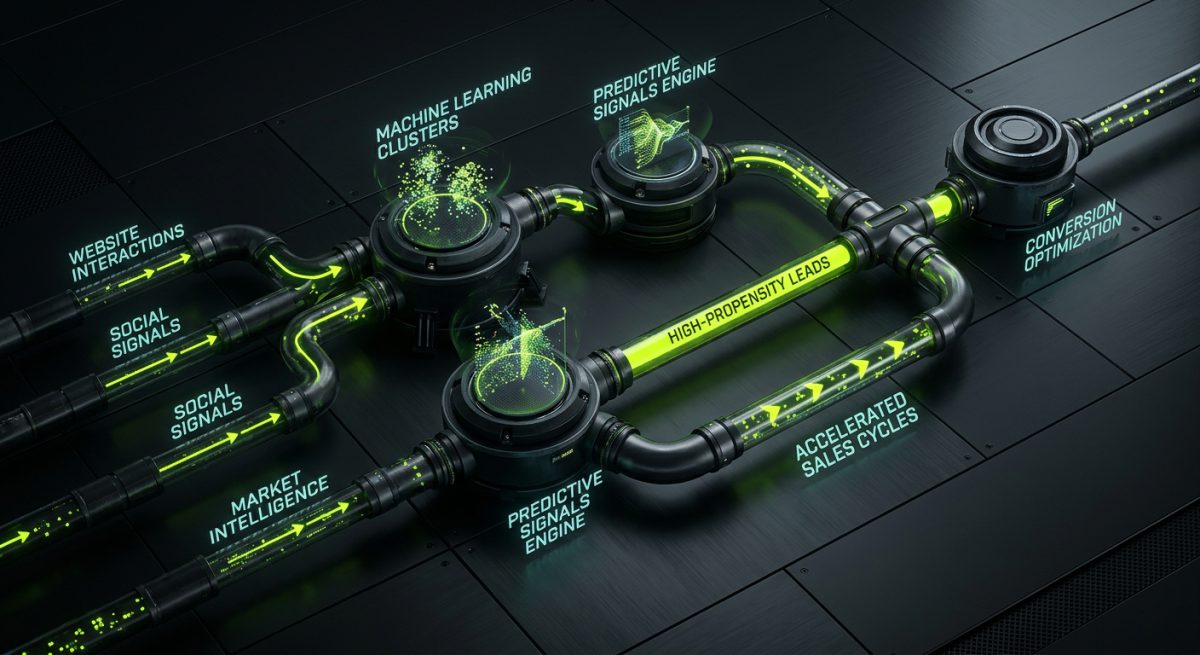
The landscape of B2B sales has undergone a fundamental shift from reactive management to proactive intelligence. Historically, sales teams relied on static lead scoring models and historical intuition to prioritize their efforts. However, in an era where data is generated at every touchpoint—from website interactions to email engagement and social signals—the human capacity to synthesize this information has reached its limit. Predictive intelligence, powered by machine learning, has emerged not just as a luxury, but as a critical infrastructure component for modern sales enablement. By leveraging AI integrations, organizations can now transform raw data into actionable foresight, identifying which prospects are most likely to convert before a sales representative even picks up the phone.
Traditional B2B sales cycles are notoriously long and complex, often involving multiple stakeholders and a myriad of digital interactions. In this environment, the primary challenge is not a lack of data, but the presence of data silos. Information trapped in siloed CRM systems or marketing automation platforms provides an incomplete picture of the buyer's journey. Predictive intelligence solves this by aggregating cross-channel data to build a multi-dimensional profile of the prospect. This involves analyzing first-party data, such as time spent on specific pricing pages or whitepaper downloads, and third-party intent data, which signals interest across the broader web. When these data points are processed through a predictive model, the result is a dynamic lead score that evolves in real-time based on current behavior rather than historical averages.
At werun.dev, our approach to AI integration focuses on breaking down these silos. We recognize that for predictive intelligence to be effective, it must be embedded directly into the technical fabric of the organization. This means building scalable data pipelines that feed high-quality information into specialized machine learning models. Whether we are optimizing a SaaS architecture to capture more granular user events or integrating third-party AI tools into a custom WordPress dashboard, our goal is to ensure that the intelligence is both accurate and accessible. We prioritize secure, high-performance integrations that allow sales teams to trust the data they are seeing, reducing the friction between insight and action. This technical rigor is what allows our clients to move beyond basic automation into the realm of true predictive sales enablement.
Implementing these systems requires a shift in mindset. Sales leaders must move away from the 'volume-first' approach—where more calls and more emails are the only levers for growth—and toward a 'precision-first' strategy. Statistical evidence supports this transition: research indicates that AI-powered lead scoring can increase conversion rates by up to 30%. Furthermore, considering that the average sales representative spends only 33% of their time actually selling, the ability of AI to automate the administrative burden of lead qualification and prioritization is a massive force multiplier. By focusing human talent on the leads with the highest probability of closing, companies can drastically reduce their customer acquisition costs while simultaneously increasing their win rates.
Technical Architecture for AI-Driven Sales Enablement
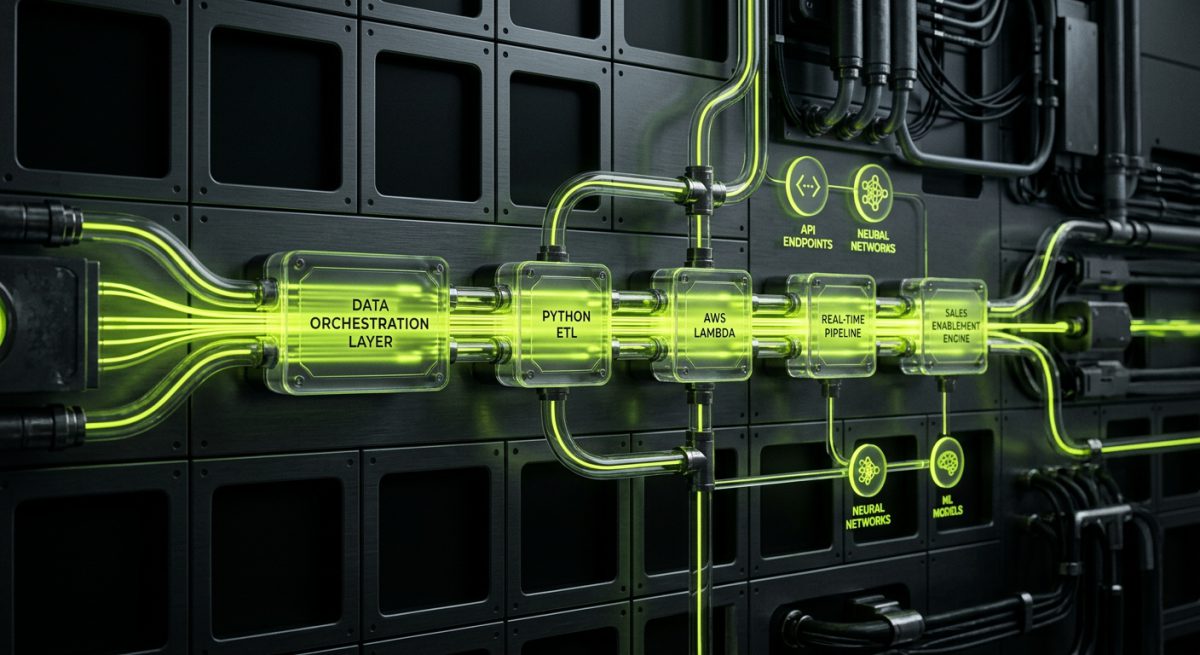
Moving from the theoretical benefits of AI to a production-ready implementation requires a robust technical foundation. At the core of a predictive pipeline is the data orchestration layer. This layer is responsible for the extraction, transformation, and loading (ETL) of data from various sources—such as Webflow CMS, Shopify storefronts, or custom-built web applications—into a centralized repository where it can be processed by machine learning algorithms. Modern automation workflows often utilize Python-based frameworks or cloud-native tools like AWS Lambda and Google Cloud Functions to handle these data movements with low latency. The architecture must be designed to handle both structured data (like transaction history) and unstructured data (like email transcripts or call notes), the latter of which is increasingly processed using Large Language Models (LLMs).
To build a truly intelligent pipeline, the system must incorporate a feedback loop. This is where many off-the-shelf solutions fall short. A custom-built AI layer allows for the continuous training of models based on actual sales outcomes. For instance, when a 'high-intent' lead fails to convert, that data point is fed back into the system to refine the predictive parameters. This requires a sophisticated API orchestration layer that can communicate between the CRM, the AI model, and the communication tools used by the sales team. Below is a conceptual example of how a lead enrichment function might look when integrating an LLM to analyze prospect intent from a contact form submission:
import openai

def analyze_lead_intent(form_data):
    # Combine form fields into a context string
    context = f"Company: {form_data['company']}, Message: {form_data['message']}, Industry: {form_data['industry']}"

    # Use an LLM to categorize intent and assign a priority score
    response = openai.ChatCompletion.create(
        model="gpt-4",
        messages=[
            {"role": "system", "content": "You are a sales intelligence assistant. Categorize lead intent and score 1-100."},
            {"role": "user", "content": context}
        ]
    )

    return response.choices[0].message.content

# Example usage in a WordPress or Webflow webhook
lead_analysis = analyze_lead_intent({
    'company': 'TechCorp',
    'message': 'We are looking to scale our cloud infrastructure by Q3.',
    'industry': 'FinTech'
})
Beyond simple scoring, the architecture must support real-time personalization. Predictive intelligence can determine not just who to contact, but what to say. By analyzing the specific content a prospect has engaged with, the AI can suggest the most relevant case studies or technical documentation to share during the outreach process. This level of granularity requires a high degree of technical synergy between the front-end website and the back-end sales tools. At werun.dev, we specialize in creating these seamless connections, ensuring that the data captured on a high-performance Webflow site or a complex WordPress ecosystem is immediately useful to the sales stack. We focus on building secure integrations that comply with global data privacy standards (like GDPR or CCPA), ensuring that while the sales process becomes more intelligent, it remains fully compliant and trustworthy.
Furthermore, the scalability of the architecture is paramount. As a B2B company grows, the volume of data points increases exponentially. A system built on fragile, no-code connectors may suffice for a small startup, but it will inevitably crumble under the weight of enterprise-level data flows. We advocate for a decoupled architecture where the AI processing engine is independent of the primary CRM. This allows for easier updates to the machine learning models and prevents the CRM from becoming a performance bottleneck. By utilizing vector databases for semantic search and efficient data retrieval, we enable sales teams to query their entire historical database for patterns that correlate with success, turning every past deal into a lesson for the future.
Implementing Predictive Workflows: A Real-World Use Case
To illustrate the impact of these technologies, let us examine a real-world implementation for a B2B manufacturing firm operating on a global scale. This company faced a common challenge: their website generated thousands of leads per month, but the sales team was overwhelmed by the sheer volume, leading to a 'first-come, first-served' approach that ignored the actual value of the prospects. The result was a bloated pipeline filled with low-quality leads, while high-value enterprise opportunities were left cold for days. werun.dev was engaged to design and implement an AI-driven sales enablement layer that would sit between their WordPress-based lead generation engine and their Salesforce CRM.
Our solution began with the implementation of a sophisticated data capture layer. We replaced standard contact forms with dynamic, multi-step interfaces that used progressive profiling to gather more information without increasing friction. This data was then pushed into a custom middleware layer where it was enriched with external data points—such as the prospect's company size, recent funding rounds, and technology stack—using APIs from providers like Clearbit or Apollo. Once enriched, the data was passed to a custom machine learning model trained on five years of the client's historical sales data. This model didn't just look at the lead's profile; it analyzed the 'velocity' of their engagement, flagging leads that moved from initial awareness to deep technical research within a 24-hour window.
One of the most impactful features of this integration was the automated 'Sales Playbook' generation. When a high-priority lead was identified, the system didn't just alert the sales rep; it generated a brief, AI-composed summary of why the lead was prioritized, what their likely pain points were, and which eCommerce development or technical services they were most likely to need based on their industry profile. This reduced the pre-call research time for sales reps from 30 minutes to less than 5 minutes. The impact was immediate: within the first quarter of implementation, the company saw a 25% increase in the number of qualified meetings booked and a significant reduction in the average time-to-close for enterprise deals.
This scenario highlights how werun.dev helps companies move from experimentation to production-ready AI systems. We don't just provide the tools; we build the infrastructure that makes those tools effective. Our expertise in managing complex SaaS architecture and deep API integrations ensures that the AI layer is not a standalone 'gimmick' but a core driver of business value. We also addressed the critical issue of churn. By applying predictive intelligence to existing customer data, we built a 'health score' dashboard that alerted account managers to clients whose usage patterns suggested a risk of cancellation. Predictive analytics used in this way can reduce customer churn by 15-20%, directly impacting the company's bottom line and long-term stability.
Ultimately, the success of AI in sales enablement is measured by its ability to augment human expertise, not replace it. By automating the analytical heavy lifting, we empower sales professionals to do what they do best: build relationships and solve complex problems for their clients. The technical bridges we build at werun.dev ensure that the right information reaches the right person at the right time, turning the sales pipeline into a precision-engineered engine for growth. If your organization is ready to move beyond manual lead management and embrace the power of predictive intelligence, we invite you to explore our AI integration services or book a technical consultation with our team to discuss how we can optimize your sales stack for the future.