The Architectural Shift from Reactive Chatbots to Proactive Agents
The landscape of business automation has undergone a fundamental transformation. For years, B2B entities relied on standard chatbots—systems designed to follow rigid, pre-defined decision trees or, more recently, to provide answers based on static data retrieval. While these tools improved customer service efficiency, they remained inherently reactive. They waited for a prompt, looked up information, and returned a response. However, the emergence of the "Autonomous Agent" marks a departure from this passive model. At werun.dev, we are seeing a significant shift where our clients no longer want a bot that just talks; they want an agent that works.
An autonomous agent differs from a chatbot in its ability to reason, plan, and execute multi-step tasks without constant human intervention. While a standard RAG (Retrieval-Augmented Generation) chatbot might tell a customer where their package is by querying a database, an autonomous agent can identify that a package is delayed, cross-reference the delay with a Shopify refund policy, initiate a partial refund via the Shopify API, and notify the logistics team via a Slack integration—all within a single workflow. This evolution is powered by the "Agentic" workflow, which utilizes Large Language Models (LLMs) like GPT-4 or Claude 3.5 Sonnet not just as text generators, but as reasoning engines.
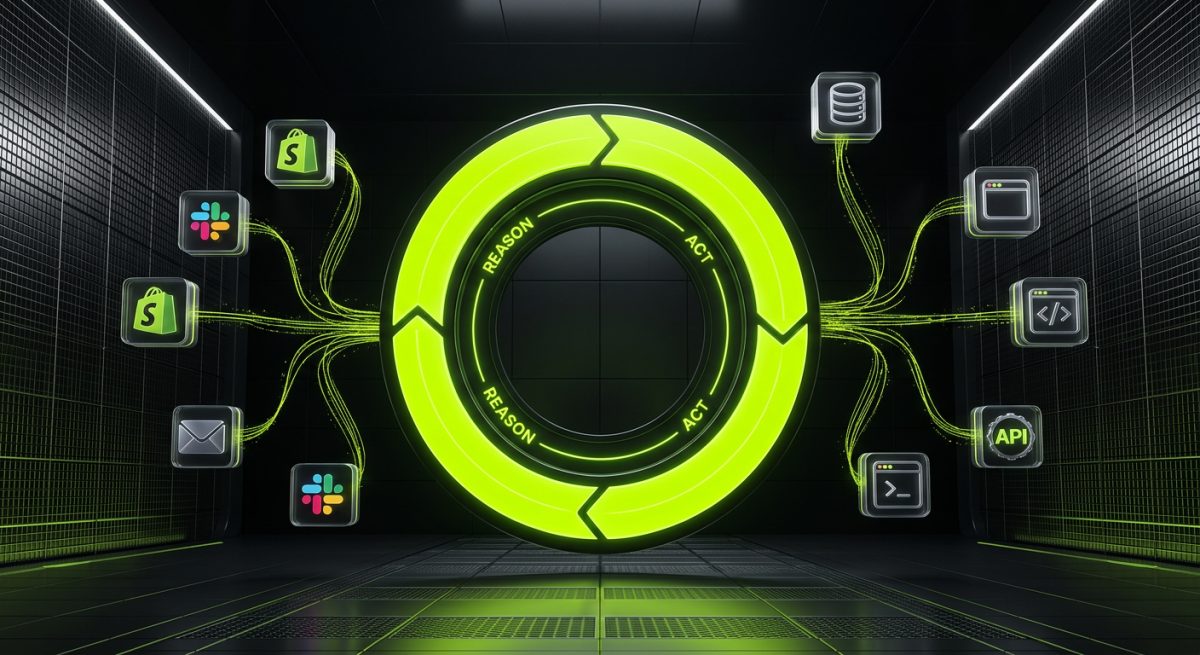
To move from a chatbot to an agent, the architecture must transition from a linear flow to a loop. This is often referred to as the ReAct (Reason + Act) pattern. In this framework, the agent receives a goal, thinks about the steps required to achieve it, chooses a specific tool to execute the first step, observes the result, and then repeats the process until the goal is met. For a B2B agency like werun.dev, this means building robust "Toolkits" for these agents. Whether it is a custom WordPress plugin that exposes specific REST API endpoints or an n8n workflow that connects a CRM to a vector database, the agent's power is directly proportional to the tools it has at its disposal. We are moving away from the era of "conversational UI" and into the era of "agentic operations," where the interface is merely the starting point for complex background execution. This shift requires a deeper understanding of how LLMs handle tool-calling and how they maintain state across long-running processes, ensuring that the agent doesn't just hallucinate a solution but follows a verifiable logic path.
The Role of Context and Memory in Autonomy
One of the primary hurdles in evolving from a chatbot to an agent is the management of context. A simple chatbot treats every interaction as a fresh start or relies on a limited conversation history. An autonomous agent, however, requires a more sophisticated memory architecture. At werun.dev, we implement this through a combination of short-term memory (conversation buffers) and long-term memory (Vector databases like Pinecone or Weaviate). When an agent is tasked with managing a complex WordPress multisite environment, it needs to remember previous configurations, user permissions, and past error logs.
By utilizing an Agent Builder approach—often integrated through orchestration platforms like n8n or LangChain—we can give agents access to "persistent state." This allows the agent to learn from previous failures. If an API call to a Shopify store fails due to a rate limit, an autonomous agent with a memory module can log that event and adjust its execution strategy for the next attempt, perhaps by implementing an exponential backoff or batching the requests. This level of self-correction is what separates a script from an agent. It transforms the AI from a tool that developers have to manage into a teammate that manages its own tasks within the parameters we define. For our clients, this translates to lower overhead and higher reliability in their automation pipelines.
Building the Engine: Tools, RAG, and Actionable Triggers
Transitioning to an autonomous agent requires a complete rethink of the "Tooling" layer. In the context of the werun.dev ecosystem, tools are the bridges between the LLM's reasoning and the actual business data residing in WordPress, Webflow, or Shopify. When using an Agent Builder, the developer's primary job is no longer writing the logic for every possible user query; instead, it is defining the "Function Schema" that the agent can call. This involves creating precise, well-documented API endpoints that the agent can understand. For instance, if we are building an agent to manage a WooCommerce store, we provide it with tools like get_inventory_levels(), update_product_price(), and generate_discount_code().
Each of these tools must be accompanied by a description that explains to the LLM exactly when and how to use it. This is where the technical expertise of a senior developer becomes critical. If the tool description is ambiguous, the agent may call the wrong function or provide incorrect parameters, leading to catastrophic errors in a production environment. At werun.dev, we specialize in building these "Agent-Ready" APIs. We ensure that every custom WordPress plugin we develop includes the necessary hooks and filters, properly authenticated via JWT or OAuth 2.0, so that an autonomous agent can interact with the site safely and effectively. We aren't just building websites; we are building API-first environments that serve as the playground for autonomous agents.
Function Calling and JSON Schema Definition
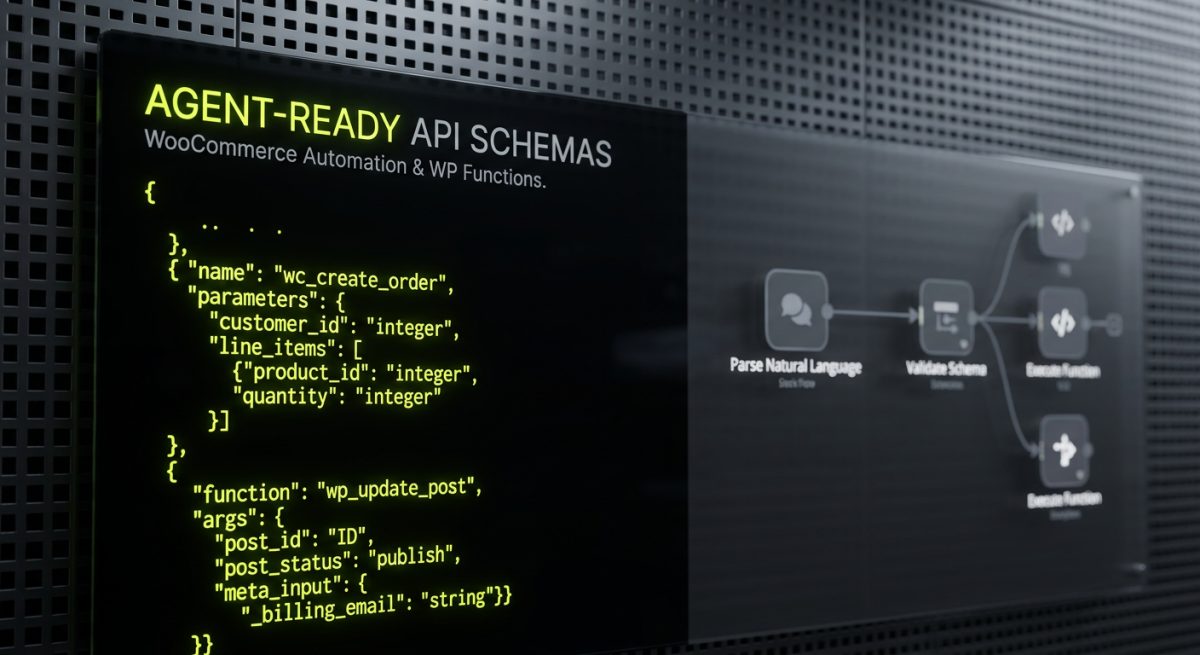
The technical core of an autonomous agent is the "Function Calling" capability. This is a feature of modern LLMs where the model can output a JSON object containing arguments for a specific function instead of a text response. For example, if a user asks, "Can you check if the new 'Blue Suede Shoes' are in stock and notify the marketing team if they are below 10 units?", the agent doesn't just reply. It generates a JSON call to a custom endpoint we've built in WordPress.
{
  "function": "check_woo_inventory",
  "parameters": {
    "product_name": "Blue Suede Shoes",
    "threshold": 10,
    "action": "slack_notify",
    "channel": "#marketing-alerts"
  }
}
This structured output is then intercepted by an orchestration layer—such as an n8n workflow—which executes the real code. This separation of concerns is vital. The LLM handles the intent and the extraction of parameters, while our robust, server-side code handles the actual database interaction and external API calls. This ensures that the agent operates within the security constraints of the enterprise. We implement strict validation on these inputs, treating the agent's output as untrusted data, just as we would with a traditional user-facing form. By layering this security on top of the Agent Builder, we provide B2B clients with the confidence to deploy autonomous agents in high-stakes environments like e-commerce fulfillment or enterprise content management.
Integrating RAG for Deep Knowledge Access
While tools allow the agent to act, Retrieval-Augmented Generation (RAG) allows the agent to know. However, in an autonomous agent, RAG is not just a search tool; it is a reference library that the agent can consult mid-task. If an agent is managing a Webflow site and encounters a custom code error, it can use a RAG tool to search the project's internal documentation or the Webflow API reference. This allows the agent to troubleshoot its own tasks. At werun.dev, we build these knowledge bases by scraping client documentation, Slack histories, and technical specs, then indexing them into a vector store. When the agent is initialized via the Agent Builder, it is given a "Search Documentation" tool. This creates a loop: the agent attempts a task, encounters a gap in its knowledge, searches the RAG system, updates its plan, and tries again. This iterative self-sufficiency is the hallmark of a truly autonomous system, reducing the need for human developers to step in every time a minor hurdle is encountered.
Operationalizing Autonomy: Real-World B2B Workflows
Theoretical autonomy is impressive, but for a B2B agency, the value lies in operationalizing these agents to solve real business problems. The shift from chatbot to agent is most visible in the "Middle Office"—the space where data from different platforms must be synchronized and acted upon. For example, consider a lead generation workflow for a high-traffic WordPress site. A traditional chatbot might capture a lead's email and put it in a database. An autonomous agent, however, can take that email, use a tool to research the company via an enrichment API (like Clearbit), determine if the lead fits the Ideal Customer Profile (ICP), and then either book a meeting via the Calendly API or send a personalized nurture sequence via HubSpot.
At werun.dev, we focus on creating these end-to-end pipelines using n8n as the central nervous system. The Agent Builder allows us to define the logic, but the n8n nodes provide the connectivity. This approach is particularly powerful for Shopify Plus merchants. An agent can be tasked with "Optimizing the Store for the Weekend Sale." The agent can then autonomously check inventory levels, adjust prices on the Shopify backend, update the Webflow landing page content via the Webflow API, and schedule a promotional email. By automating these cross-platform tasks, we allow business owners to focus on strategy while the agents handle the tactical execution. This is not just automation; it is the scaling of human intent through intelligent delegation.
Maintenance, Monitoring, and the Human-in-the-Loop
Deploying an autonomous agent is not a "set it and forget it" project. Because these agents make decisions, they require rigorous monitoring and a "Human-in-the-Loop" (HITL) framework for high-risk actions. At werun.dev, we integrate approval gates into our agentic workflows. For instance, an agent might be allowed to draft a blog post in WordPress and find relevant internal links using RAG, but it won't be allowed to hit "Publish" without a human editor's sign-off. We use custom Slack interfaces to provide these "Approval Triggers," where the agent presents its proposed action and the reasoning behind it, and a human can click "Approve" or "Revise."
Furthermore, the maintenance of these agents is a core part of our service offering. With our 99.97% uptime guarantee and <4h SLA, we ensure that the underlying APIs and infrastructure supporting the agents remain stable. As LLM models evolve and APIs change, the "Tools" the agent uses must be updated. We treat agent maintenance like a traditional software lifecycle, including version control for prompts (PromptOps), testing for regression in reasoning, and monitoring for "agent drift," where the agent's performance degrades over time. By providing this level of professional oversight, werun.dev enables B2B companies to embrace the power of autonomous agents without the risk of unmonitored AI systems causing havoc in their production ecosystems. The evolution from chatbot to agent is a journey toward higher operational maturity, and with the right tools and partnership, it is a journey that yields massive dividends in efficiency and scalability.