
The businesses that thrived in the early days of AI adoption did so by automating one thing: answering questions. A customer asks where their order is. A chatbot replies. Simple, transactional, contained. That era is over.
Today, AI systems don't just respond — they plan, execute, monitor, and iterate. The shift from reactive chatbots to autonomous AI agents represents one of the most significant operational transformations in modern business history. For B2B companies, this isn't a technology trend to track from a distance. It's a structural change in how competitive advantage gets built and sustained.
The Chatbot Era: Useful, but Fundamentally Limited
To understand where AI is going, it's worth being precise about where it started in a business context. Chatbots emerged as rule-based systems — decision trees dressed up with natural language interfaces. A user typed a query, the system matched it to a predefined intent, and a scripted response was returned. The value was real: reduced support ticket volume, 24/7 availability, faster first-response times.
Then came the first wave of machine learning-enhanced chatbots. These systems could handle more varied inputs, learn from conversation logs, and escalate intelligently. Platforms like Intercom, Drift, and Zendesk AI built entire product categories around this capability. For many businesses, this felt like the ceiling of what AI could do in a customer-facing role.
Why Chatbots Hit a Wall
The fundamental constraint of chatbot architecture is scope. A chatbot operates within a single channel, on a single task, with no memory of what happened outside that conversation window. It cannot:
- Access and update a CRM record based on what it learned
- Trigger a fulfillment workflow after resolving a complaint
- Detect a pattern across thousands of conversations and surface it as a strategic insight
- Coordinate with another system to proactively reach out before a problem escalates
These limitations aren't bugs — they're architectural features of systems designed for containment. The chatbot was never meant to think beyond the conversation. That's precisely why the next evolution required a fundamentally different design philosophy.
The Hidden Cost of Isolated AI
For B2B operations specifically, isolated AI tools created what analysts now call "automation islands" — pockets of efficiency surrounded by manual handoffs. A sales team might use an AI tool to draft outreach emails, while the CRM update still required human input, the follow-up scheduling was still manual, and the pipeline reporting was still a weekly spreadsheet exercise. Each tool worked. The system didn't.
Research from McKinsey's 2023 State of AI report found that companies using AI in isolated, single-function deployments captured roughly 20% of the potential productivity value compared to companies that integrated AI across connected workflows. That gap is where the next generation of AI systems operates.
Agentic AI: When Systems Start Acting, Not Just Answering
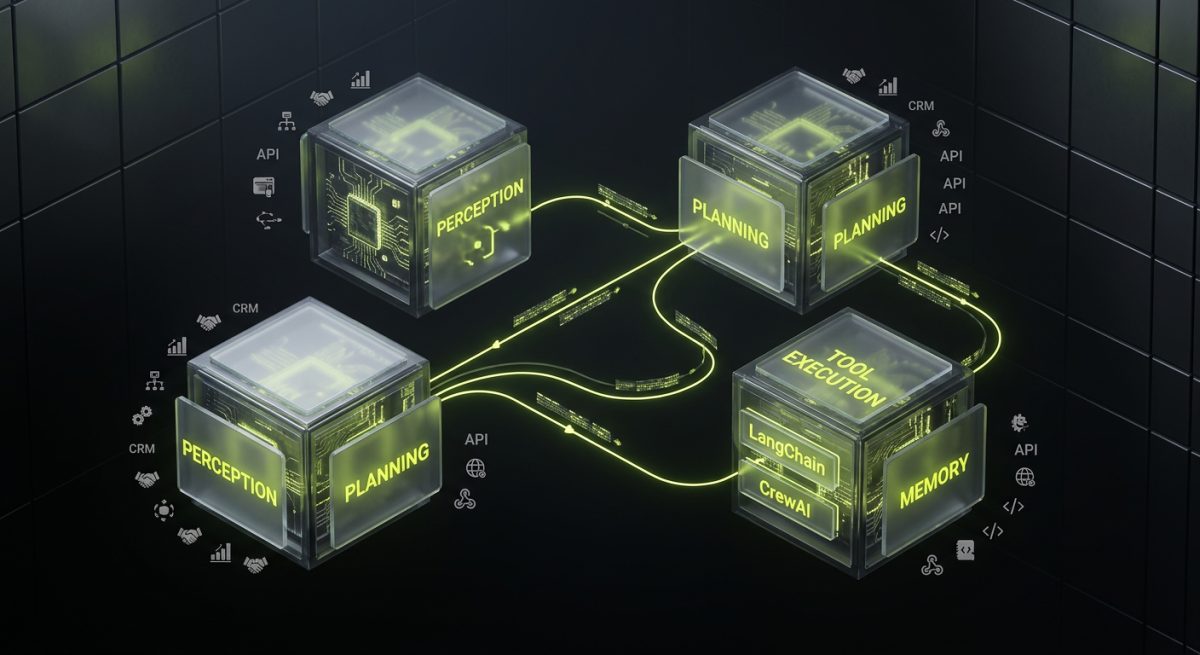
The term "AI agent" has become overloaded, but its technical meaning is specific and important. An AI agent is a system that perceives its environment, makes decisions based on goals rather than scripts, takes actions that affect that environment, and adjusts its behavior based on feedback. It is, in the truest sense, goal-directed rather than prompt-directed.
This distinction matters enormously for business applications. A prompt-directed system (like a standard LLM interface) requires a human to initiate every action and interpret every output. A goal-directed agent can be given an objective — "reduce churn in the enterprise segment by 15% this quarter" — and autonomously determine which actions to take, in what sequence, using which tools.
How Agentic Systems Work in Practice
The architecture of a modern AI agent typically involves four components working in concert:
1. Perception Layer The agent ingests data from connected sources — CRM records, support tickets, website analytics, product usage data, email threads, and external market signals. Unlike a chatbot that only sees the current conversation, an agent maintains a persistent, updating model of its operational context.
2. Planning and Reasoning Engine Using large language models as a reasoning core, the agent breaks down high-level goals into executable sub-tasks. This is where frameworks like LangChain, AutoGPT, and CrewAI operate — enabling multi-step reasoning chains that can span hours or days of real-world time.
3. Tool Use and Action Execution Agents are equipped with tools: APIs, database write access, browser automation, code execution environments, and communication channels. When the agent decides an action is warranted, it executes it directly rather than surfacing a recommendation for human approval (unless configured to do so).
4. Memory and Feedback Loops Agents maintain both short-term working memory (the current task context) and long-term memory (learned patterns, past decisions, outcome data). This enables genuine improvement over time — not just better responses, but better judgment.
Real Business Applications Right Now
This isn't theoretical. Agentic AI systems are already operating in production environments across B2B industries:
- Revenue Operations: Agents that monitor deal velocity in a CRM, identify at-risk opportunities based on engagement signals, draft personalized re-engagement sequences, and update forecast models — without human initiation
- Customer Success: Agents that track product usage metrics, detect early churn signals, trigger proactive outreach campaigns, and escalate to human CSMs only when intervention thresholds are crossed
- Content and SEO Operations: Agents that monitor keyword ranking changes, identify content gaps, draft optimization briefs, and publish updates to a CMS on a defined schedule
- Financial Operations: Agents that reconcile invoices, flag anomalies, generate variance reports, and initiate approval workflows for exceptions
The common thread: these systems complete multi-step workflows across multiple tools with minimal human touchpoints. The human role shifts from executor to supervisor.
Building AI-Ready Infrastructure for Autonomous Systems

The gap between businesses that will capture value from agentic AI and those that won't is not primarily about AI strategy. It's about infrastructure readiness. Autonomous AI systems require a fundamentally different technical foundation than the tools most businesses currently run.
This is where web development and digital infrastructure become directly relevant to AI adoption — and where the decisions made today will either accelerate or constrain what's possible in the next 18 months.
Data Architecture: The Non-Negotiable Foundation
An AI agent is only as capable as the data it can access and act upon. Businesses with fragmented data architectures — where customer data lives in five different systems with no unified identifier, where product data is inconsistent across platforms, where historical records exist only in spreadsheets — cannot deploy effective autonomous agents.
The infrastructure requirements for agentic AI include:
- Unified customer data layer: A single source of truth for customer identity, history, and behavior — typically a CDP (Customer Data Platform) or a well-structured data warehouse like BigQuery or Snowflake
- API-first systems: Every tool an agent might need to interact with must expose clean, authenticated APIs. Legacy systems without API access are dead ends for automation
- Event-driven architecture: Rather than batch data syncs, agentic systems require real-time event streams so agents can respond to changes as they happen
- Structured content models: For businesses running WordPress or Webflow, this means moving beyond page-based content to headless or structured content architectures that AI systems can query and update programmatically
Platform Considerations for WordPress, Webflow, and Shopify
For businesses on the platforms werun.dev specializes in, AI readiness looks different depending on the stack:
WordPress offers the most flexibility for agentic integration, particularly through the REST API and GraphQL (via WPGraphQL). Headless WordPress deployments are particularly well-suited for AI agent integration because the content layer is fully decoupled from the presentation layer. Custom post types with well-defined schemas give AI agents reliable, structured data to work with.
// Example: AI agent updating a WordPress CPT via REST API
const updateProductRecord = async (postId, agentData) => {
  const response = await fetch(
    `${WP_API_BASE}/wp/v2/products/${postId}`,
    {
      method: 'POST',
      headers: {
        'Authorization': `Bearer ${AUTH_TOKEN}`,
        'Content-Type': 'application/json'
      },
      body: JSON.stringify({
        meta: {
          ai_last_reviewed: agentData.timestamp,
          seo_score: agentData.seoScore,
          recommended_updates: agentData.recommendations
        }
      })
    }
  );
  return response.json();
};
Webflow presents more constraints due to its closed CMS architecture, but the Webflow API enables meaningful agent integration for content updates, form data processing, and CMS item management. The key limitation is write access — Webflow's API is more restrictive than WordPress for complex data operations.
Shopify is arguably the most agent-ready of the three platforms out of the box. The Shopify Admin API, Storefront API, and webhook infrastructure provide comprehensive access for agents managing inventory, pricing, customer segmentation, and fulfillment workflows. The Shopify Flow automation layer can also serve as a lightweight orchestration tool for simpler agent tasks.
Security and Governance Architecture
Autonomous systems that can take actions — send emails, update records, trigger purchases, modify content — require a governance layer that most businesses haven't built yet. This includes:
- Permission scoping: Agents should operate with the minimum permissions required for their designated tasks. An agent managing content updates should not have access to financial records
- Audit logging: Every action an agent takes should be logged with full context — what decision was made, what data informed it, what action was executed, and what the outcome was
- Human-in-the-loop thresholds: Define explicitly which actions require human approval before execution, and build those checkpoints into the agent's workflow architecture
- Rollback capabilities: For any agent with write access to production systems, ensure that its actions can be reversed. This is especially critical for e-commerce and CMS applications
The businesses building this governance infrastructure now are not slowing down their AI adoption — they're enabling it to scale without the catastrophic failure modes that come from deploying autonomous systems without guardrails.
The Organizational Shift: From Tool Users to System Supervisors
Technology infrastructure is only half the transformation. The other half is organizational. As AI systems take on more autonomous execution responsibilities, the human roles around them change in ways that most businesses are not yet prepared for.
The chatbot era required minimal organizational adaptation. A support team learned a new tool. Escalation paths were adjusted. Metrics shifted slightly. The fundamental structure of the team — and how work got done — remained intact.
Agentic AI requires something different. When a system is autonomously executing multi-step workflows, the human role becomes supervisory and strategic rather than operational and tactical. This is not a reduction in human importance — it's a redefinition of where human judgment creates the most value.
New Roles Emerging in AI-Augmented Organizations
Forward-looking B2B companies are already building or hiring for roles that didn't exist three years ago:
AI Operations Manager: Responsible for monitoring agent performance, identifying failure modes, tuning decision thresholds, and coordinating between human teams and automated systems. This role requires both technical literacy and deep understanding of business operations.
Prompt and Systems Engineer: Beyond writing prompts for individual queries, this role involves designing the reasoning architectures, tool configurations, and memory systems that govern how agents behave across complex, multi-step workflows.
Data Quality Lead: Agentic systems are acutely sensitive to data quality issues. A dedicated role focused on maintaining the integrity, consistency, and completeness of the data layer that agents rely on becomes a critical operational function.
Change Management Realities
The resistance to agentic AI adoption in B2B organizations rarely comes from technical barriers. It comes from legitimate concerns about accountability, quality control, and role security. Effective implementation requires:
- Transparent communication about what agents will and won't do, and how human oversight is maintained
- Gradual autonomy expansion — starting with agents that recommend actions for human approval, then progressively expanding autonomous execution as trust is established
- Clear success metrics that demonstrate value without obscuring the human contributions that remain essential
- Reskilling investment that helps existing team members develop the supervisory and strategic capabilities that agentic environments require
The organizations that navigate this transition most effectively will be those that treat it as an organizational design challenge as much as a technology implementation project. The systems are increasingly capable of running autonomously. The question is whether the humans around them are equipped to direct them well.