The Strategic Value of Automated Web Scraping for B2B Growth

In the modern B2B landscape, data is the primary currency of competitive advantage. However, the vast majority of actionable intelligence is not stored in neatly organized databases; it is scattered across the web in unstructured formats. Industry reports suggest that approximately 80% of enterprise data is unstructured, trapped within HTML structures, PDF documents, and social media feeds. For businesses looking to scale, manual data collection is no longer a viable option. It is slow, prone to human error, and impossible to maintain at the speed of today’s markets. Automated web scraping and data extraction pipelines allow organizations to convert the entire internet into a structured, queryable database, providing a foundation for informed decision-making and aggressive growth strategies.
At werun.dev, we specialize in building these pipelines to solve complex business challenges. The applications for high-volume data extraction are diverse. In the e-commerce sector, companies utilize scraping to monitor competitor pricing in real-time, allowing for dynamic pricing models that protect margins while remaining competitive. In the recruitment and HR space, automated extraction from professional networks and job boards enables firms to identify talent trends and map out the movement of key personnel across an industry. For sales teams, scraping provides a constant stream of enriched leads, moving beyond simple email lists to include deep insights into a prospect's recent activities, technology stack, and public financial disclosures.
The transition from manual research to automated pipelines typically results in an efficiency gain of over 90%. By removing the human bottleneck, teams can redirect their focus from data entry to data analysis. Furthermore, automated systems can run 24/7, ensuring that the information driving your business is never more than a few minutes old. This real-time capability is critical for market sentiment analysis, where rapid shifts in public perception can impact brand equity or stock performance. By leveraging custom-built scraping solutions, B2B enterprises can move from a reactive posture to a proactive one, identifying opportunities and threats long before they appear in traditional reports.
Technical Architectures for Scalable and Resilient Data Extraction
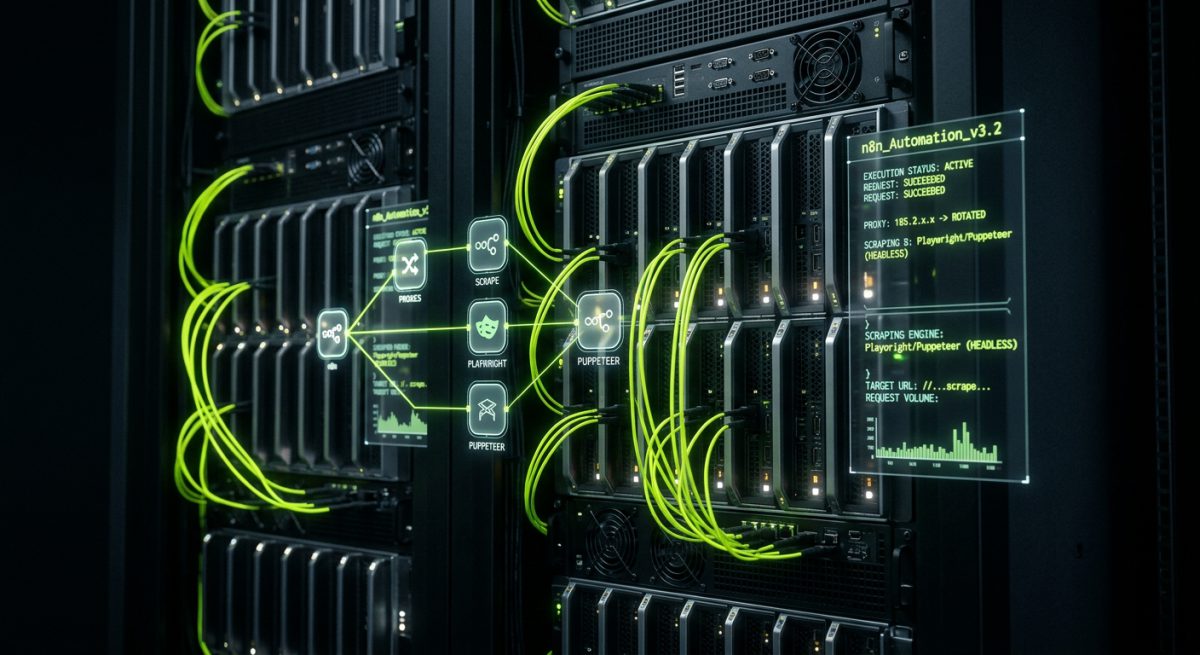
Building a basic scraper is a relatively simple task, but engineering a resilient, scalable extraction pipeline capable of handling millions of requests without detection is a significant technical challenge. Professional-grade web scraping requires a sophisticated stack that accounts for dynamic content, anti-bot mechanisms, and infrastructure stability. At werun.dev, our approach centers on a combination of headless browser technology and robust orchestration tools like n8n. We utilize frameworks such as Playwright and Puppeteer to interact with modern, JavaScript-heavy Single Page Applications (SPAs) that traditional HTTP-based scrapers cannot parse. These tools allow us to simulate real user behavior, including clicking buttons, scrolling through lazy-loaded content, and handling complex authentication flows.
Resilience is built into the core of our architecture through advanced proxy management and request rotation. To bypass rate-limiting and IP-based blocking, we implement rotating residential and mobile proxies that mask the origin of the requests. Furthermore, we integrate sophisticated fingerprinting techniques to ensure that our headless browsers appear as legitimate user agents to security services like Cloudflare or Akamai. This is complemented by our custom n8n workflows, which manage the logic of the extraction process. These workflows include comprehensive error handling and retry logic; if a request fails due to a temporary network issue or a CAPTCHA challenge, the system automatically triggers a retry using a different proxy or a modified browser configuration.
// Example of a custom n8n Function Node for handling extraction logic
const playwright = require('playwright');

async function extractData(url) {
    const browser = await playwright.chromium.launch({ headless: true });
    const context = await browser.newContext({
        userAgent: 'Mozilla/5.0 (Windows NT 10.0; Win64; x64) AppleWebKit/537.36...'
    });
    const page = await context.newPage();

    try {
        await page.goto(url, { waitUntil: 'networkidle' });
        const data = await page.evaluate(() => {
            return {
                title: document.querySelector('h1')?.innerText,
                price: document.querySelector('.price-tag')?.innerText,
                availability: document.querySelector('.stock-status')?.innerText
            };
        });
        return data;
    } catch (error) {
        console.error('Extraction failed:', error);
        throw error;
    } finally {
        await browser.close();
    }
}
Our infrastructure is designed for high uptime, often exceeding 99.97%, by leveraging self-hosted n8n instances on optimized cloud servers. This allows for full control over the execution environment, including the ability to run custom Python or JavaScript nodes for complex data transformation before the information ever reaches your CRM or database. By decoupling the extraction layer from the processing layer, we ensure that the system remains performant even as the volume of data grows.
AI-Enhanced Scraping and Intelligent Data Enrichment Pipelines
The integration of Artificial Intelligence, specifically Large Language Models (LLMs) like GPT-4 and Claude, has revolutionized the data extraction field. Traditionally, scrapers were fragile because they relied on fixed HTML selectors (CSS or XPath). If a website changed its layout, the scraper would break. AI-enhanced scraping solves this by using LLMs to understand the semantic meaning of a page. Instead of looking for a specific div class, the AI identifies the "product price" or "company description" based on context, making the extraction process significantly more robust and self-healing.
Beyond simple extraction, we leverage AI for intelligent data enrichment and cleaning. Raw data from the web is often messy, containing duplicate entries, inconsistent formatting, and irrelevant noise. By building pipelines that pass extracted data through LLMs, we can automatically categorize, summarize, and normalize the information. For instance, a pipeline can take a raw company description from a website and automatically extract the industry, headquarters location, and key product features into a structured JSON format ready for CRM ingestion. This automated cleaning process can reduce the time spent on manual data preparation by up to 70%, allowing your data scientists and sales teams to work with high-quality, ready-to-use information.
Furthermore, these pipelines serve as the backbone for Retrieval-Augmented Generation (RAG) systems. By scraping industry-specific documentation, news, and technical papers, we can build a private knowledge base that powers custom AI agents. These agents can then provide real-time answers to complex queries based on the most current data available on the web, rather than relying on the static training data of a general LLM. Whether it is for customer support bots, internal research tools, or automated lead scoring, the combination of web scraping and AI creates a powerful ecosystem for automation. At werun.dev, we build these end-to-end systems—connecting n8n, LLM APIs, and vector databases—to ensure your business stays ahead of the curve.
To learn how we can automate your data extraction and integrate it into your existing workflows, contact us at https://werun.dev/.