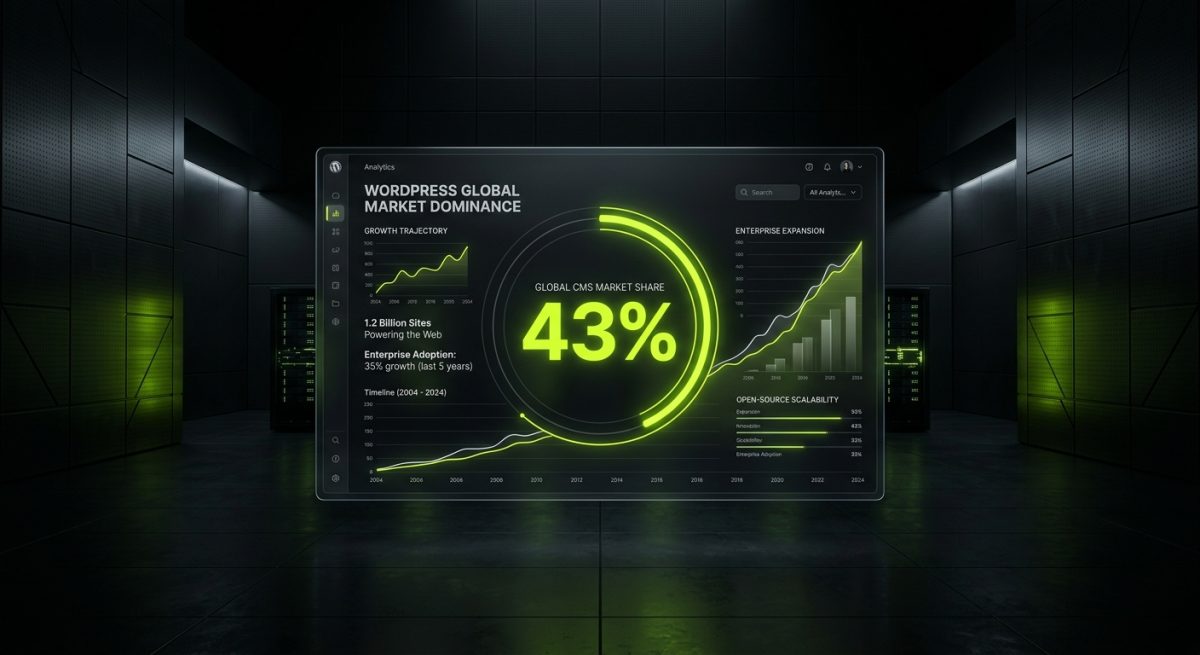
WordPress powers over 43% of all websites on the internet — a statistic that would have seemed absurd when Matt Mullenweg and Mike Little launched it as a simple blogging platform in 2003. Two decades later, it remains not just relevant but dominant, outpacing competitors, surviving the rise of website builders, and expanding aggressively into enterprise territory. The question worth asking isn't whether WordPress is growing — it clearly is — but why it keeps growing in a market that has never been more crowded or competitive.
The Open-Source Advantage Is Still Unmatched
At the core of WordPress's resilience is something no proprietary platform can replicate: a truly open-source ecosystem governed by the GPL license. This isn't just a philosophical position — it has direct, compounding business consequences that explain why agencies, developers, and enterprises continue to bet on WordPress year after year.
No Vendor Lock-In
Proprietory platforms like Squarespace, Wix, or even Webflow operate on a subscription model where your site's infrastructure, hosting, and often your data are tied to their ecosystem. If pricing changes, if a feature disappears, or if the company pivots or shuts down, you have limited recourse. WordPress eliminates that risk entirely. The codebase is yours. The database is yours. You can migrate to any hosting provider, fork the code, or hire any developer in the world to work on your installation.
For B2B clients — especially those managing multi-site networks, high-traffic publishing platforms, or complex e-commerce operations — this flexibility is not a nice-to-have. It's a procurement requirement.
The Contributor Economy
The WordPress open-source project is maintained by thousands of contributors across the globe, coordinated through WordPress.org and the various Make WordPress teams. This means:
- Security patches are released rapidly because the community has financial skin in the game
- Core features are developed based on real-world use cases from millions of active installations
- Plugin and theme APIs are documented, stable, and backward-compatible in ways that commercial platforms rarely match
According to State of the Word 2023, over 1,000 contributors submitted code to WordPress Core in a single year. No internal engineering team at a SaaS company can match that throughput, and no SaaS company would fund it at the same scale without charging for access.
GPL Licensing Drives Commercial Innovation
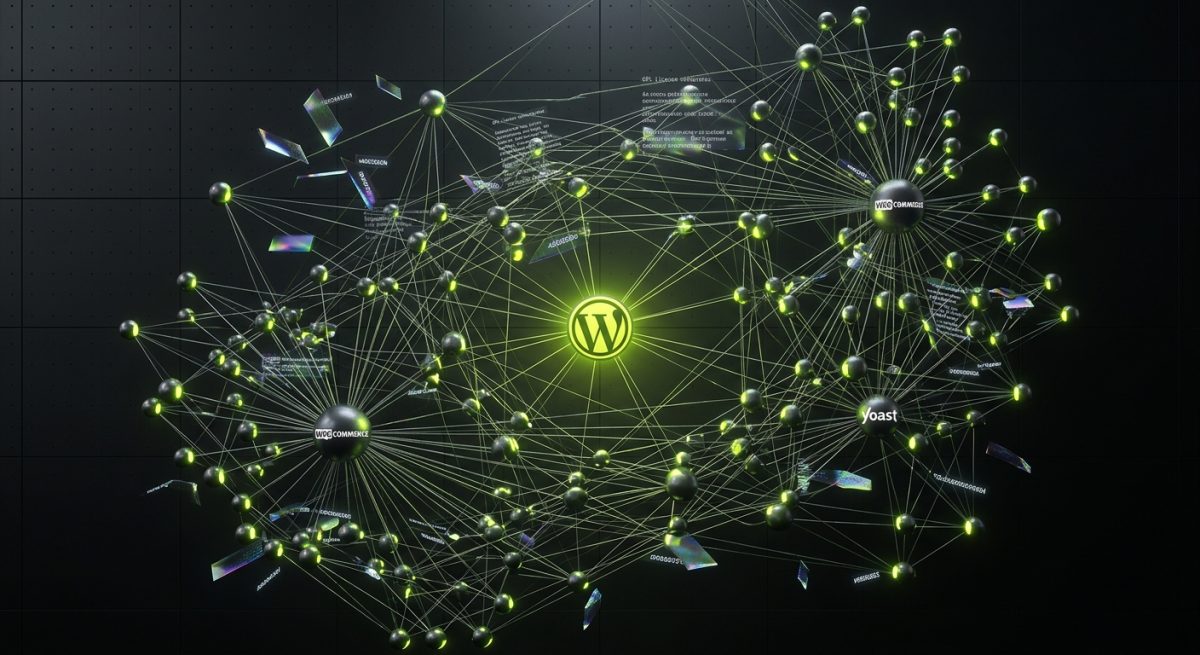
A common misconception is that open source means free-as-in-free-lunch. In reality, the GPL license has created a multi-billion dollar commercial ecosystem. Companies like WooCommerce (acquired by Automattic), Yoast (acquired by Newfold Digital), and Advanced Custom Fields (acquired by WP Engine) have built substantial businesses on top of WordPress's open foundation. Premium plugins, managed hosting, support contracts, and custom development services all exist because the platform itself is free — lowering the barrier to adoption while creating enormous demand for expertise.
For agencies like werun.dev, this means clients arrive with lower initial resistance to the platform and a higher willingness to invest in custom development, performance optimization, and ongoing maintenance.
WordPress's Architecture Has Evolved Without Breaking the Ecosystem
One of the most technically impressive things about WordPress is that it has undergone fundamental architectural changes — the block editor (Gutenberg), the Site Editor (Full Site Editing), and the REST API — without breaking the millions of existing sites running on older paradigms. This backward compatibility is not accidental. It's a deliberate engineering philosophy that has massive implications for enterprise adoption.
The Block Editor Maturation Curve
When Gutenberg launched in WordPress 5.0 (December 2018), the developer community's reaction was mixed at best. Performance was inconsistent, third-party plugin compatibility was rocky, and the learning curve for content editors was steeper than Classic Editor. Five years later, the picture looks dramatically different.
The block editor now supports:
- Block patterns — reusable layout compositions that give content teams design flexibility without developer intervention
- Block themes — theme.json-driven design systems that replace fragile PHP template hierarchies with a structured, version-controllable configuration layer
- Block locking — granular control over which blocks clients can edit, delete, or move, giving agencies precise control over design integrity
Here's a simplified example of how theme.json defines typography at the global level:
{
  "version": 2,
  "settings": {
    "typography": {
      "fontFamilies": [
        {
          "fontFamily": "Inter, sans-serif",
          "name": "Inter",
          "slug": "inter"
        }
      ],
      "fontSizes": [
        { "slug": "small", "size": "14px", "name": "Small" },
        { "slug": "medium", "size": "18px", "name": "Medium" },
        { "slug": "large", "size": "28px", "name": "Large" }
      ]
    }
  }
}
This approach brings WordPress closer to the design-token systems used in enterprise design systems, making it easier to maintain visual consistency across large multi-editor teams.
The REST API and Headless WordPress
The WordPress REST API, now a stable core feature, has opened an entirely new category of use cases: headless WordPress. In a headless setup, WordPress functions purely as a content management backend — handling authentication, content modeling, media management, and editorial workflows — while the front end is built with a modern JavaScript framework like Next.js, Nuxt, or Astro.
This architecture allows teams to:
- Decouple performance from the WordPress PHP rendering layer
- Reuse content across web, mobile, and third-party integrations via a single API
- Leverage WordPress's editorial UX without inheriting its front-end constraints
Platforms like WPGraphQL have taken this further by adding a GraphQL layer on top of the REST API, enabling precise, efficient data fetching that REST alone can't match. The result is that WordPress can now compete directly with headless CMS platforms like Contentful or Sanity — while retaining the advantage of a familiar editorial interface that non-technical stakeholders already know how to use.
Plugin Ecosystem Depth
As of 2024, WordPress.org hosts over 59,000 free plugins, with thousands more available commercially. This isn't just quantity — it's functional depth across categories that no other CMS can match:
- E-commerce: WooCommerce, Easy Digital Downloads
- SEO: Yoast SEO, Rank Math, The SEO Framework
- Performance: WP Rocket, Perfmatters, NitroPack
- Security: Wordfence, Sucuri, iThemes Security
- Membership and LMS: MemberPress, LearnDash, LifterLMS
For B2B clients evaluating platforms, this depth translates directly into lower custom development costs and faster time-to-market for complex functionality.
Enterprise Adoption Is Accelerating, Not Slowing

The narrative that WordPress is a "small business platform" has been obsolete for years. The enterprise segment is now one of the fastest-growing areas of the WordPress ecosystem, driven by VIP hosting, advanced security tooling, and the platform's ability to handle genuinely complex content operations at scale.
WordPress VIP and the Enterprise Infrastructure Play
WordPress VIP — Automattic's enterprise hosting and application platform — counts clients like Meta, Salesforce, CNN, and The New York Times among its customers. These aren't organizations that chose WordPress because it was cheap or convenient. They chose it because it could handle their specific requirements: high-concurrency traffic, complex editorial workflows, multi-language content operations, and deep integration with enterprise data systems.
WordPress VIP provides:
- 99.99% uptime SLAs backed by a global CDN infrastructure
- Dedicated security teams performing continuous vulnerability monitoring
- Code review pipelines that enforce quality standards before deployment
- Multisite network management for organizations running dozens or hundreds of properties
The existence of this tier confirms something important: WordPress's architecture is not a ceiling. With the right infrastructure and engineering investment, it scales to meet demands that would challenge any platform.
Gutenberg's Role in Enterprise Content Operations
Large organizations — media companies, global brands, higher education institutions — face a specific content operations problem: how do you give hundreds of editors the freedom to create compelling content while maintaining brand consistency and preventing layout chaos?
Gutenberg's block locking, role-based editor access, and pattern library system address this problem directly. An enterprise can define a set of approved block patterns, lock the structural blocks that define page architecture, and give editors freedom only within those guardrails. This is a governance model, not just a design system — and it's one that enterprise content teams have been asking for since the Classic Editor era.
The Multisite Advantage for Global Organizations
WordPress Multisite allows a single WordPress installation to power a network of distinct websites, each with its own domain, content, and user base, all managed from a single admin dashboard. For global organizations managing regional sites, franchise networks, or multi-brand portfolios, this architecture reduces:
- Infrastructure costs by consolidating hosting and maintenance
- Development overhead by sharing themes, plugins, and core updates across the network
- Administrative complexity by centralizing user management and security policies
No other open-source CMS offers Multisite with the same level of maturity, plugin compatibility, and hosting support that WordPress provides. This feature alone is a decisive factor for enterprise procurement teams evaluating CMS platforms at scale.
The growth of WordPress, then, is not a mystery or a market anomaly. It's the predictable outcome of a platform that has consistently solved real problems — for solo bloggers, for mid-market businesses, and for global enterprises — without forcing any of them to compromise on ownership, flexibility, or cost structure. The technical foundation has deepened, the ecosystem has matured, and the enterprise tooling has caught up with the ambitions of the organizations that rely on it.