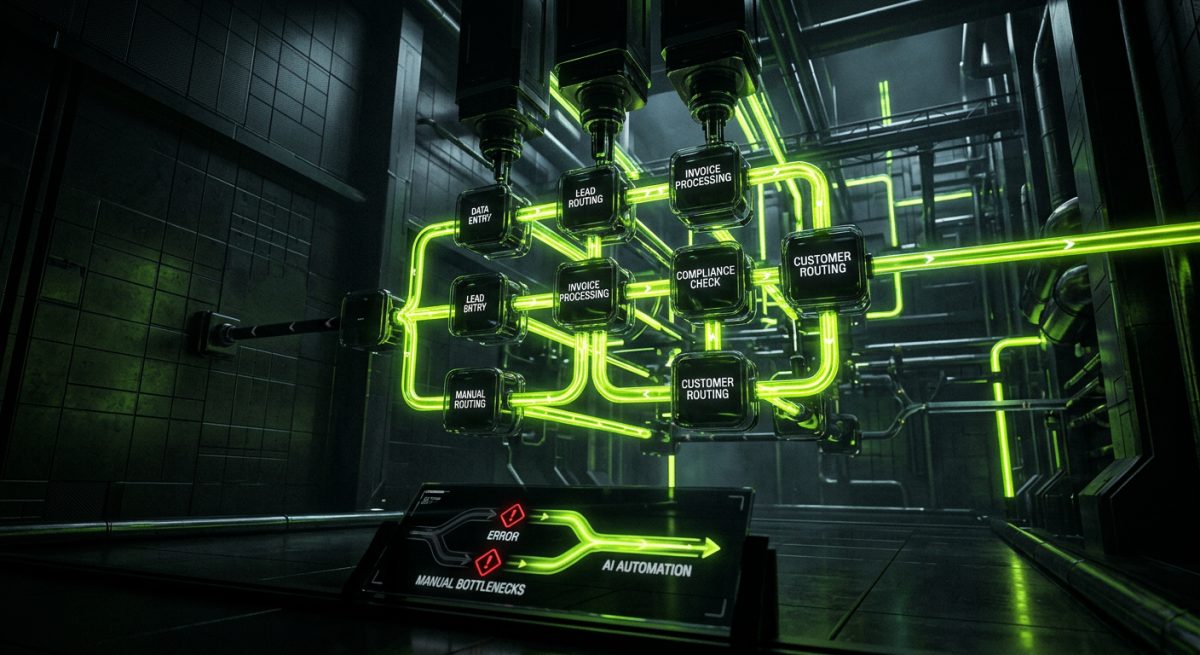
The Hidden Cost of Manual Operations in Modern Business

Every business runs on processes — and for decades, those processes have been executed by people performing repetitive, rule-based tasks. Data entry, invoice processing, lead routing, content tagging, customer support triage, report generation. These tasks are not inherently complex, but they consume enormous amounts of human time, introduce error rates that compound over months, and create bottlenecks that slow down every team they touch.
The financial toll is more significant than most organizations acknowledge. According to McKinsey, knowledge workers spend approximately 60% of their time on work about work — tasks like gathering information, chasing approvals, formatting data, and coordinating handoffs — rather than on the skilled work they were hired to do. When you multiply that across a team of 20, 50, or 500 people, the operational drag becomes a structural liability.
Beyond direct labor costs, manual workflows carry hidden expenses that rarely appear on a single line item:
- Error correction overhead: Human error rates in data entry average between 1% and 4%. At scale, that means thousands of records requiring manual review and remediation.
- Latency in decision pipelines: When a sales lead sits in an inbox for four hours before being routed, conversion probability drops measurably. Manual handoffs introduce lag at every stage.
- Institutional knowledge risk: When a process lives in someone's head or in an undocumented spreadsheet, employee turnover becomes an operational crisis.
- Compliance exposure: In regulated industries, inconsistent manual execution of compliance checks creates audit vulnerabilities that carry real financial penalties.
The emergence of AI-powered workflow automation directly addresses these failure points — not by replacing human judgment where it matters, but by removing humans from tasks where judgment is not required. The distinction is important. AI workflows are not about headcount reduction as a primary goal. They are about redeploying human capacity toward work that actually requires human intelligence.
What Makes AI Workflows Different from Traditional Automation
Rule-based automation tools — robotic process automation (RPA), scheduled scripts, conditional logic in CRMs — have existed for years. The limitation has always been brittleness. Traditional automation breaks when inputs deviate from expected formats, when edge cases appear, or when upstream systems change. Maintaining rule-based automation at scale requires significant engineering effort and produces fragile systems that need constant patching.
AI workflows operate differently. Large language models and machine learning classifiers can handle ambiguous inputs, infer intent from unstructured data, and adapt to variation without requiring explicit rule updates. A traditional automation might fail when an invoice arrives in a slightly different format. An AI workflow reads the invoice, extracts the relevant fields, flags anomalies, and routes it correctly — regardless of formatting variation.
This resilience is what makes AI workflows viable for the kinds of messy, real-world processes that traditional automation could never reliably handle. It is also what is driving enterprise adoption at a pace that has surprised even optimistic forecasters.
Where AI Workflow Automation Is Delivering Measurable ROI
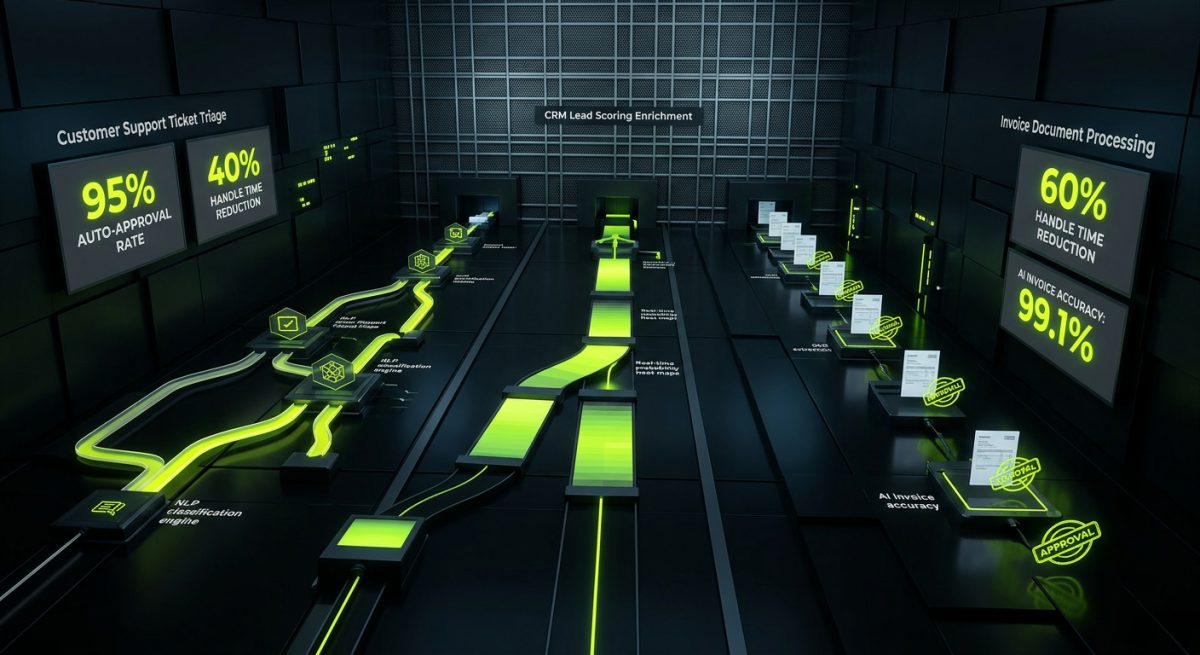
The business case for AI workflow automation is no longer theoretical. Across industries, organizations are documenting specific, quantifiable returns from replacing manual processes with intelligent automation pipelines. The most compelling implementations share a common characteristic: they target high-frequency, high-volume processes where even marginal efficiency gains compound into significant annual savings.
Customer Support and Ticket Triage
Support operations are among the highest-impact targets for AI workflow automation. The typical support workflow involves a human agent reading an incoming ticket, classifying the issue, determining urgency, routing it to the appropriate team, and drafting an initial response — all before any actual resolution work begins. For high-volume support organizations, this intake process alone can consume hundreds of agent-hours per week.
AI workflows can handle the entire intake layer autonomously:
- Classification: Categorize tickets by issue type, product area, and sentiment using NLP models trained on historical ticket data.
- Priority scoring: Assign urgency scores based on customer tier, issue type, and language indicators of frustration or escalation risk.
- Routing: Deliver tickets directly to the correct queue or agent based on classification output.
- Draft generation: Produce an initial response draft that the agent reviews and sends, rather than writing from scratch.
Organizations implementing this pattern consistently report 40–60% reductions in average handle time for tier-1 support, with customer satisfaction scores holding steady or improving due to faster initial response times.
Sales and Marketing Operations
Revenue operations teams are drowning in manual data work. CRM hygiene — keeping contact records accurate, enriched, and properly segmented — is a full-time job at most mid-market companies. Lead scoring models require constant recalibration. Campaign performance data lives in disconnected platforms that someone has to manually reconcile into a coherent picture.
AI workflow integrations are replacing these manual RevOps tasks with continuous, automated pipelines:
- Automated CRM enrichment: Pulling firmographic and technographic data from external sources and updating contact records without human intervention.
- Dynamic lead scoring: Models that re-score leads in real time as behavioral signals accumulate, rather than relying on static point systems updated quarterly.
- Cross-platform reporting synthesis: AI agents that pull data from ad platforms, analytics tools, and CRMs, then generate structured performance summaries on a defined cadence.
The downstream effect is that revenue teams spend less time on data work and more time on pipeline development and relationship management — the activities that actually drive revenue.
Document Processing and Back-Office Operations
Finance, legal, and operations teams process enormous volumes of structured and semi-structured documents: contracts, invoices, purchase orders, compliance filings, onboarding forms. Extracting data from these documents, validating it against internal records, and routing it through approval workflows has historically required significant manual effort.
Modern AI document processing pipelines — built on models capable of handling varied document layouts and extracting semantic meaning, not just pattern-matched fields — can process thousands of documents per hour with accuracy rates that exceed manual processing. More importantly, they can flag exceptions for human review rather than requiring humans to review everything.
A practical implementation might look like this:
Incoming invoice → OCR extraction layer →
AI field validation (vendor match, amount range check, PO reconciliation) →
Exception flagging →
Auto-approve (within threshold) or route to human reviewer →
ERP entry
This architecture means human reviewers only see the 5–10% of invoices that require judgment. The other 90–95% move through the pipeline without touching a human queue.
How to Evaluate and Implement AI Workflows in Your Organization
Adoption of AI workflow automation fails most often not because the technology is inadequate, but because organizations select the wrong processes to automate first, underestimate integration complexity, or deploy without adequate change management. A structured evaluation framework prevents these failure modes.
Process Selection Criteria
Not every manual task is a good candidate for AI automation. The highest-ROI targets share specific characteristics:
High frequency: Processes that run hundreds or thousands of times per month generate more return from automation than processes that run weekly. Prioritize volume.
Rule-describable logic: Even if the process handles variation, it should have a describable decision logic. If the criteria for a decision cannot be articulated, training an AI model to replicate it is significantly harder.
Measurable outcomes: Automation ROI requires baseline measurement. If you cannot measure the current process — time per execution, error rate, cost per transaction — you cannot demonstrate improvement.
Tolerance for imperfection: AI workflows are not 100% accurate. Processes where errors are costly and difficult to catch downstream are poor candidates for full automation. Processes where errors are easily detected and low-cost to correct are better starting points.
Integration Architecture Considerations
AI workflows do not operate in isolation. They connect to existing systems — CRMs, ERPs, support platforms, document management systems — and the quality of those integrations determines whether the automation is reliable in production.
Key integration decisions include:
- Trigger design: What event initiates the workflow? Webhook from an upstream system, scheduled polling, or user-initiated action? Each has different reliability and latency characteristics.
- Data validation layers: AI model outputs should pass through validation logic before writing to production systems. Confidence thresholds, format checks, and anomaly detection prevent bad data from propagating.
- Human-in-the-loop design: Define explicitly which conditions route to human review. This is not a failure mode — it is a design feature that makes the system trustworthy.
- Observability: Log every workflow execution with enough detail to audit outcomes, diagnose failures, and retrain models on edge cases.
Tooling Landscape
The current tooling ecosystem for AI workflow automation spans a wide range of complexity and capability:
- No-code/low-code platforms (Zapier, Make, n8n): Suitable for straightforward automation with AI steps inserted via API calls. Good for rapid prototyping and simpler use cases.
- AI-native workflow platforms (Relevance AI, Voiceflow, Botpress): Built specifically for AI agent workflows, with better support for multi-step reasoning and tool use.
- Custom implementations: For complex, high-volume, or compliance-sensitive workflows, custom-built pipelines using LLM APIs (OpenAI, Anthropic, Gemini) with purpose-built orchestration logic often deliver better performance and auditability than platform-dependent solutions.
The right choice depends on process complexity, volume requirements, integration depth, and internal engineering capacity. Organizations without dedicated engineering resources often start with platform-based tools and migrate to custom implementations as workflows mature and requirements become clearer.
Change Management and Team Adoption
The technical implementation of an AI workflow is often the easier part. The harder challenge is organizational: helping teams understand what the automation does, trust its outputs, and adapt their work patterns around it.
Effective change management for AI workflow deployment includes:
- Transparent communication about scope: Be explicit that the automation handles intake, routing, or drafting — and that human judgment remains in the loop for decisions that matter.
- Gradual rollout with parallel running: Run the AI workflow in parallel with the manual process for a defined period, comparing outputs before cutting over fully.
- Feedback mechanisms: Give team members a direct channel to flag workflow errors. This data is valuable for model improvement and builds trust by demonstrating that feedback is acted upon.
- Outcome visibility: Share performance data with the teams affected. When people can see that the automation is processing 800 invoices per day with a 96% accuracy rate, confidence in the system grows organically.
Organizations that treat AI workflow implementation as a technology project alone consistently underperform compared to those that treat it as an operational change initiative with technology as the enabling layer.