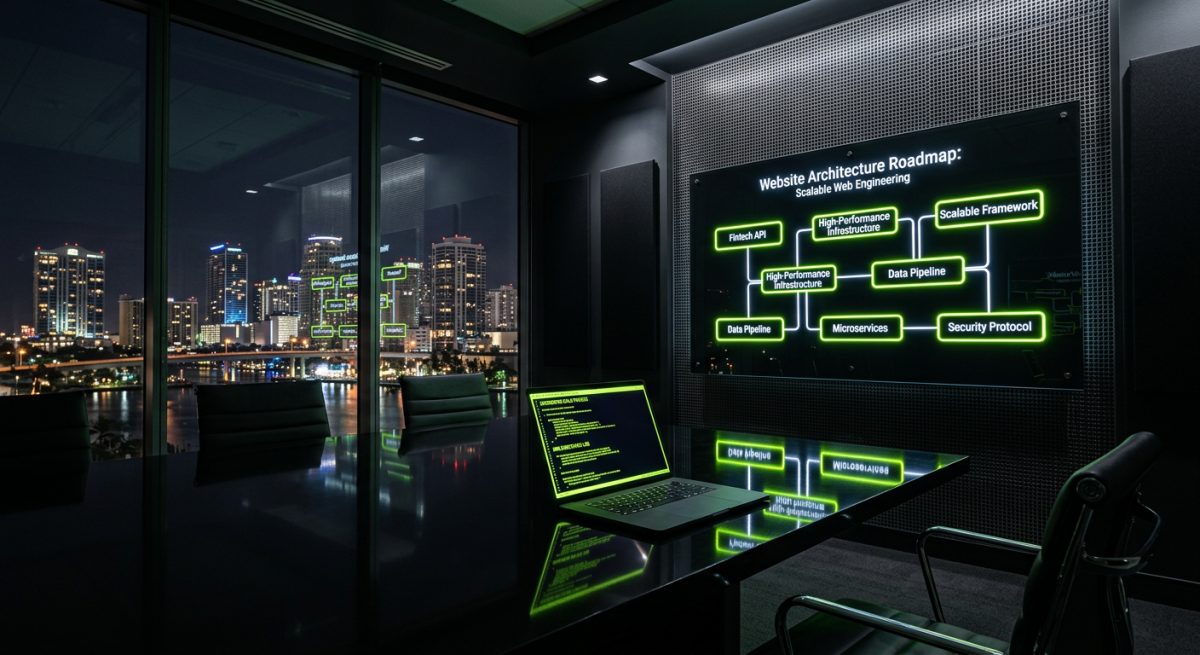
Fort Lauderdale's business landscape has shifted decisively toward digital-first operations. From the marine industry corridor along the 17th Street Causeway to the fintech startups clustering around downtown Las Olas, companies in Broward County are no longer asking whether they need a high-performance website — they're asking who can build one that actually delivers results. The answer isn't a freelancer running WordPress themes from a template library. It's a team with deep platform expertise, a documented build process, and the infrastructure to maintain what they ship.
This post breaks down what modern web development actually requires in 2025, which platform decisions matter most for South Florida businesses, and how werun.dev delivers the kind of technical depth that separates a website that performs from one that merely exists.
What Modern Web Development Actually Requires in 2025
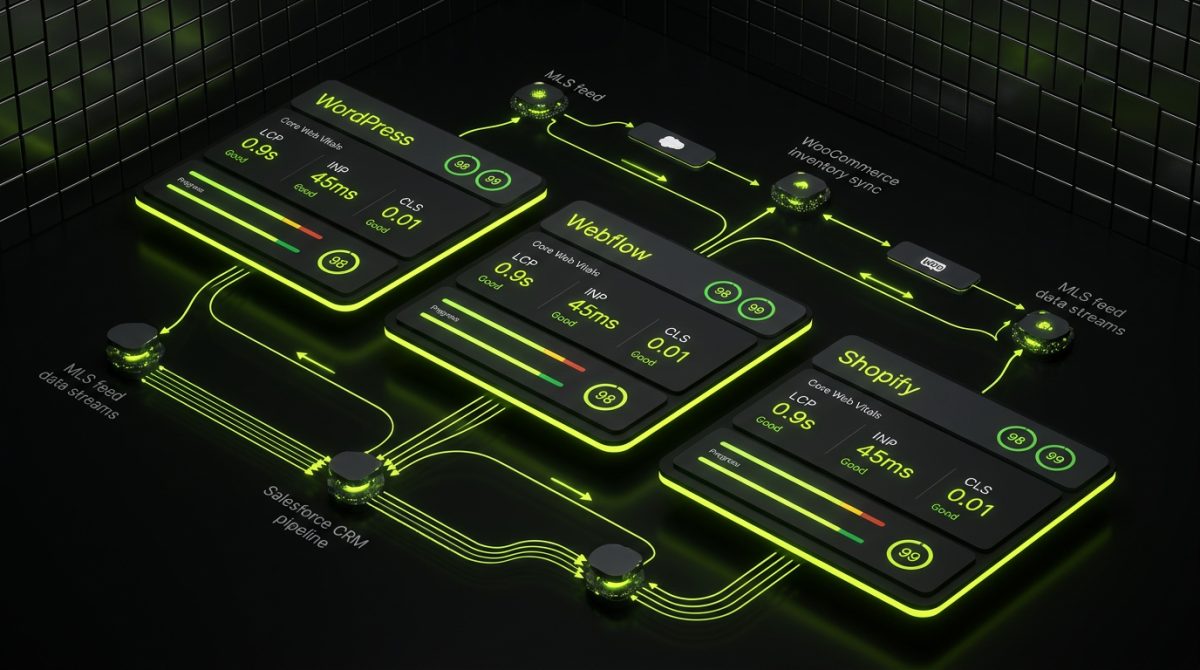
The phrase "modern website" gets thrown around constantly, but it has a precise technical meaning that most agencies gloss over. A modern website in 2025 is not just one with a fresh visual design. It's a system — one that scores consistently on Core Web Vitals, integrates cleanly with your CRM and marketing stack, handles real transaction volume without breaking, and can be extended by developers months or years after launch without a full rebuild.
For Fort Lauderdale businesses competing regionally and nationally, this distinction matters enormously. A luxury real estate firm in Coral Ridge needs a site that loads instantly on mobile, syncs property listings from an MLS feed, and captures leads directly into Salesforce. A marine equipment distributor in Dania Beach needs a WooCommerce store with custom pricing rules for wholesale buyers, connected to their ERP for inventory sync. A SaaS startup in Fort Lauderdale's emerging tech corridor needs a Webflow marketing site that their growth team can edit without touching code, backed by a CMS architecture that doesn't collapse under scale.
None of these are achievable with off-the-shelf themes and drag-and-drop builders used at surface level. They require platform expertise — knowing not just how to use WordPress, Webflow, or Shopify, but how to extend them at the architecture level.
The Three Platforms That Actually Matter
At werun.dev, the technology stack is deliberately focused. After 12+ years building on the web, the team operates across three platforms that cover the full spectrum of modern business needs:
- WordPress — for businesses that need custom functionality, complex content architectures, or WooCommerce ecosystems with real transaction volume
- Webflow — for marketing-driven organizations that need pixel-perfect design, editorial flexibility, and clean integrations without the overhead of a PHP codebase
- Shopify — for e-commerce operations that need a reliable, scalable storefront, from direct-to-consumer brands to Shopify Plus enterprise builds
This isn't a portfolio of convenience. It's a deliberate specialization. Each platform has a different ceiling, a different ideal use case, and a different set of failure modes. Knowing which one fits your business — and being honest when one doesn't — is itself a form of expertise.
Core Web Vitals Are Non-Negotiable
Google's Core Web Vitals — Largest Contentful Paint, Interaction to Next Paint, and Cumulative Layout Shift — are now direct ranking signals. For Fort Lauderdale businesses competing in local and regional search, a site that scores below 90 on PageSpeed Insights is actively costing you organic visibility.
Every build that leaves werun.dev is architected for performance from the ground up:
- Custom WordPress themes built from scratch with clean semantic HTML, no bloated page builders, and optimized asset loading
- Shopify themes built in Liquid using Online Store 2.0 JSON templates, with Core Web Vitals optimization baked into the architecture
- Webflow projects with scalable BEM-style class naming and GSAP interactions that don't compromise load times
Performance isn't a final checklist item. It's a constraint that shapes every technical decision made during the build.
WordPress Development: Beyond Themes and Plugins
WordPress powers a significant portion of the web, but the gap between a WordPress site built by someone who knows the platform and one assembled from third-party plugins is enormous. For Fort Lauderdale businesses with complex requirements — multi-location service companies, B2B portals, high-volume WooCommerce stores — that gap translates directly into security vulnerabilities, performance degradation, and technical debt that compounds over time.
werun.dev's WordPress development services are built around a single principle: build the parts that don't exist yet, and keep them running. That means custom plugin development to professional standards — proper hooks and filters, REST API endpoints with JWT or OAuth 2.0 authentication, Settings API admin UIs, WP Cron background jobs, and auto-update mechanisms via GitHub releases. Every plugin ships with documentation. Nothing is a black box.
Custom Plugin Development: The Right Way
Most agencies reach for an existing plugin when a client needs custom functionality. That approach works until it doesn't — when the plugin author abandons maintenance, when a security vulnerability surfaces in code you don't control, or when you need to extend functionality in a direction the plugin wasn't designed for.
The alternative is building the functionality directly, using WordPress APIs correctly:
// Example: Registering a custom REST API endpoint with proper authentication
add_action( 'rest_api_init', function() {
    register_rest_route( 'werun/v1', '/leads', [
        'methods'             => WP_REST_Server::CREATABLE,
        'callback'            => 'werun_handle_lead_submission',
        'permission_callback' => function( $request ) {
            return current_user_can( 'edit_posts' ) || werun_verify_api_key( $request );
        },
        'args' => [
            'email' => [
                'required'          => true,
                'sanitize_callback' => 'sanitize_email',
                'validate_callback' => function( $value ) {
                    return is_email( $value );
                },
            ],
        ],
    ]);
});
This is what professional WordPress development looks like — capability checks, sanitization, validation, proper REST namespace registration. Not a functions.php workaround.
WooCommerce Ecosystems for South Florida Commerce
For Fort Lauderdale retailers, distributors, and service businesses moving transactions online, WooCommerce remains the most extensible e-commerce layer available within WordPress. But "extensible" only delivers value when the extensions are built correctly.
werun.dev builds complete WooCommerce ecosystems:
- Custom product types and variations — for businesses selling configurable products, services with options, or digital goods with access control
- Custom checkout and cart flows — removing friction from the purchase path, adding B2B-specific logic like purchase order fields or account-based pricing
- Payment gateway integration — beyond Stripe and PayPal, including industry-specific processors common in marine, real estate, and hospitality sectors
- Subscription and recurring billing — for service businesses and SaaS products that need reliable recurring revenue infrastructure
- WooCommerce ↔ ERP/3PL sync — connecting your store to inventory management, fulfillment, and accounting systems via the WordPress REST API and webhook architecture
The result is a store that handles real transaction volume without the brittleness that comes from stacking incompatible plugins on top of each other.
Multisite for Multi-Location Businesses
Fort Lauderdale businesses with multiple locations, franchise networks, or agency clients managing dozens of sites benefit significantly from WordPress Multisite architecture. One codebase, centralized plugin management, shared user bases where appropriate, and the ability to push updates across the entire network simultaneously. werun.dev architects Multisite installations for agencies, SaaS products, and franchise operators that need this kind of scale without managing separate WordPress installations for each property.
Webflow and Shopify: The Right Tool for the Right Business
Not every Fort Lauderdale business needs WordPress. Part of delivering genuine value as a web development partner is being direct about which platform serves a given business model best — and having the expertise to execute at a high level on each one.
Webflow: For Marketing-Driven Organizations
Webflow has matured into a serious production platform for marketing sites, portfolio properties, and content-driven businesses that need editorial flexibility without a PHP backend. The key is understanding where Webflow excels and where it requires custom code extensions to reach its full potential.
werun.dev's Webflow development services go well beyond the Designer. The work includes:
- Design-to-Webflow production builds from Figma files, with scalable BEM-style class architecture that doesn't collapse when a content editor adds a new page six months post-launch
- CMS collection architecture designed for real editorial workflows — not just technically functional, but structured so that non-technical team members can add and update content without breaking the design
- Custom JavaScript and Webflow API integrations connecting the site to HubSpot, Airtable, Stripe, Memberstack, and other platforms in the business stack
- GSAP animations and interactions that deliver the motion design quality Fort Lauderdale's design-conscious industries — hospitality, luxury real estate, professional services — expect
- Membership and client portals built on Webflow with Memberstack or Outseta, including gated content, member dashboards, and custom JWT authentication flows
For businesses that have outgrown Webflow's native limitations, werun.dev also builds hybrid architectures — Webflow as the CMS and design layer, with a Next.js or Astro front-end handling the rendering. This approach gives marketing teams the editorial experience they want while giving engineers the performance and extensibility they need.
Ready to move your Fort Lauderdale business to a platform that performs? Start a project with werun.dev and get a technical assessment of which platform fits your requirements.
Shopify: For E-Commerce Operations Built to Scale
For Fort Lauderdale businesses with serious e-commerce operations — whether that's a direct-to-consumer brand, a B2B distributor, or a retailer migrating from WooCommerce or Magento — Shopify offers the most reliable foundation for scaling transaction volume without infrastructure headaches.
werun.dev's Shopify development services are built around custom Liquid theme development, not modified starter themes. The distinction matters:
- Online Store 2.0 architecture with JSON templates, Sections Everywhere, and app blocks — giving merchants the flexibility to customize page layouts without developer involvement
- Metafield and metaobject integration for complex product data that doesn't fit Shopify's default schema — technical specifications, size charts, compatibility matrices
- Shopify Plus enterprise builds for high-volume operations needing custom checkout extensibility, B2B wholesale portals, Shopify Flow automations, and multi-currency/multi-region configurations
- Store migrations from WooCommerce, Magento, and BigCommerce with zero data loss — products, customers, order history, and SEO equity preserved
- Private Shopify apps built with the Admin API and Storefront API, connecting the store to ERP, 3PL, CRM, and fulfillment platforms
For Fort Lauderdale's retail and distribution sector, the combination of a performant custom theme and reliable back-end integrations is what separates a Shopify store that converts from one that merely processes orders.
AI Automation: The Layer Most Agencies Aren't Building Yet
Modern web development increasingly includes the automation layer — the workflows that run between your website, your CRM, your support systems, and your internal operations. werun.dev's AI and automation services add this layer to web projects that need it:
- n8n workflow automation connecting form submissions, e-commerce events, and CRM updates without manual intervention
- AI chatbots and virtual agents powered by GPT-4 or Claude, trained on your content, embedded directly in WordPress or Webflow sites
- Knowledge-base chat with RAG — retrieval-augmented generation systems that give customers accurate answers from your documentation, product catalog, or support content
- Web scraping and data extraction pipelines for businesses that need competitive intelligence or aggregated data feeds
For a Fort Lauderdale marine equipment company, this might mean an AI agent that answers technical specification questions at 2am, synced to a product database updated by a nightly n8n workflow. For a real estate firm, it might mean a lead qualification bot that scores inbound inquiries and routes them to the right agent before a human ever touches the CRM.
Platform Selection, Integration Architecture, and Long-Term Maintenance
The most technically sophisticated website in Fort Lauderdale delivers zero business value if it breaks six months after launch, can't be updated without a full rebuild, or exists in isolation from the rest of the business's technology stack. Platform selection, integration architecture, and ongoing maintenance are not afterthoughts — they're the decisions that determine whether a web investment compounds over time or depreciates.
Choosing the Right Platform for Your Business Model
The platform decision should follow from business requirements, not from what the agency happens to know best. A structured evaluation looks at:
| Factor | WordPress | Webflow | Shopify |
|---|---|---|---|
| Custom functionality | Highest ceiling | Moderate (custom code) | App ecosystem + custom apps |
| Editorial flexibility | High (Gutenberg/FSE) | High (Designer + CMS) | Moderate (theme sections) |
| E-commerce depth | WooCommerce ecosystem | Limited native | Purpose-built |
| Developer extensibility | Maximum | Custom code + API | Liquid + APIs |
| Hosting control | Self-hosted or managed | Webflow hosting | Shopify infrastructure |
| Maintenance overhead | Higher | Lower | Lower |
For most Fort Lauderdale service businesses, professional firms, and content publishers, the choice comes down to WordPress versus Webflow. For retailers and product-based businesses, Shopify is almost always the right foundation. The nuance is in the details of each specific project.
Integration Architecture: Connecting Your Web Presence to Your Business Stack
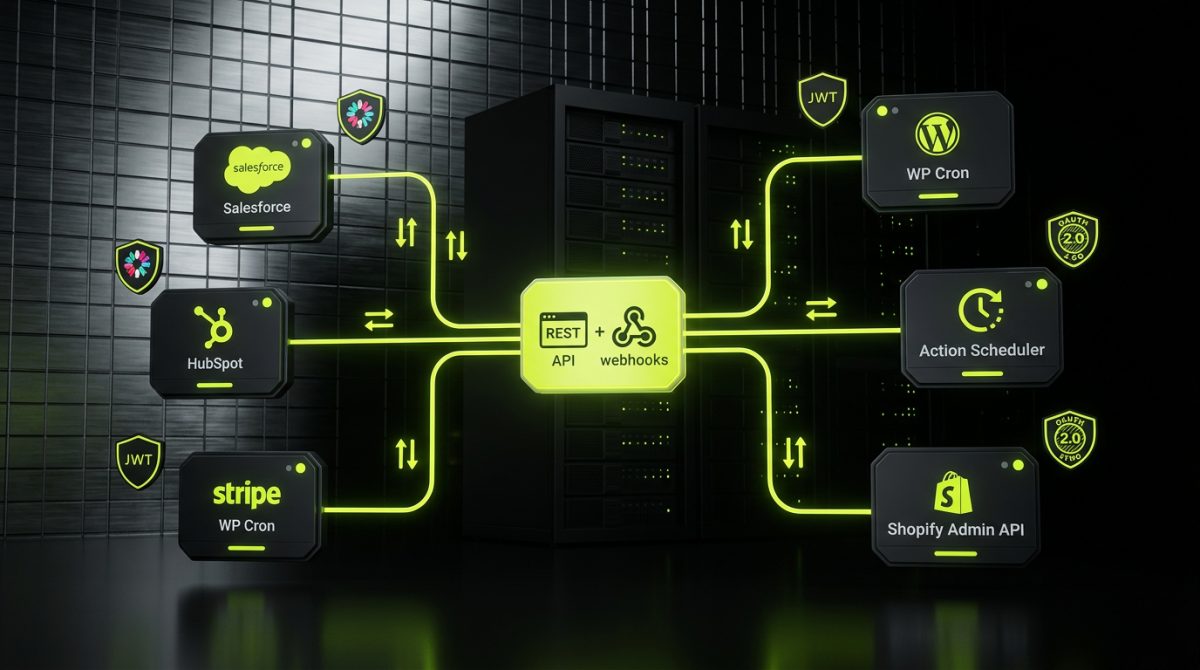
A website that doesn't communicate with your CRM, your ERP, your email platform, and your analytics infrastructure is a disconnected asset. werun.dev's integration services bridge that gap with:
- Custom REST API endpoints in WordPress with JWT and OAuth 2.0 authentication — properly rate-limited, documented, and versioned
- Webhook listeners with retry logic — so that when Stripe fires a payment event or HubSpot updates a contact record, your site processes it reliably, not just when conditions are perfect
- Background queue processing via WP Cron and Action Scheduler — eliminating timeout failures on long-running sync operations
- Bidirectional CRM sync with Salesforce, HubSpot, Pipedrive, and Zoho — connecting form submissions, WooCommerce customers, and user registrations to your sales pipeline automatically
For Fort Lauderdale businesses with complex operations — multi-location service companies, wholesale distributors, professional services firms with CRM-driven workflows — this integration layer is often where the most significant efficiency gains are found.
The Case for Long-Term Maintenance Retainers
WordPress core, plugins, and themes release updates continuously. Shopify's API versioning requires periodic theme updates. Webflow's platform evolves. Security vulnerabilities surface. Without a structured maintenance program, a website that launched in excellent condition degrades predictably.
werun.dev maintains 200+ sites on monthly retainers — covering:
- Core, plugin, and theme updates with regression testing before deployment
- Security hardening and malware monitoring
- Performance monitoring and optimization
- Ongoing feature development and content support
- Priority response for critical issues
For Fort Lauderdale businesses that have invested in a properly built website, a maintenance retainer is the mechanism that protects that investment. It's also the model that allows werun.dev to know each client's codebase deeply — so when a new feature is needed, it's built by engineers who understand the existing architecture, not handed off to someone starting from scratch.
What to Look for in a Fort Lauderdale Web Development Partner
The South Florida market has no shortage of web development options — from solo freelancers to large digital agencies with broad service menus. Evaluating them requires asking the right questions:
- Do they specialize in the platform your project requires, or do they build on everything? Generalism at the agency level usually means junior execution at the project level.
- Can they show you code they've shipped? Not just screenshots of finished sites — actual plugins, themes, or custom components with documentation.
- Do they have a maintenance model? Agencies that only do project work have no incentive to build for long-term maintainability.
- How do they handle integrations? If the answer is "we use Zapier for everything," that's a ceiling that will limit your stack as you scale.
- Do they understand your industry? A developer who has built for Fort Lauderdale's marine, real estate, hospitality, or professional services sectors brings context that accelerates every decision in the project.
werun.dev's 12+ years of WordPress development, 80+ custom plugins shipped, and 200+ sites under active maintenance represent a track record that answers these questions directly. The work is documented, the code is maintainable, and the team is structured for long-term client relationships — not one-time launches.