
Architectural Integrity and CMS Governance
Enterprise-grade Webflow development begins long before the first div block is placed in the Designer. At werun.dev, we treat Webflow as a production-grade software environment rather than a simple visual builder. The foundation of any scalable B2B site is a robust architectural framework, typically utilizing BEM (Block Element Modifier) or a standardized system like Finsweet’s Client-First. This ensures that as a company grows from a 10-page marketing site to a 500-page enterprise portal, the CSS remains maintainable, the class naming stays intuitive, and the technical debt is non-existent. Without this rigid structure, enterprise sites quickly become unmanageable, leading to inconsistent branding and slow loading times that frustrate potential B2B leads.
When we talk about "pixel-perfect" builds from Figma, we aren't just referring to visual alignment. We are referring to the underlying DOM structure. Clean, semantic HTML is non-negotiable for accessibility (A11Y) and SEO. In a B2B context, where procurement managers and directors are the primary users, the site must perform flawlessly across all devices and assistive technologies. This level of precision requires a deep understanding of CSS Grid, Flexbox, and responsive typography systems that scale fluidly without breaking the layout. We prioritize a "mobile-first, desktop-optimized" approach that ensures the user experience is consistent regardless of the hardware being used.
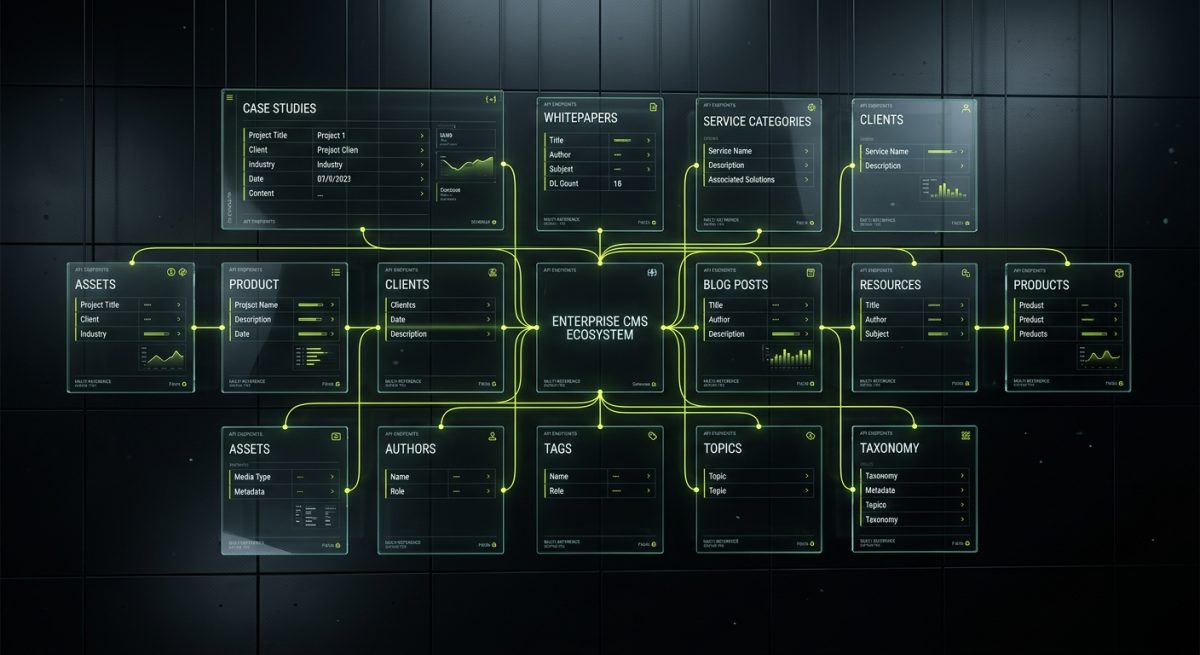
The CMS architecture is where most Webflow sites either succeed or fail at scale. An enterprise CMS must be built for real editorial workflows. We don't just create generic collections; we architect relational databases within Webflow that allow for complex content associations. For example, a B2B service page might need to pull dynamic case studies, related whitepapers, and specific consultant profiles based on the service category. By using multi-reference fields and carefully planned collection structures, we empower marketing teams to launch new landing pages in minutes using pre-built components and CMS data, rather than waiting for a developer to manually assemble a new page. This speed-to-market is a critical competitive advantage in the fast-moving B2B landscape.
Furthermore, we implement strict CMS governance. This includes setting up character limits, required fields, and instructional text within the Webflow Editor. We recognize that our clients are often managing large teams; therefore, the interface they use to update the site must be foolproof. Our handoff process includes comprehensive training and documentation, ensuring that the editorial team understands the logic behind the scalable class architecture we’ve implemented. This prevents the "class soup" that often plagues amateur Webflow builds and ensures the site remains fast and performant for years to come. By treating the CMS as a structured database rather than a simple blog tool, we provide a level of flexibility that traditional builders cannot match.
Beyond the Designer: Custom Code and API Integrations

Webflow’s native features are powerful, but for an enterprise-level B2B operation, they are often just the starting point. At werun.dev, we specialize in "Webflow beyond the Designer." This means extending the platform’s capabilities with custom JavaScript, advanced API integrations, and third-party logic that connects the website to the broader business stack. Whether it’s a custom-built calculator for a FinTech firm or a complex filtering system for a global real estate portfolio, we use custom code to bridge the gap between no-code and pro-code. This allows us to deliver the ease of use of Webflow with the power of a bespoke software application.
One of the most critical aspects of enterprise Webflow solutions is the integration with CRM and ERP systems. A B2B site is a lead generation engine, and that engine needs to feed data directly into platforms like Salesforce, HubSpot, or Pipedrive. While tools like Zapier or Make are excellent for simple triggers, we often develop custom middleware or use Webflow’s Logic and API to handle high-volume data transfers with sophisticated error handling. This ensures that every lead captured on a custom-built form is sanitized, validated, and correctly attributed before it ever hits the sales team’s dashboard. Reliability in data transmission is paramount when dealing with high-value B2B contracts.
Consider the implementation of advanced animations and user interactions. While Webflow’s native Interactions 2.0 is capable, enterprise sites often require the performance and precision of GSAP (GreenSock Animation Platform). We integrate GSAP to handle complex, scroll-triggered sequences that remain performant even on mobile devices. This isn't just about visual flair; it's about guiding the user through a narrative, highlighting key value propositions, and reducing bounce rates through a more engaging UI. By offloading heavy interactions to specialized libraries, we maintain high Core Web Vitals scores while delivering a premium feel.
Technical Example: Custom API Data Sync
To illustrate the power of custom integrations, consider a scenario where a Webflow site needs to display real-time inventory or service availability from an external ERP. We implement custom JavaScript to fetch and render this data dynamically, ensuring the site is always accurate without manual updates.
// Example of a custom API integration for dynamic data loading
async function fetchEnterpriseData(endpoint) {
  const response = await fetch(`https://api.werun.dev/v1/${endpoint}`, {
    method: 'GET',
    headers: {
      'Authorization': 'Bearer YOUR_TOKEN',
      'Content-Type': 'application/json'
    }
  });
  if (!response.ok) {
    console.error('Data sync failed: Check API status');
    return;
  }
  const data = await response.json();
  // Logic to map data to Webflow DOM elements
  renderToWebflowCMS(data);
}
Beyond simple data fetching, we build entire ecosystems around Webflow. This includes membership portals and client dashboards using tools like Memberstack or Outseta, or even custom JWT (JSON Web Token) authentication for gated content. For businesses that need to move beyond Webflow’s hosting limitations while keeping the visual editing experience, we even offer "Webflow to Next.js" or "Webflow to Astro" pipelines. This allow the marketing team to continue using the Webflow Designer while the developers deploy a lightning-fast, headless front-end that can handle millions of concurrent visitors and complex server-side logic.
Operations, Security, and Long-term Maintenance
The "werun" philosophy—"We don't launch projects, we run them"—is particularly relevant for Webflow. Many agencies deliver a site and disappear, leaving the client to deal with platform updates, SEO regressions, or broken integrations. At werun.dev, we view the launch as Day 1 of a multi-year partnership. Enterprise sites require proactive maintenance to ensure they continue to meet Core Web Vitals standards and align with evolving business goals. Our role is to ensure that your digital asset never becomes obsolete or technically stagnant.
Our maintenance retainers are designed for businesses that cannot afford downtime. With a response SLA of less than 4 hours, our clients know that any technical issue—from a broken webhook to a CMS sync error—will be addressed immediately. This is critical for B2B companies where a site being offline or a lead form not working translates directly into lost revenue. We provide monthly performance audits, security hardening for third-party scripts, and continuous optimization of the user experience based on real-world data and heatmaps. We don't wait for things to break; we optimize them before they do.
Maintenance also involves the constant evolution of the site. As a B2B company scales, its website must scale with it. This might mean adding new language versions using Weglot or Webflow's native localization features, or expanding the site to include a B2B wholesale portal. Because we build with a scalable class architecture from the start, adding new sections or features is a streamlined process. We don't have to "hack" the existing code; we simply extend the system we’ve already built. This modularity ensures that the cost of adding new features remains predictable and the code remains clean.
Furthermore, we integrate our AI & Automation expertise into the ongoing operation of the site. Using n8n workflows, we can automate content updates, monitor for broken links, or even use AI agents to analyze user behavior and suggest layout improvements. This proactive approach ensures that the Webflow site isn't just a static brochure, but a dynamic asset that is constantly being refined for better conversion rates. We track performance metrics such as Page Speed Insights and Core Web Vitals religiously, ensuring that every update we push maintains the high standards required for enterprise visibility in search engines. Our goal is to provide a worry-free technical environment where your marketing team can focus on strategy while we handle the execution.