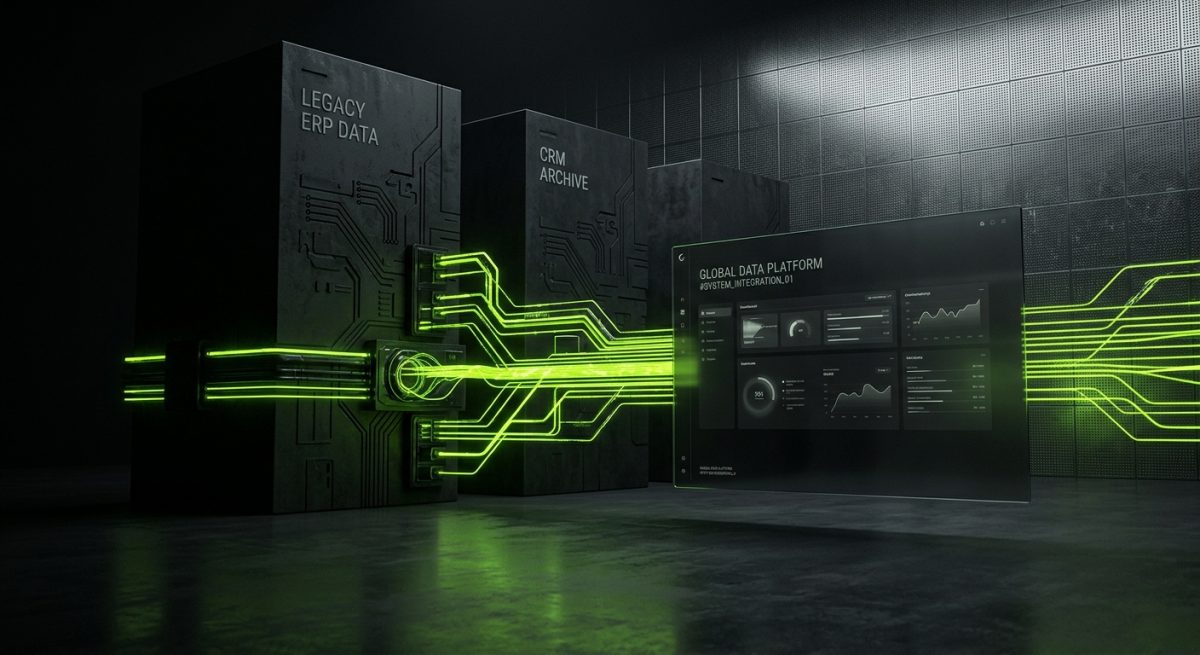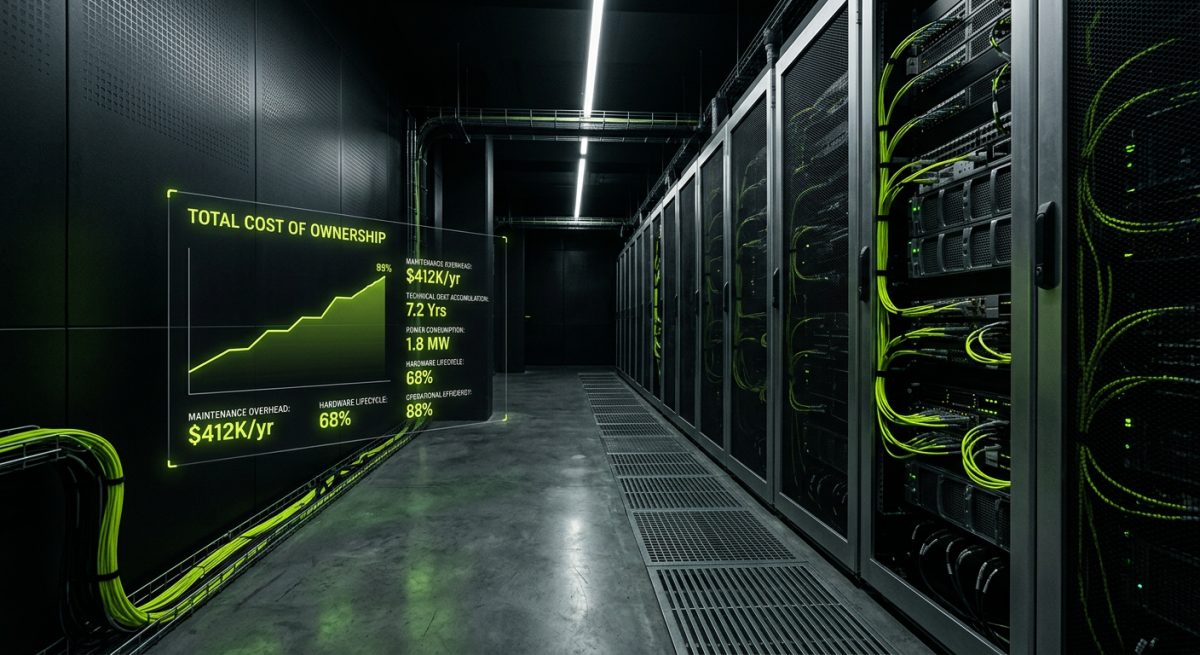
When a business chooses a web platform, the decision is almost always framed around the build cost. How much does it cost to launch a WordPress site? What does a Webflow project run? How expensive is a custom Shopify theme? These are legitimate questions, but they represent only the surface of the total cost of ownership. The real financial weight of any web platform accumulates over time — through hosting infrastructure, ongoing maintenance, security obligations, and the compounding cost of technical debt that quietly grows every month a site runs without proper stewardship.
This post breaks down the true cost structure of WordPress, Webflow, and Shopify — not to declare a winner, but to give decision-makers an honest picture of what they are committing to when they choose a platform.
Hosting Costs: What You Pay vs. What You Actually Need
Hosting is the most visible recurring cost in any web platform budget, but the sticker price rarely reflects the infrastructure you will actually need once your site matures.
WordPress Hosting
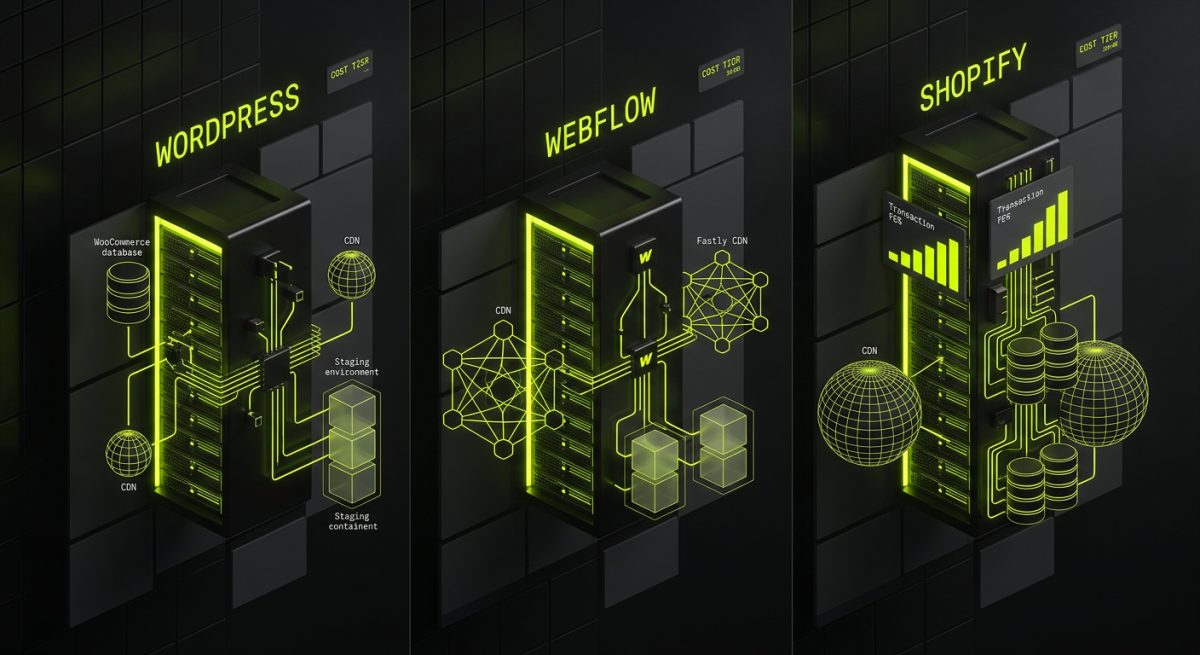
WordPress gives you the widest range of hosting options of any platform, from shared hosting at €5/month to enterprise managed WordPress environments at €500+/month. That flexibility is both a strength and a trap. Many businesses launch on undersized infrastructure and only discover the problem when traffic spikes, WooCommerce checkout slows to a crawl, or a poorly optimised plugin brings the server to its knees.
At werun.dev, our WordPress hosting partners — WP Engine, SiteGround, and Automattic — are selected precisely because they are engineered for WordPress workloads. Managed WordPress hosting at this tier typically runs €30–€150/month for a production site, and it includes server-level caching, automatic backups, staging environments, and security monitoring that you would otherwise have to build and maintain yourself.
What businesses frequently underestimate:
- CDN costs: A global audience means CDN bandwidth charges that can add €20–€100/month depending on asset volume.
- Staging environments: Many hosts charge separately for staging. Budget for it from day one.
- Database scaling: High-volume WooCommerce stores with complex queries need dedicated database resources. Shared database tiers will throttle you.
- Email infrastructure: WordPress does not handle transactional email well by default. Add Postmark, SendGrid, or Mailgun — typically €10–€50/month depending on volume.
- Object storage: Media-heavy sites benefit from offloading uploads to S3-compatible storage, which adds another variable cost.
A realistic annual hosting budget for a production WordPress site with WooCommerce, proper staging, CDN, and transactional email sits between €800 and €3,600/year — not the €60/year figure a shared hosting provider advertises.
Webflow Hosting
Webflow's hosting is bundled into its subscription model, which simplifies the cost picture considerably. A CMS site plan runs around €23/month, a Business plan €39/month, and Enterprise pricing is negotiated directly. For most B2B marketing sites and content-driven platforms, this is genuinely good value — the hosting is fast, the CDN is global (Fastly), and there are no server management responsibilities.
The hidden cost in Webflow hosting is not the infrastructure itself — it is the workspace and seat pricing. As your team grows, editor seats, client billing seats, and workspace upgrades accumulate. A Webflow site that starts at €23/month can reach €100–€200/month once you account for the full workspace structure a growing team requires.
Additionally, Webflow's hosting is not appropriate for every use case. High-traffic e-commerce, complex membership platforms, and applications requiring server-side logic will eventually push you toward custom code embeds, third-party middleware, or a hybrid architecture — all of which carry their own cost implications.
Shopify Hosting
Shopify's hosting is fully managed and included in the subscription. Basic starts at €32/month, Shopify at €92/month, Advanced at €399/month, and Shopify Plus at €2,300+/month. For e-commerce, this is a reasonable trade — you get globally distributed infrastructure, 99.99% uptime SLAs at the Plus tier, and zero server management overhead.
The hosting cost trap in Shopify is transaction fees. Unless you use Shopify Payments, every transaction incurs a fee of 0.5–2% depending on your plan. For a store doing €500,000/year in revenue through a third-party payment gateway, that is €2,500–€10,000/year in fees that never appear in any hosting line item. Factor this into your true platform cost before comparing Shopify to WooCommerce, where you own your payment gateway relationship entirely.
Maintenance Overhead: The Monthly Cost Nobody Budgets For
Every platform requires ongoing maintenance. The question is not whether you will pay for it — it is whether you pay proactively through structured retainers, or reactively through emergency fixes, security breaches, and site downtime.
WordPress Maintenance Complexity
WordPress is the most maintenance-intensive of the three platforms, and that is a direct consequence of its open-source architecture. As of 2024, the WordPress plugin repository contains over 59,000 plugins, and the average production site runs 20–40 of them. Each plugin is an independent codebase maintained by a different author on a different release schedule. Compatibility conflicts, security vulnerabilities, and breaking changes on updates are not edge cases — they are routine.
A proper WordPress maintenance programme covers:
- Core updates: Major WordPress releases (e.g., 6.5 → 6.6) can break custom functionality, particularly in sites using custom hooks, filters, or REST API extensions.
- Plugin updates: Each update needs to be tested in staging before deployment to production. Automated updates without testing are how sites break.
- Theme updates: Child themes and custom themes need to be reviewed against parent theme changes.
- Security hardening: File permission audits, login protection, XML-RPC management, and malware scanning.
- Database optimisation: Transient cleanup, post revision pruning, and query performance monitoring.
- Backup verification: Backups that have never been tested are not backups.
- PHP version management: PHP releases have defined end-of-life dates. Running PHP 7.4 in 2025 is a security liability.
At werun.dev, our WordPress maintenance retainers cover all of the above, plus the custom plugins and WooCommerce extensions we build — because we wrote them, we know exactly what to watch for when WordPress core or WooCommerce releases a major update.
For a site running custom plugins, active WooCommerce, and regular content updates, a realistic monthly maintenance budget is €200–€600/month depending on complexity. Businesses that skip this budget do not avoid the cost — they defer it until a crisis forces a much larger emergency spend.
Webflow Maintenance
Webflow's maintenance burden is significantly lower than WordPress because there is no plugin ecosystem to manage, no server to patch, and no PHP version to track. Webflow handles platform security and infrastructure updates automatically.
Maintenance costs in Webflow concentrate around:
- CMS architecture evolution: As content strategy matures, collection structures need to be refactored. This is developer work, not editor work.
- Custom code maintenance: Any JavaScript interactions, API integrations, or embed-based functionality requires ongoing attention as third-party APIs change.
- Webflow Designer updates: Webflow regularly releases new features that can affect existing class structures, interactions, or CMS bindings.
- Integration maintenance: Connections to HubSpot, Memberstack, Airtable, or Stripe through middleware (Zapier, Make, custom code) require monitoring and occasional rebuilding when APIs deprecate endpoints.
For a Webflow site with moderate custom code and active integrations, a maintenance retainer of €100–€300/month is realistic. Pure marketing sites with no custom code can often be maintained on an ad-hoc basis, but any site with live integrations needs proactive oversight.
Shopify Maintenance
Shopify sits between WordPress and Webflow in maintenance complexity. The platform manages its own infrastructure, but the theme layer and app ecosystem introduce meaningful maintenance obligations:
- Theme updates: Custom Liquid themes need to be updated when Shopify releases breaking changes to the Online Store 2.0 architecture or checkout extensibility APIs.
- App compatibility: The Shopify app ecosystem has its own version of the WordPress plugin problem. Apps update independently, and conflicts between apps — particularly in the cart and checkout — are common.
- Shopify API versioning: Shopify deprecates API versions on a quarterly cycle. Any custom app or private integration needs to track and migrate to current API versions.
- Checkout extensibility migrations: Shopify deprecated the old
checkout.liquidin favour of Checkout Extensibility for Plus merchants. Sites that have not migrated are running on deprecated infrastructure.
A Shopify store with a custom theme, 10–15 apps, and at least one custom integration should budget €150–€400/month for maintenance.
Technical Debt: The Cost That Compounds Silently
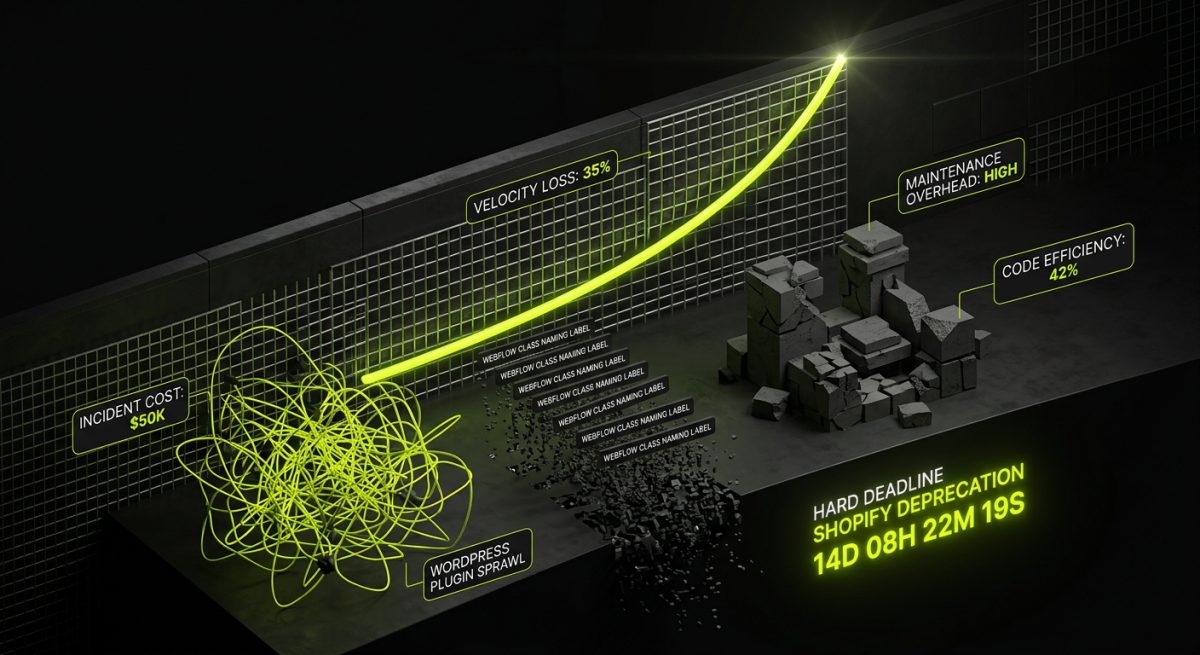
Technical debt is the most expensive item on this list, and the most consistently ignored. It does not appear on any invoice. It does not trigger an alert. It accumulates quietly in the gap between how a site was built and how it should have been built — and it charges interest every single day.
How Technical Debt Accumulates on Each Platform
WordPress technical debt is the most varied and the most dangerous. It takes several forms:
- Plugin sprawl: Sites that have accumulated 50+ plugins over years of incremental feature requests carry enormous compatibility risk. Removing or replacing plugins without breaking functionality requires significant audit and refactoring work.
- Non-standard customisations: Modifications made directly to theme files or plugin files (rather than through child themes or hooks) are overwritten on every update and create a permanent maintenance liability.
- Outdated database schemas: Custom post types and meta structures designed for a 2018 content model may be fundamentally incompatible with a modern block editor workflow, requiring a data migration rather than a simple update.
- Accumulated shortcodes: Sites built on page builders like Visual Composer or WPBakery in 2016–2019 are often locked to those builders because thousands of shortcodes are embedded in post content. Migrating away requires content-level surgery.
At werun.dev, when we inherit a WordPress site for maintenance, the first engagement is always a technical audit. We have seen sites where the accumulated technical debt — plugin conflicts, non-standard hooks, hardcoded credentials, deprecated API calls — would cost more to remediate than a full rebuild. Knowing that early prevents years of compounding cost.
Webflow technical debt is structurally different but equally real:
- Class naming entropy: Webflow projects built without a naming convention (BEM or equivalent) accumulate hundreds of redundant, single-use classes. Styling changes become unpredictable, and new developers cannot work efficiently in the project.
- CMS architecture mismatch: A CMS structure designed for 50 items that now holds 5,000 items — with the wrong fields, wrong reference relationships, and no pagination strategy — is a debt that blocks every content operation.
- Interaction conflicts: Native Webflow interactions and GSAP animations added incrementally by different contributors can conflict in ways that are extremely difficult to debug without a full interaction audit.
Shopify technical debt concentrates in the theme and app layers:
- Theme modification accumulation: Stores that have been customised by multiple agencies over several years often have Liquid templates with contradictory logic, duplicate CSS, and undocumented JavaScript that no one fully understands.
- App dependency chains: Removing an app that has been in place for three years may break functionality that five other apps depend on. Untangling these dependencies requires systematic testing, not just deletion.
- Deprecated checkout code: As noted above, stores still running
checkout.liquidcustomisations are carrying a specific, quantifiable technical debt with a hard deadline — Shopify has already announced the deprecation timeline for Plus merchants.
Quantifying Technical Debt Before It Quantifies You
The business cost of unaddressed technical debt manifests in three ways:
- Velocity loss: Developer time spent working around legacy constraints rather than building new features. A task that should take two hours takes eight.
- Incident cost: Technical debt increases the probability and severity of production incidents. A single checkout outage on a Shopify store doing €50,000/month in revenue can cost €5,000–€15,000 in lost sales and emergency remediation.
- Migration cost: When technical debt reaches a threshold where the platform can no longer support business requirements, a full migration becomes necessary. Platform migrations — WooCommerce to Shopify, Webflow to Next.js, legacy WordPress to a modern stack — typically cost €15,000–€80,000 depending on data complexity and integration depth.
The most cost-effective strategy is continuous debt management: structured code reviews, documented architecture decisions, and a maintenance partner who understands the full stack. This is precisely why werun.dev's maintenance retainers are not just update services — they are ongoing engineering relationships that track the health of your platform over time.
The Build Quality Premium Pays for Itself
There is a direct relationship between the quality of the initial build and the rate at which technical debt accumulates. A WordPress site built with proper hook architecture, documented custom plugins, a child theme, and a clean database schema will accumulate debt far more slowly than one built by a developer who edited core files and installed 40 plugins to avoid writing code.
This is the practical argument for working with a specialist agency rather than a generalist freelancer or a template-based build service. The premium on build quality is not a luxury — it is an amortised cost reduction over the operational life of the site.
At werun.dev, every plugin we build ships with documentation and a GitHub-powered auto-update system. Every Webflow project uses a scalable BEM-style class architecture. Every Shopify theme is built from scratch in Liquid against Online Store 2.0 standards — not a modified template with accumulated workarounds. These are not marketing claims; they are engineering decisions that directly reduce the long-term cost of ownership for our clients.
If you are evaluating platforms for a new project, or auditing the true cost of a site you already own, contact the werun.dev team for a technical assessment. We will give you an honest picture of what you are working with — and what it will cost to keep it running well.