
The Shopify App Store contains over 8,000 apps. That number is frequently cited as a selling point — and it is one, to a degree. But for merchants operating at scale, the app ecosystem is also one of the most common sources of technical debt, performance degradation, and runaway monthly spend. Understanding the architecture behind Shopify's app model is essential before you commit to a stack that could cost you significantly more than the plan fee on your invoice.
What the Shopify App Ecosystem Actually Gives You
Shopify's app marketplace exists because the platform is intentionally opinionated. Shopify controls the core commerce experience — checkout, payments, inventory, orders — and delegates everything else to third-party developers. This is a deliberate architectural decision, not a limitation. It allows Shopify to maintain a stable, secure core while enabling an enormous range of extensions without compromising platform integrity.
For merchants, this model has genuine advantages:
Speed to Market
Installing a reviews app, a subscription engine, or a loyalty program takes minutes rather than months. For early-stage merchants validating product-market fit, this is the right trade-off. You can test a upsell strategy with a $15/month app before committing to a custom build.
Access to Specialized Functionality
Many apps solve genuinely complex problems — tax compliance across jurisdictions (Avalara, TaxJar), advanced subscription logic (Recharge, Skio), or carrier-calculated shipping integrations. Building these from scratch would require deep domain expertise and ongoing maintenance that most merchant teams cannot sustain internally.
The Online Store 2.0 App Block Model
Since Shopify introduced Online Store 2.0, well-built apps can inject UI components directly into theme sections via app blocks. This is a significant architectural improvement over the legacy approach of injecting JavaScript into theme.liquid. App blocks are:
- Controlled by the merchant through the theme editor
- Rendered server-side when possible
- Scoped to specific templates rather than loading globally
This means a well-integrated app in a well-built theme has minimal performance overhead. The keyword there is well-integrated — which is not a guarantee.
The Storefront API and Headless Extensions
For merchants running headless Shopify — decoupling the frontend from Shopify's rendering layer — the Storefront API enables apps to expose their functionality through GraphQL queries rather than Liquid injection. This is increasingly relevant for Shopify Plus merchants building custom frontends on Next.js or similar frameworks, where traditional app embed scripts simply do not work.
What This Means in Practice
A thoughtfully selected app stack, built on Online Store 2.0 principles and integrated into a purpose-built Liquid theme, can deliver substantial functionality without significant technical compromise. The problem is that most stores do not have a thoughtfully selected app stack. They have an accumulated one — apps added incrementally over months or years, often by different team members, with no architectural review.
The distinction between a curated stack and an accumulated one is where most of the real cost in the Shopify ecosystem lives.
Where the App Model Breaks Down
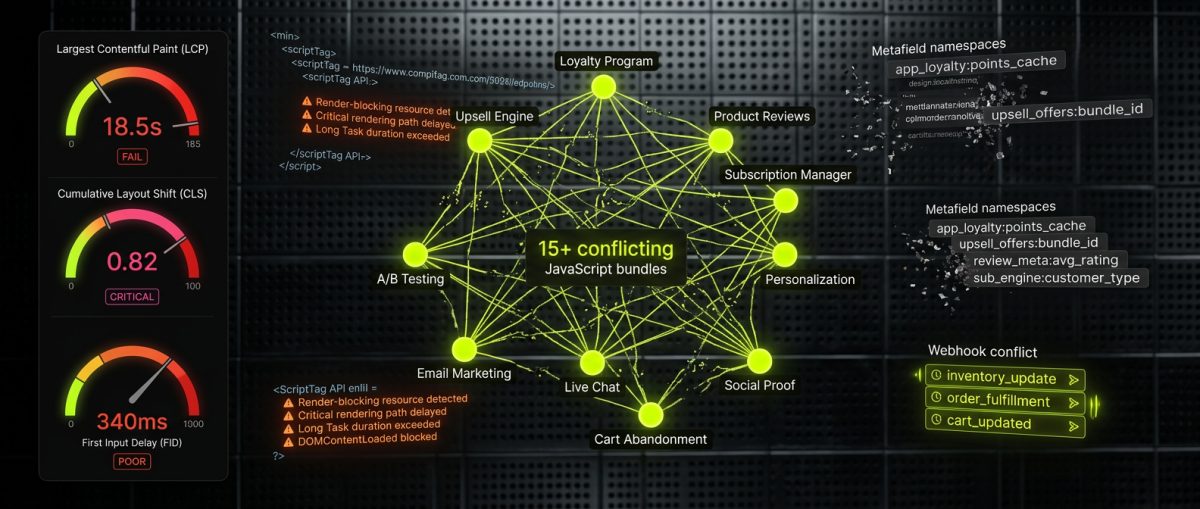
The structural weaknesses of Shopify's app ecosystem are not bugs — they are predictable consequences of the model's architecture. Recognizing them early prevents expensive remediation later.
Script Injection and Theme Pollution
Despite Online Store 2.0's improvements, a significant portion of apps in the marketplace still rely on legacy script injection — appending JavaScript tags to theme.liquid or using ScriptTag API endpoints. Each additional script is a potential render-blocking resource, a Cumulative Layout Shift contributor, and a Core Web Vitals liability.
A store with 15 active apps, each loading a 40–80KB script bundle, can easily accumulate 600KB–1.2MB of third-party JavaScript before a single line of product content loads. Google's PageSpeed Insights will flag this. Your conversion rate will reflect it.
// Legacy app injection pattern — what you want to avoid
{{ content_for_header }} <!-- Contains injected ScriptTags from all active apps -->

// Modern app block pattern — scoped and controlled
{% schema %}
{
  "name": "App Block",
  "target": "section"
}
{% endschema %}
Checkout Limitations on Standard Plans
On standard Shopify plans (below Plus), the checkout is a black box. Apps cannot modify the checkout UI — they can only influence it through order-level discounts, scripts (being deprecated), and post-purchase pages. If your business model requires custom checkout logic — B2B pricing tiers, conditional shipping rules, custom field capture — you will eventually hit a wall that no app can solve without a Shopify Plus subscription.
This is not a criticism of Shopify; it is a constraint merchants should understand before building a roadmap that depends on checkout customization.
App Conflicts and Data Fragmentation
Apps operate in relative isolation. A loyalty app, a subscription app, and a discount app may each have their own customer record model, their own definition of "order value," and their own webhook listeners on the same Shopify events. Conflicts are common:
- Subscription apps and automatic discount apps frequently interact in ways that produce incorrect pricing
- Multiple apps writing to the same metafield namespace will overwrite each other's data
- Apps that modify cart attributes can conflict with checkout extensibility scripts
Debugging these interactions requires access to Shopify's Partner Dashboard logs, webhook delivery records, and often direct communication with multiple app support teams simultaneously — a significant operational burden.
Vendor Lock-In at the Data Layer
Many category-leading apps store critical business data in their own databases rather than in Shopify's native data model. Recharge stores subscription contracts in Recharge's infrastructure. Klaviyo stores customer segments and flow logic in Klaviyo's infrastructure. If you migrate away from these platforms, data portability is limited and often requires custom extraction scripts.
This is a meaningful consideration for merchants planning platform migrations or acquisitions, where clean data portability is a due diligence requirement.
The Compounding Complexity Problem
Each app added to a store increases the surface area for failure. A store running 20 apps has 20 potential sources of downtime, 20 sets of release notes to monitor, and 20 billing relationships to manage. When Shopify releases a platform update — a new checkout version, a deprecation of the ScriptTag API, a change to the Cart API — each app vendor must update their integration independently. The probability that at least one app in a 20-app stack is broken at any given time is not negligible.
The Real Cost Model: What You're Actually Paying
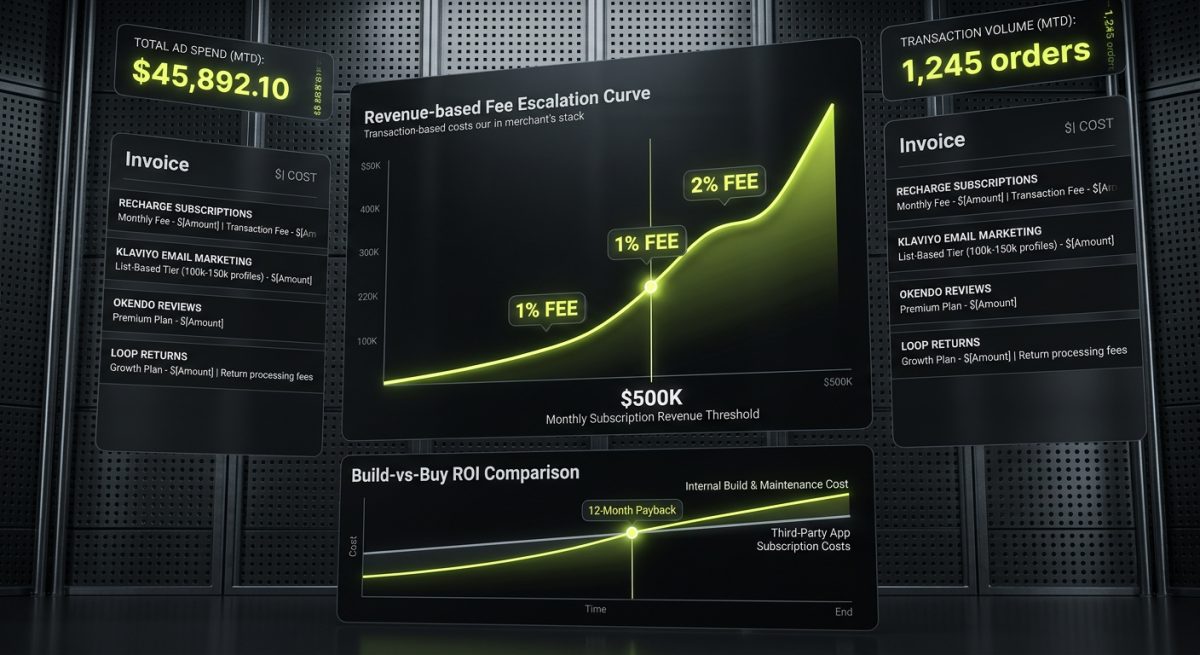
The sticker price of Shopify apps is straightforward. The total cost of ownership is not. For merchants evaluating their app stack — or agencies advising them — a complete cost model includes several categories that rarely appear on a single invoice.
Direct Subscription Costs
This is the visible layer. A mid-market Shopify store running a standard app stack might include:
- Reviews platform (Okendo, Yotpo, Stamped): $99–$299/month
- Email + SMS (Klaviyo, Attentive): $150–$500/month based on list size
- Subscriptions (Recharge, Skio): $99–$499/month plus transaction fees
- Search + merchandising (Searchanise, Boost Commerce): $29–$99/month
- Loyalty (Smile.io, LoyaltyLion): $49–$299/month
- Upsell/cross-sell (ReConvert, Zipify): $29–$99/month
- Returns management (Loop, AfterShip): $59–$299/month
A conservative mid-market stack lands at $500–$2,000/month in app subscriptions alone, before Shopify's plan fee, payment processing, and any agency or developer costs.
Revenue-Based and Transaction Fees
Several app categories charge percentage-based fees on top of flat subscriptions. Subscription platforms like Recharge charge 1–2% of subscription revenue. Some upsell apps charge 0.75–1% of revenue generated through their widgets. At meaningful revenue scale, these fees dwarf the flat subscription cost.
A merchant doing $500K/month in subscription revenue on Recharge's standard plan pays approximately $5,000/month in platform fees — $60,000/year — for a service that could potentially be replicated with a custom app built on Shopify's native Subscriptions API.
Developer Time for Integration and Maintenance
Apps rarely work perfectly out of the box with custom themes. App blocks need to be styled to match brand design systems. Liquid templates need to be modified to accommodate app-injected metafields. Webhook handlers need to be tested against edge cases in your specific product catalog.
For each app added to a custom-built theme, budget 4–16 hours of developer time for proper integration — more for complex apps with deep theme dependencies. Multiply that across a 15-app stack and you are looking at 60–240 hours of integration work, plus ongoing maintenance as apps release updates that break existing integrations.
Performance Remediation Costs
When an accumulated app stack degrades Core Web Vitals scores, the remediation is not simply removing apps. It involves:
- Auditing which scripts are render-blocking versus deferred
- Identifying which apps can be migrated to app block architecture
- Removing and replacing apps that cannot be made performant
- Re-testing conversion impact of removed functionality
This is a non-trivial engagement. Stores that reach out to werun.dev for performance optimization frequently discover that 30–40% of their installed apps are either redundant, unused, or replaceable with native Shopify functionality that has been added to the platform since the app was installed.
The Build-vs-Buy Threshold
For specific high-cost app categories, custom development becomes economically rational at surprisingly accessible revenue thresholds. Consider a merchant paying $499/month for a subscription app plus 1% of $200K/month subscription revenue:
- Monthly app cost: $499 + $2,000 = $2,499
- Annual cost: ~$30,000
- Custom app build cost (using Shopify's Subscriptions API): $15,000–$25,000 one-time
At that revenue level, a custom app pays for itself within 12 months and eliminates ongoing vendor dependency. This calculation does not apply to every app category — it is most relevant for high-transaction-volume functions where revenue-based fees are significant. But it is a calculation that merchants and their development partners should be running regularly.
Building a Rational App Architecture
The alternative to an accumulated app stack is an intentional one — where every installed app has been evaluated against native Shopify functionality, alternatives, and the build-vs-buy threshold. This is not a one-time exercise; it is an ongoing part of Shopify store governance.
Audit Before You Add
Before installing any new app, answer these questions:
- Does Shopify native functionality cover this? Metafields, metaobjects, Shopify Markets, B2B features, and the Flow automation engine cover a significant portion of what merchants historically needed apps for. Many stores are paying for apps that became redundant when Shopify shipped the feature natively.
- What does this app write to the store? Understand which metafields, files, script tags, and webhooks the app creates. Document it. You will need this information when you eventually remove the app.
- What is the exit cost? If you need to migrate off this app in 18 months, what does that look like? Is your data portable? Is there an API for bulk export?
- Does this app support Online Store 2.0 app blocks? If not, it will inject scripts globally and affect every page load.
Prefer Native Over Third-Party Where Equivalent
Shopify has invested heavily in native functionality over the past three years. Areas where native now competes meaningfully with third-party apps:
- B2B and wholesale: Shopify Plus native B2B features (company accounts, custom catalogs, net payment terms) have significantly reduced the need for third-party B2B apps
- Automation: Shopify Flow covers a wide range of trigger-action workflows without requiring Zapier or custom webhook handlers
- Checkout customization: Checkout Extensibility (Plus only) enables UI injection, custom fields, and validation logic that previously required Checkout.liquid hacks
- Search: Shopify's native predictive search and filter API have improved substantially; evaluate before defaulting to a third-party search app
Custom Apps for Strategic Functions
For functionality that is genuinely core to your business model — not commodity functionality available from any app — a private custom app built on the Shopify Admin API and Storefront API gives you complete control over behavior, data ownership, and cost structure.
At werun.dev, we build private Shopify apps for merchants who have outgrown the app store's constraints. Common scenarios include ERP and 3PL integrations where data fidelity is non-negotiable, custom pricing engines for B2B wholesale portals, and subscription logic that does not fit the assumptions baked into commercial subscription platforms. These are not projects that make sense at every scale — but for Shopify Plus merchants with significant transaction volume, a custom app is frequently the most economical and technically sound option.
Governance and the App Audit Cadence
Establish a quarterly app audit as a standard operating procedure. Review:
- Active vs. inactive apps (uninstalled apps can leave orphaned data and webhooks)
- Apps approaching their revenue-based fee thresholds
- Apps that have not shipped a meaningful update in 12+ months (abandonment risk)
- Apps that conflict with recent Shopify platform updates
This cadence does not require a developer for every review — a structured spreadsheet tracking app name, monthly cost, owner, last-reviewed date, and replacement candidate is sufficient for most teams. The discipline of reviewing is more important than the tooling.
The Shopify app ecosystem is a genuine asset when approached with architectural discipline. It becomes a liability when treated as a catalog to browse rather than a system to design. The merchants who extract the most value from Shopify are not the ones with the most apps — they are the ones who have built the most intentional stack, understand exactly what each component costs and does, and have a development partner capable of building custom solutions when the app store's ceiling is too low.