Apps that grow with your users
Your users keep coming, your app keeps up.
Your product gets accounts, plans and billing, with each customer kept apart from the rest. The code is yours, in your repository, and any good team can maintain it. We keep it running as you grow.
Short answer
Who builds a custom web app or SaaS that scales with users?
werun.dev builds custom web apps and SaaS with accounts, plans and billing, each customer kept apart in the data. Your customers sign up, choose a plan and get a workspace of their own. The code is Next.js and PostgreSQL in your own repository, a stack other teams can maintain. Projects start from $5.5k, and a Retainer at $4,800 a month keeps the app running as you grow. To start, tell us who signs up and what they pay for.
- Price
- Projects from $5.5k
- Reply
- Under 2 hours on business days
- Each customer
- A workspace of their own
- Kept running
- Retainer, $4,800 a month


























































In your words
What outgrowing your first app feels like, and what a sound base changes.
What happens: Every new customer means someone copies a setup by hand.
What changes: A new customer signs up and gets a workspace of their own.
What happens: You worry that one customer’s data could show up in another’s account.
What changes: Each customer’s data is kept apart from the first day, so nobody sees another’s.
What happens: Plans and limits live in a spreadsheet someone updates by hand.
What changes: Plans, quotas and billing live in the app, and each customer sees what they used.
What happens: Only the person who wrote the code dares to change it.
What changes: It is written in code other teams know, with a note on how it works.
How it works
From your idea to paying customers, in an order you can follow.
Each step lights up in turn, with what you receive at that point. Growth is decided early, in how your customers’ data is shaped.
You hear first if a platform can carry it
If WordPress, Webflow or Shopify can run your product, we say so and build it there. Custom code is for a real constraint.
You getA written answer: a platform or custom code, and why
You agree how each customer is kept apart
Accounts, plans and the line between one customer and the next are set in the data, before any screen.
You getA written plan of accounts, plans and limits to approve
Your customers can sign up on their own
Sign-up, roles, plans, usage limits and billing go in, so a new customer starts without your help.
You getA sign-up you can try as your own first customer
What you test is what goes live
Every change is tried on a copy first. What you approved there is what your customers get.
You getYour app’s code in your own repository
Your app keeps up as customers arrive
A Retainer covers watching the app, safe changes and new features, with habits learned on our own products.
You getOne engineer who knows your code, every month
What changes for you
What changes as your customer list grows.
Adding a customer becomes a sign-up, and your team carries on.
New customers start on their own
They sign up, choose a plan and get a workspace of their own.
Each customer stays in their own space
Their data stays apart from everyone else’s, however many customers you have.
Usage your customers can read
Each customer sees what they used against what their plan allows, like 3 / 10.
What it costs
What a custom app costs, sized before you commit.
Prices come from the price list each of our proposals uses.
Project
From $5.5k one project
Your app designed, built, tested and handed over in your repository.
- Accounts, roles and plans
- Each customer kept apart from the first day
- Every page tested before launch
- A guide for your team and a week of support
Retainer
$4,800 a month
Your own product team: the app kept running, plus new features every month.
- 40 development hours a month
- One engineer who knows your code
- Watched, with every change tried first
- Replies in under 2 hours on business days
Ad hoc
$120 per hour
A fix or a feature in an app you already have.
- Minimum task length: 30 minutes
- Every hour logged against its task
- No monthly commitment
The price depends on the shape of your data, your plans and the systems your app talks to. See every engagement
Side by side
An app builder or your own codebase, side by side.
A builder is often the right start, and we will say so. Code earns its place when your data or your customers need it.
| Side by side | A no-code app builder | Your own codebase with werun.dev |
|---|---|---|
| Where it lives | Inside the builder’s account | In your repository, under your licence |
| Each customer kept apart | As far as the builder allows | From the first day, in the data itself |
| Plans and billing | The options the builder offers | Plans, quotas and billing for your pricing |
| Who can maintain it | People who know that builder | Any good team, from the notes in your repository |
Your next step
Tell us your goal, we reply within 2 hours.
Write it the way you would tell a colleague. A person reads it and answers on business days.
- A written answer with what it takes and what it costs
- You decide before anything starts
- We sign an NDA if you need one
Free first look
Tell us what you need.
Proof
Apps of ours you can try today.
All three are ours, and in each one every customer sees only their own.
Working with us
You stay on the job, we keep you in the loop.
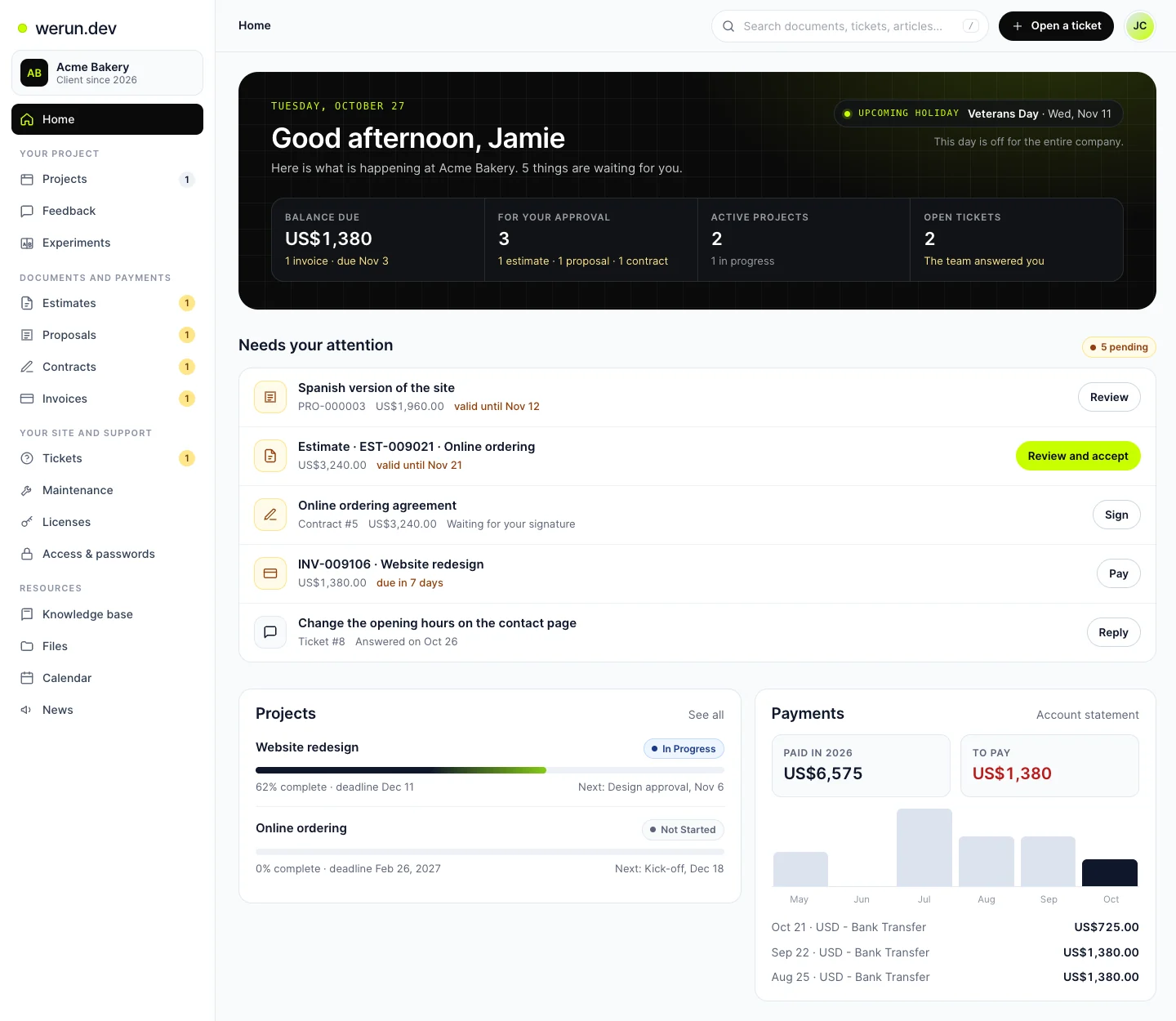
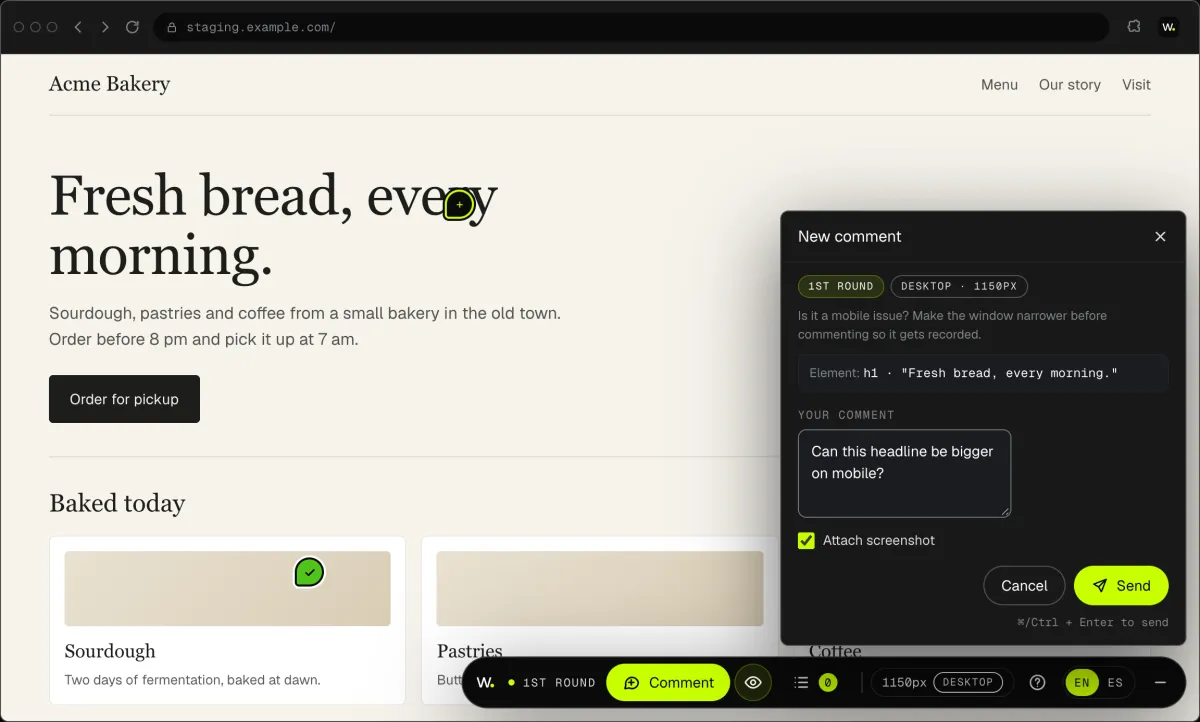
Your project, approvals and invoices live in the Client Portal. You ask for a change by clicking on your own site. With Care, a written report arrives every month.
01Client Portal
Projects, requests, invoices, proposals and contracts in one place. Ask it a question and it answers from your own records.
02Client Feedback
Click anything on your own site and say what you want. That's it: the team gets it as a task with a screenshot, and you watch it get solved.
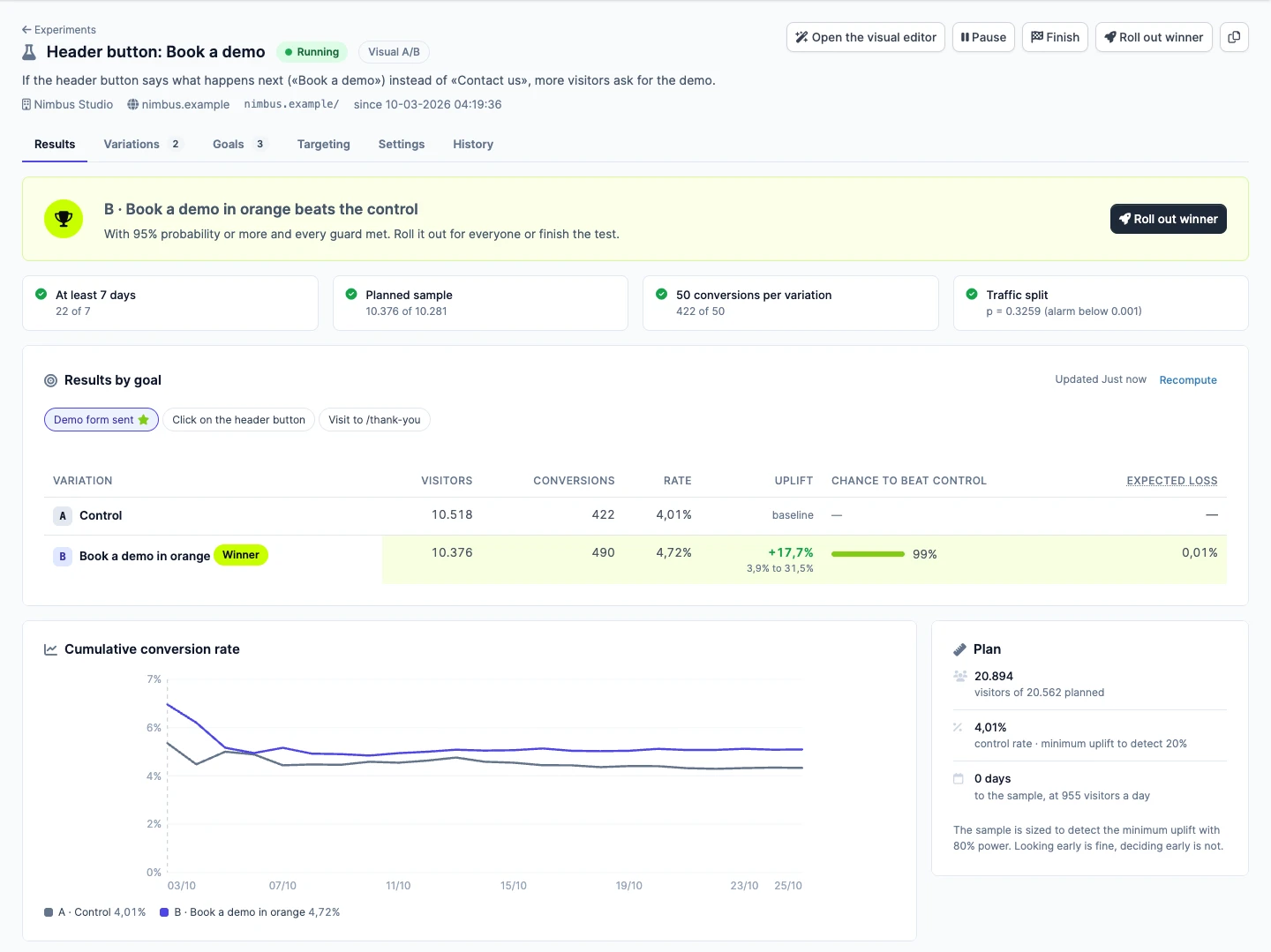
03werun.Experiments
Not sure which version sells more? Try both with real visitors. Tell us the idea in plain words and we set up the test. You watch the winner from your Client Portal.
What clients say
Teams like yours, in their own words.

“The client portal, the feedback extension and the WordPress security alerts have been very intuitive, pretty turnkey. Just this past week getting comfortable with it, it’s been really helpful. We’re rolling it out to our core team. Nice job.”
Custom app questions
How much does it cost to build a SaaS app?
Building one starts from $5.5k. Small projects run to $11k, medium ones to $22k and large ones to $44.1k. The price follows the shape of your data, your plans and the systems the app talks to. Running it is a Retainer at $4,800 a month, with one engineer who knows your code. Every figure is in your written proposal before you sign.
How long until my first customers can sign up?
It depends on what has to exist on day one. Sign-up, one plan and your core feature is the short path. More plans, roles and integrations can follow once customers are inside. Your proposal states the hours for that first release before any work starts. After launch, a Retainer adds features each month on the same code.
Should I use a no-code app builder or custom code for my SaaS?
A no-code builder is often the right start, and we will tell you if it is. Custom code earns its place when your data, your pricing or your customers need it. In a builder, the product lives in the builder’s account and its options. In code, it lives in your repository, and any good team can work on it.
What are good alternatives to a big consultancy for a custom app?
A small team that builds and runs its own products. We wrote WelcomeAI and this website, and we still run them both. You get a written proposal with the hours, and one engineer who knows your code on a Retainer. A person replies in under 2 hours on business days. You keep the code, so you can change teams whenever you like.
How do you keep each customer’s data separate in a SaaS?
Each customer is kept apart in the data itself, from the first table. Every read is limited to one account, so one customer’s records stay out of another’s account. Our own product, WelcomeAI, works this way, with a workspace per organisation. Inside an account, roles decide what each person may do, and they are checked on every request.
Will a custom app hold up when users grow into the thousands?
It holds up when growth is planned in the data first, which is where we start. Every change is tried on a copy first, and what you approved is what goes live. Slow work, like importing files, runs in the background and reports on each item. The monitoring and on-call habits from our own products come with yours. What any app can carry depends on its load, and your proposal says how yours is built for it.
Can a custom SaaS handle plans, subscriptions and usage limits?
Yes. Plans, quotas and billing live in the app, set to your pricing rather than a builder’s options. Each customer sees what they used against what their plan allows, like 3 / 10. In WelcomeAI, each plan’s allowances live in the database, so changing one needs no new release.
Can another developer take over my app’s code later?
Yes, and that is why it is built on Next.js, React, TypeScript and PostgreSQL. They are documented and widely known, so a team other than ours can maintain it. The code lives in your repository under your licence, and the database is yours. It runs on Vercel, with the database wherever you already keep one.
Keep reading
More answers on this topic.
What should your app do for its first customers?
Tell us who signs up, what they pay for and what they do inside. We reply within 2 hours on business days with whether it needs custom code.