Store and ERP integrations
Your store and ERP in step, order by order.
Each order reaches your ERP once, and stock and prices come back to the store on their own. If a system goes down, orders wait their turn. Your team stops retyping.
Short answer
How much does an ecommerce ERP integration cost?
werun.dev prices an ecommerce ERP integration in hours at $120, estimated once a written map of your fields exists. The map says which system owns each order, stock count and price, and you read it first. It works for WooCommerce, Shopify and Shopify Plus stores. A first version usually takes three to four weeks. Looking after it later is the Retainer, $4,800 a month, or $120 an hour as needed. To start, tell us your store, your ERP and what your team copies by hand.
- Price
- $120 an hour, estimated first
- First version
- Usually three to four weeks
- Reply
- Under 2 hours on business days
- Plugins written
- 80+


























































In this guide
Four questions store owners ask, each with its own page.
Pick the one closest to yours. Each page says how it works, what it costs and how to start.
How do I integrate Shopify with my ERP?
How Shopify or Shopify Plus connects to your ERP for orders, stock, customers and B2B prices, and what it costs.How do I connect WooCommerce to my ERP?
How WooCommerce connects to your ERP through a plugin of your own, what it moves and what it costs.How do I automate quotes from my online store?
How a quote request on your store becomes a quote in your template, saved in your ERP or CRM.How do I set up a multilingual online store?
How a store sells in new markets: a real page per language, prices per market and what each language adds.
In your words
What retyping orders costs you, and what changes once they flow.
What happens: Someone on your team copies every order from the store into the ERP by hand.
What changes: Each order reaches the ERP once, on its own, with its customer attached.
What happens: The store says 3 in stock, the warehouse says 0, and a customer already paid.
What changes: Stock comes down from your ERP, so the store sells what you hold.
What happens: A price changed in the ERP last week, and the store still shows the old one.
What changes: Prices have one home, the ERP, and the store follows it.
What happens: The ERP was down for an hour, and nobody knows which orders made it.
What changes: Orders wait in a queue, and a nightly check sends again anything missed.
How it works
One connection, built in order, and checked every night.
Each step lights up in order. Under each one, what lands in your hands at that point.
- 17 left after a sale
- Price list updated
- Order #1042 shipped
- Order #1042 paid
- New customer added
Each paid order travels from your store to your ERP with its customer. Stock, prices and shipping come back to the store. Your team stops copying orders between screens.
You see which system owns each number
Before any code, we write down where each order, stock count and price lives. You read it and decide.
You getA written map of your fields, and the estimate in hours
Test orders run on a copy of your store
That copy is called staging, so your real orders stay apart. A test run lists every change before anything is written.
You getA list of every change a test order would make
Orders reach your ERP on their own
Checkout confirms each order at once and passes it on in the background. Stock and prices come back the same way.
You getEach paid order in your ERP, with its customer attached
Both sides are compared every night
Anything missed is sent again. Anything that disagrees opens a ticket for a person on our team.
You getA ticket for any mismatch, read by a person
Your team learns how it works
The code goes to your repository with a written note. A handover call walks your team through it.
You getThe code in your repository, with a written guide
What changes for you
What changes for your team once orders flow.
You feel it in the hours your team gets back, and in numbers that match.
Orders entered once
Your team stops copying orders between screens, and nobody types an order twice.
One version of every number
The store, the ERP and your CRM show the same stock, the same price and the same total.
A failed sync reaches a person
When the two sides disagree, a ticket opens for someone on our team. They reply within 2 hours on business days.
What it costs
What a connection costs, written before you commit.
Prices come from our price list, the same one every proposal uses. You get the estimate after the map, before any code. If a ready-made connector app fits your store and your buyers, we say so first.
Connection
$120 per hour, estimated first
A connection added to the store you have, estimated in hours once the map is written.
- A written map of every field first
- The estimate in writing before you commit
- A first version in three to four weeks
- The code in your repository
Project
From $5.5k one project
A new store or a rebuild, with its connections counted into the size of the project.
- Small from $5.5k to $11k
- Medium up to $22k
- Large up to $44.1k
Retainer
$4,800 a month
The same engineer looks after your connection and builds the next one.
- 40 development hours a month
- Failed syncs checked by a person
- Replies in under 2 hours on business days
- One engineer who knows your systems
The hours depend on how many systems, fields and rules travel. We say how many in writing before you start. See every engagement
Your next step
Tell us your goal, we reply within 2 hours.
Write it the way you would tell a colleague. A person reads it and answers on business days.
- A written answer with what it takes and what it costs
- You decide before anything starts
- We sign an NDA if you need one
Free first look
Tell us what you need.
Proof
Proof you can open, built and run by us.
These are ours. They run on the same habits your connection would.
WelcomeAI
Our own product keeps content from WordPress, Webflow and Shopify in sync on a schedule, item by item.
See itThis website
Every request sent from this site is copied to our CRM as a lead. If the CRM fails to answer, the request is still saved here.
See itThe Client Portal
The client side of that CRM. Each client signs in and finds their estimates, invoices and tickets in one place.
See itWorking with us
You stay on the job, we keep you in the loop.
Your project, approvals and invoices live in the Client Portal. You ask for a change by clicking on your own site. With Care, a written report arrives every month.
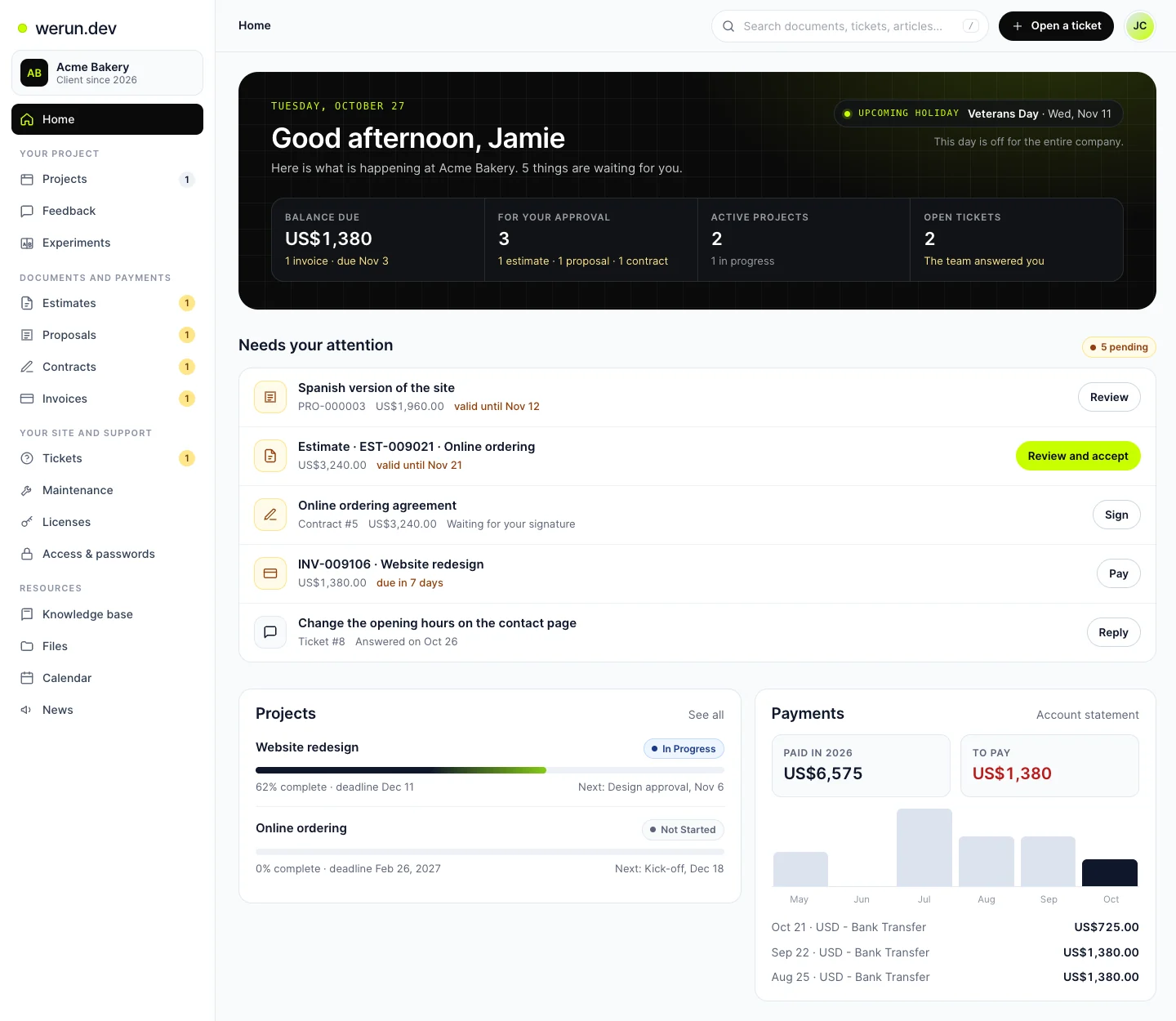
01Client Portal
Projects, requests, invoices, proposals and contracts in one place. Ask it a question and it answers from your own records.
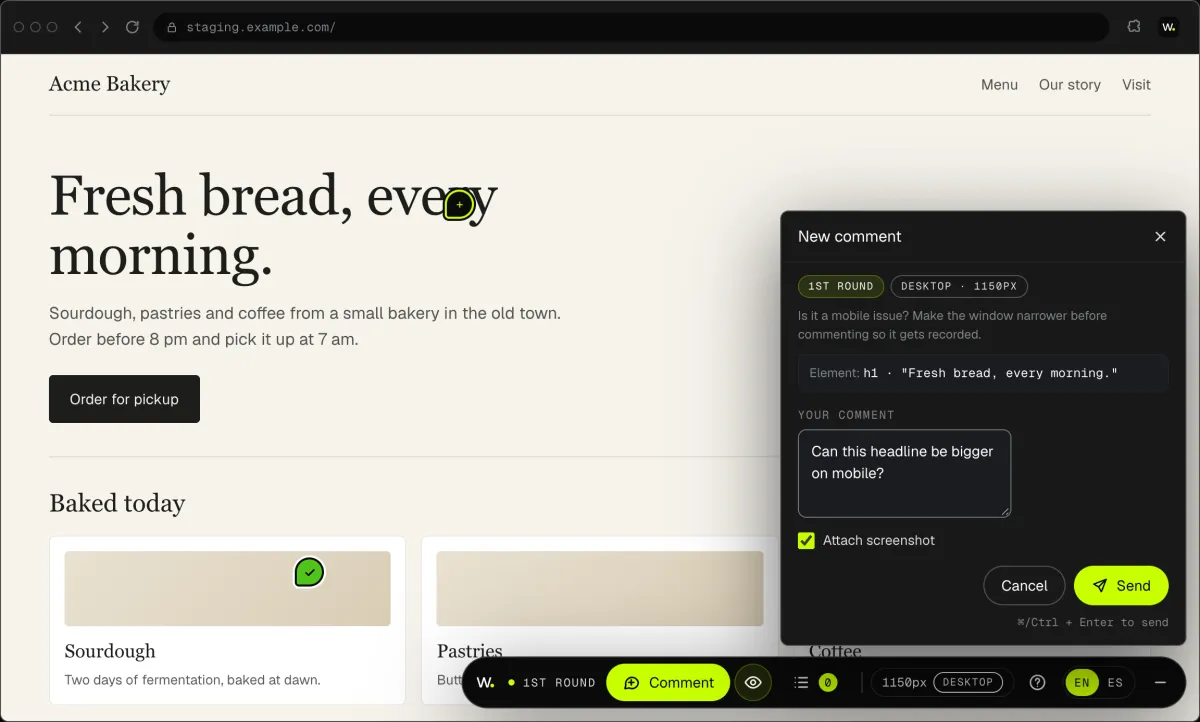
02Client Feedback
Click anything on your own site and say what you want. That's it: the team gets it as a task with a screenshot, and you watch it get solved.
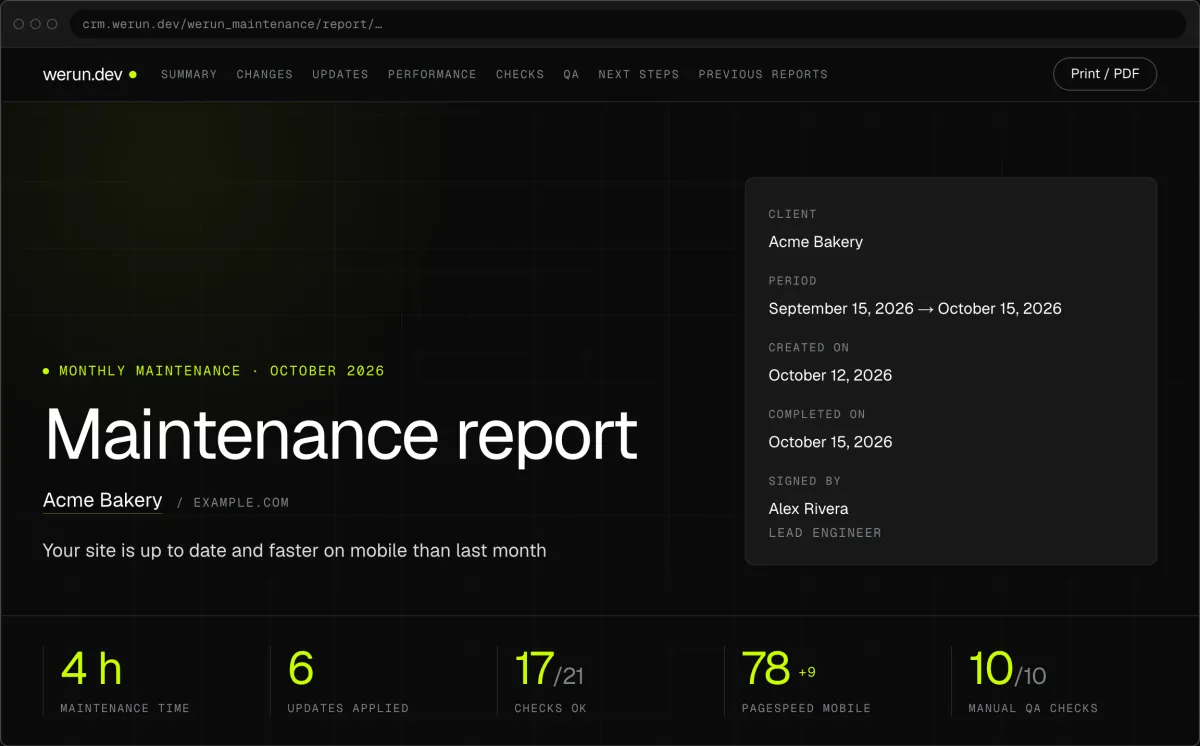
03Monthly report
Every month, in writing: what we changed on your site, what we watched over and what comes next.
What clients say
Teams like yours, in their own words.

“The client portal, the feedback extension and the WordPress security alerts have been very intuitive, pretty turnkey. Just this past week getting comfortable with it, it’s been really helpful. We’re rolling it out to our core team. Nice job.”
ERP integration questions
How long does an ecommerce ERP integration take?
Usually three to four weeks for a first version. That version moves one kind of record end to end, often orders, through a queue with a nightly check. You watch it work on test orders before it touches real ones. Prices, customers and stock follow once it has proved itself. The written proposal gives the dates for your own systems.
Which ERPs can you connect to an online store?
Any ERP with an HTTP API, or one that can send a webhook. On the store side, that means WooCommerce, Shopify and Shopify Plus. The same connector can reach a CRM such as Salesforce or HubSpot, and your fulfilment partner. If a system offers neither, we tell you before you sign. You keep the ERP and the store you have today.
Do stock and prices sync between store and ERP in real time?
Close to it, and how close depends on your ERP. Orders travel as buyers pay. An ERP that announces each change passes stock and prices at once. One that only answers when asked is read on a schedule you agree. The map writes down the timing for each record, and a nightly check catches any drift.
What happens to orders placed while our ERP is down?
They wait in a queue and reach the ERP when it returns. The buyer still gets a confirmed order, because checkout never waits for the ERP. If the queue misses one, the nightly check sends it again. Anything the two sides disagree on opens a ticket, and a person replies within 2 hours on business days.
Do we need middleware or an iPaaS between the store and the ERP?
Usually not. Your connector sits between the two systems and does that job, in code you own. When a flow has branches worth seeing, a workflow engine such as n8n can carry it instead. n8n can run on your own servers, and you can open every workflow and change it. The written map says which one fits before you commit.
What do we need to prepare before an ERP integration starts?
Three things: a list of what your team copies, your ERP’s API access and someone who knows your prices. The list tells us where to start. API access, ideally to a test company, lets everything run on a copy first. Your prices person answers the map’s questions on accounts and rules.
Who owns the integration once it is built?
You do. The code lives in your repository, under your licence, with a written note on how it works. A handover call walks your team through it. If you ever change teams, any good developer can pick it up from that note. Each connection we build belongs to the client who asked for it.
What does an ERP integration cost each month once it is live?
Only what you choose to spend on it. The connector is yours, so there is no licence to pay us. The Retainer, $4,800 a month, gives one engineer 40 hours for fixes and the next connection. Without a plan, each change is billed at $120 an hour, with a 30-minute minimum. Any hosting it needs is yours, and the proposal names it.
Want your next order to reach the ERP on its own?
Tell us your store, your ERP and what your team copies today. We reply within 2 hours on business days with what it takes and where to start.