Website and checkout speed
A fast site and checkout, ready for your campaign.
You learn what slows your site, in plain words. Each fix is tried on a copy first, and your checkout is tested before customers see it. Then the speed stays watched.
Short answer
Who can fix a slow website and checkout?
werun.dev fixes slow WordPress, WooCommerce, Shopify and Webflow sites, checkout included. Your pages are measured on phones and computers, and you get a written list of what slows them. Each fix is made on a copy of your site, and the checkout passes a written test before going live. Fixes are $120 per hour, and a rebuild is a project from $5.5k. Send your address to start: a person replies in under 2 hours on business days.
- One-off fixes
- $120 per hour
- Rebuild
- From $5.5k
- Reply
- Under 2 hours on business days
- Sites we watch over
- 200+


























































In this guide
Four questions site and store owners ask, each answered on its own page.
Pick the one closest to yours. Each says what happens, what it costs and how to start.
Who can build a fast WooCommerce store?
Who builds a WooCommerce store that loads fast, sells the way you do and stays fast after launch.How do I replace a slow WordPress theme and keep my SEO?
How a WordPress site leaves a slow theme for blocks, keeping its content and its URLs.Who can fix my online store before a big sales campaign?
What fits in the days before a sales campaign, what waits, and who keeps the store watched while it runs.Why is my Shopify store slow, and who can fix it?
Why Shopify stores slow down over time, and who audits the apps and the theme to make yours fast again.
In your words
What a slow site costs you, and what changes once it is fast.
What happens: Shoppers fill the cart and leave at the payment step.
What changes: Your checkout passes a written test after every change, on a phone too.
What happens: The home page takes ages to show on a phone.
What changes: Pages are held to a speed budget, measured on phones and computers.
What happens: A speed plugin raised the score once, then the site slowed again.
What changes: Speed is measured again every month, and a drop reaches a person.
What happens: Nobody can say which plugin or app is slowing things down.
What changes: You get a written list of what slows the site, worst first.
How it works
Five steps from slow to fast, and you see each one.
Each step lights up in order. Under it, what you receive at that point.
Your pages are measured
Google PageSpeed on phones and computers, on the pages that sell and the checkout. That is your starting point.
You getYour starting PageSpeed scores, page by page
You learn what slows them
Plugins or apps you stopped using, heavy images, scripts loaded on every page. Each cause comes with its fix and its hours.
You getA written list of what slows each page, worst first, with a price
Fixes are made on a copy of your site
A private copy, called staging, that your shoppers never see. Your live site keeps selling while the work happens.
You getA link to the copy, to review it with Client Feedback
Your checkout is tested before launch
Pages are measured again against the speed budget. Cart, shipping and payment pass a written test on a phone and a computer.
You getBefore and after scores, and the checkout test in writing
Speed stays watched every month
With Care, speed and uptime are watched after launch. A slower month shows up in your report, with what to do next.
You getA monthly report with PageSpeed beside last month’s
What changes for you
What changes for you when pages load fast.
Speed is the part customers feel without naming it. These are the moments you see it.
Checkout holds up after changes
Each change ends with a written test of the checkout, on a phone and a computer.
Pages feel quick on a phone
The budget is measured on phones too, so the fast version is the one in your customers’ hands.
You see speed month by month
Your report puts this month’s PageSpeed beside last month’s, so a slip gets caught early.
What it costs
What speed work costs, agreed in writing first.
Prices come from our price list, the same one every proposal uses. You pick how much help you need.
Ad hoc
$120 per hour
The fixes that slow your site most, done one by one.
- Minimum task length: 30 minutes
- Each fix tried on a copy first
- Every hour logged against its task
- No monthly commitment
Project
From $5.5k one project
A new theme or a rebuild, held to a speed budget from the start.
- Small from $5.5k to $11k
- Medium up to $22k, large up to $44.1k
- Speed budget set before the build
- A guide for your team and a week of support
Retainer
$4,800 a month
Your own web team, keeping the site fast while it grows.
- 40 development hours a month
- One engineer who knows your site
- Updates and backups handled for you
- Replies in under 2 hours on business days
The hours depend on your platform, your plugins or apps and how many pages sell. We size it in writing before you start. See every engagement
Side by side
Two ways to make a site faster, side by side.
A caching plugin has its place, and your site may keep one. The difference is what happens around it.
| Side by side | Another speed plugin | Fixing what slows the site |
|---|---|---|
| Where it starts | A plugin installed on the live site | Your pages measured on phones and computers |
| What it changes | Files cached and compressed | What slows the page, removed or replaced |
| Plugins to update | One more | Fewer, with unused features switched off |
| Checkout | Left for you to check | Tested in writing after each change |
| A month later | The score checked once | Speed measured again, month by month |
Your next step
Tell us your goal, we reply within 2 hours.
Write it the way you would tell a colleague. A person reads it and answers on business days.
- A written answer with what it takes and what it costs
- You decide before anything starts
- We sign an NDA if you need one
Free first look
Tell us what you need.
Proof
See it for yourself, starting with your own site.
These are ours. The first one measures your site today, at no cost.
The free SEO and AI audit
Enter your address and see Google PageSpeed for phones and computers, with the biggest savings to make.
See itThe monthly report
A sample of what Care sends you: PageSpeed on mobile and desktop, beside last month’s score.
See itwerun.
Try two versions of a page with real visitors and see which one sells. Your site stays fast while the test runs.
See itWorking with us
You stay on the job, we keep you in the loop.
Your project, approvals and invoices live in the Client Portal. You ask for a change by clicking on your own site. With Care, a written report arrives every month.
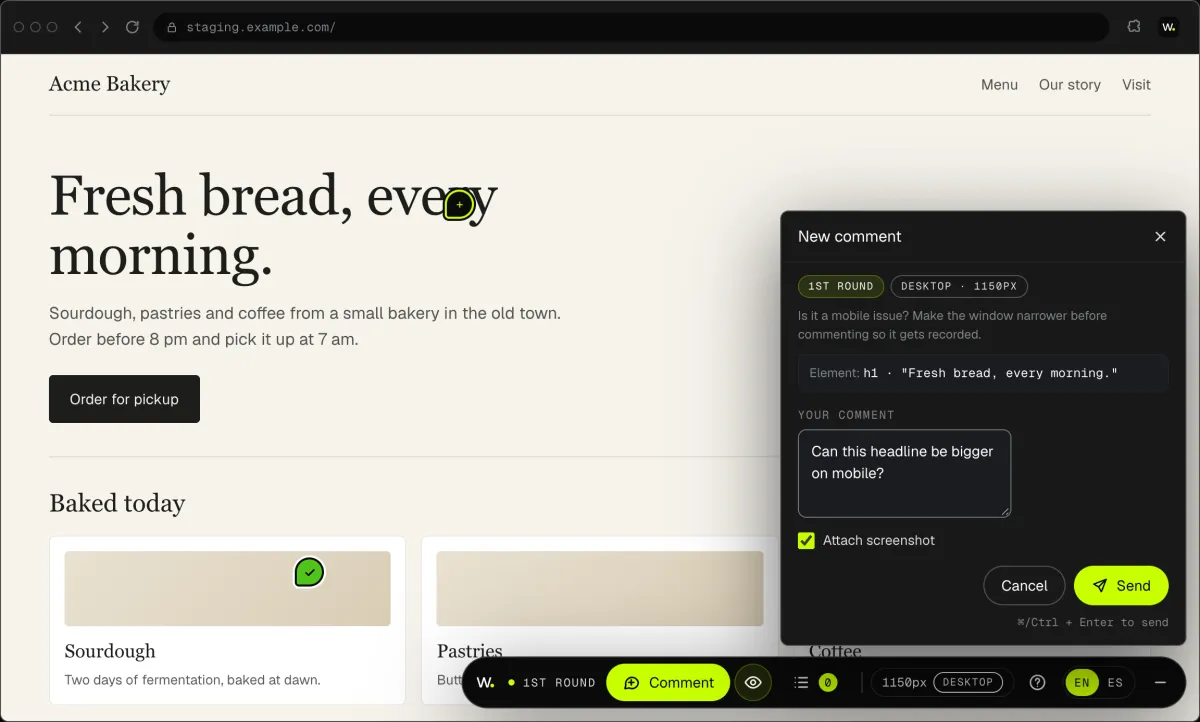
01Client Feedback
Click anything on your own site and say what you want. That's it: the team gets it as a task with a screenshot, and you watch it get solved.
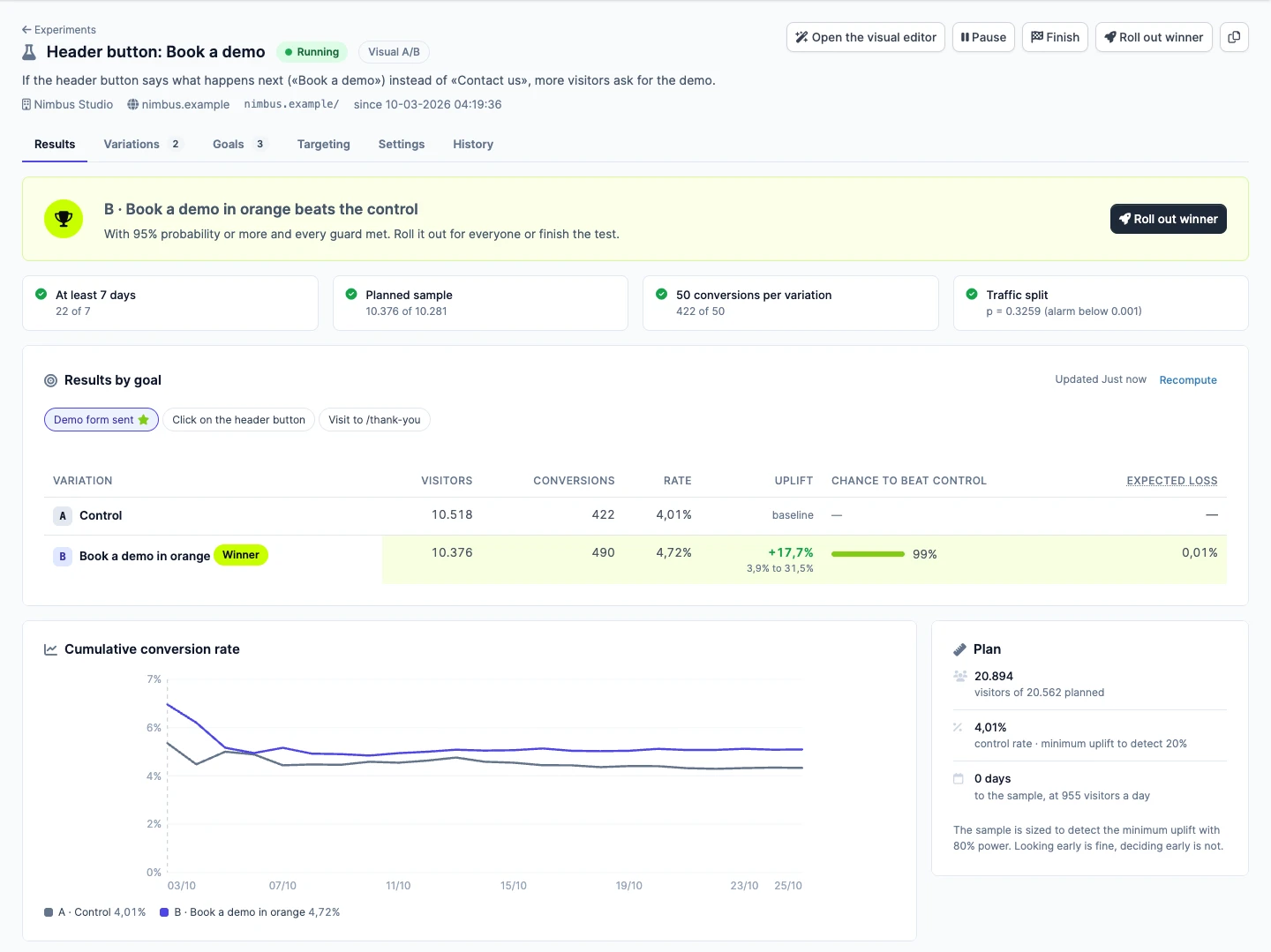
02werun.Experiments
Not sure which version sells more? Try both with real visitors. Tell us the idea in plain words and we set up the test. You watch the winner from your Client Portal.
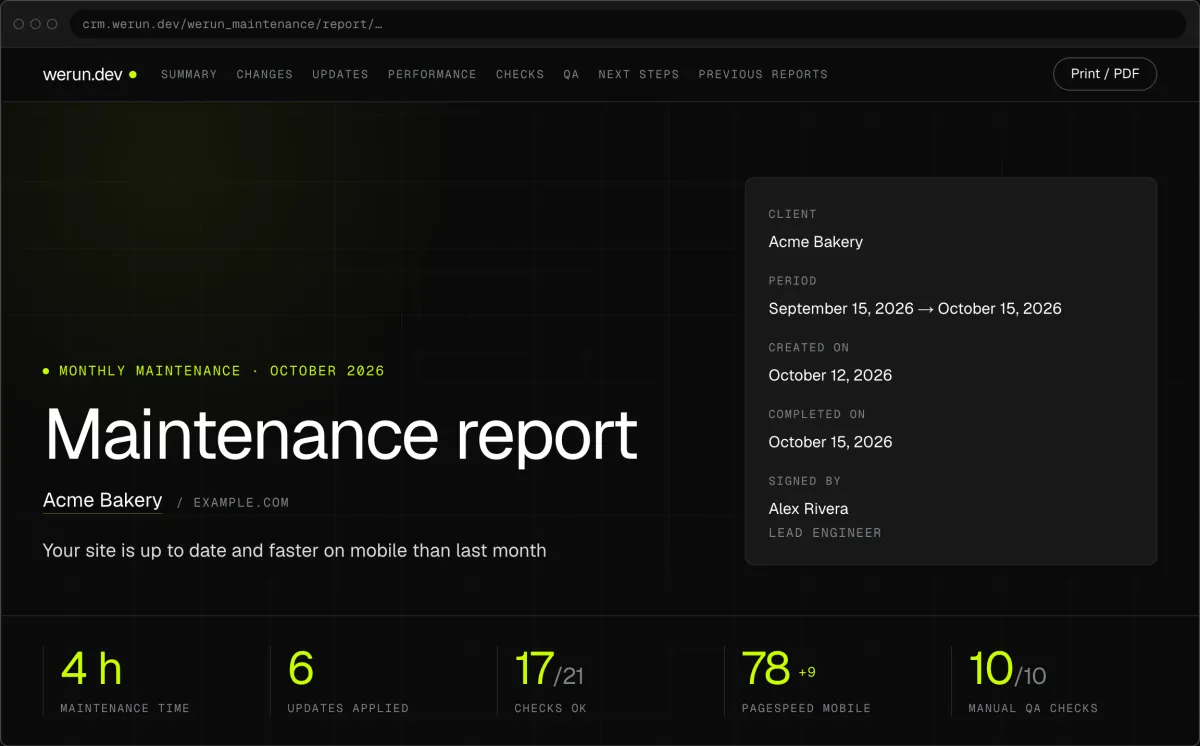
03Monthly report
Every month, in writing: what we changed on your site, what we watched over and what comes next.
What clients say
Teams like yours, in their own words.

“The client portal, the feedback extension and the WordPress security alerts have been very intuitive, pretty turnkey. Just this past week getting comfortable with it, it’s been really helpful. We’re rolling it out to our core team. Nice job.”
Website speed questions
How much does website speed optimization cost?
Speed fixes are $120 per hour, with a 30-minute minimum per task. Before any work starts, you get a written list of what slows the site, each item with its hours. You approve it in the Client Portal, and every hour is logged against its task. When the theme itself is the cause, a rebuild is a project from $5.5k. Keeping the site fast afterwards is Care, from $1,200 a month.
What makes a website slow?
Usually what piled up over the years. Plugins or apps nobody uses anymore are the most common cause. So are images far larger than the screen shows, and scripts loaded on every page. A heavy theme adds its own styles and features to every page. A slow server weighs most on pages that cannot be cached, like the cart. The free SEO and AI audit shows which of these Google finds on your site.
Why is my checkout so slow?
Usually because caching cannot help there. On WooCommerce, cart and checkout pages are built fresh for each shopper, so everything on them runs every time. Payment, shipping and tax add-ons often load there together. werun.dev measures the cart and checkout on a phone and removes what they load for nothing. Then each step passes a written test. Every fix is made on a copy first, so your store keeps selling.
Does page speed affect Google rankings?
Yes, as one signal among many. Google measures three Core Web Vitals on your pages. They show how fast the main content appears, how soon a tap responds and how much the page jumps. A slow page also loses visitors before it finishes loading. The free audit shows your PageSpeed on phones and computers, at no cost. With Care, each monthly report puts the score beside last month’s.
Is a caching plugin enough to speed up my site?
Sometimes, and your site may keep one. A caching plugin serves saved copies of your pages, which helps pages that rarely change. It leaves heavy images, unused plugins and scripts in place, and the cart and checkout are usually left out. werun.dev removes or replaces what slows each page, then measures it again. You end up with fewer plugins to update, and a checkout tested after every change.
Do I need better hosting to make my site faster?
Only when the measurements point there. Hosting decides how fast the server answers, and PageSpeed shows that apart from images and scripts. When the weight is plugins, images or scripts, a new host carries the same weight. Your hosting stays your choice, and werun.dev works inside it. If a move makes sense for WordPress, we recommend WP Engine, Automattic or SiteGround, and resell none of them.
Can speed fixes break my site or checkout?
The risk stays on a copy of your site, away from your shoppers. Each fix goes first to staging, a private copy of your site. Before it goes live, the cart, shipping and payment pass a written test on a phone and a computer. Your live site keeps selling while the work happens. If anything looks wrong after launch, you reach a person who knows the site within 2 hours on business days.
How long does it take to speed up a website?
It depends on what slows it, and you know before you approve anything. The free audit shows your PageSpeed in about a minute. Send your address, and the date of your next campaign if one is coming. A person replies in under 2 hours on business days. Fixes sized in hours fit in days, while a rebuild takes weeks. Each fix on your list carries its hours, so you start with what costs you sales.
Want your site fast before the next campaign?
Send us your address and the date of your campaign. We reply within 2 hours on business days with what slows it and what it costs.