Multilingual stores
A store for each new market, in its own language.
Buyers in each market read your store in their language, at an address in their language. Each market can show its own prices and content. Search engines send each reader to their page.
Short answer
How do I set up a multilingual online store?
werun.dev sets up multilingual Shopify and WooCommerce stores where each language is a real page with its own address. Each page is paired with its translations, so search engines show buyers the right one. Each market can carry its own prices and content. Each extra language adds 25% of the development, and the translation is priced apart. To start, tell us your store, your languages and the markets you want next.
- Each extra language
- 25% of the development
- Platforms
- Shopify and WooCommerce
- Search engines
- Each reader sent to their language
- Reply
- Under 2 hours on business days


























































In your words
Why a translated store still misses its market, and what a real one does.
What happens: Your store translates itself in the browser, and search engines see only English.
What changes: Each language is a real page with its own address, so search engines find it.
What happens: A buyer in Spain switches language and lands back on your home page.
What changes: The switch takes them to the same product, in their language.
What happens: Every market sees your home market’s prices and shipping notes.
What changes: Each market shows the prices and the content you set for it.
What happens: Your addresses stay in English, even on the Spanish pages.
What changes: Addresses can speak each language too, as they do on this website.
How it works
From one language to many, market by market.
Each new market follows the same steps. Each one lights up, with what you receive at that point.
You choose your next markets
Which languages, which prices and which content each market gets, written down before anyone builds.
You getA written plan per market, with its share of the price
Each language gets real pages
Its own addresses, its own titles, and layouts adjusted to the length of each language.
You getPages in each language, at addresses in that language
Search engines learn which page is which
Each page names its translations with a tag called hreflang. The sitemap lists every language.
You getEach page paired with its translations for search
Each market gets its own prices
Prices and content per market, set in the store or brought down from your ERP.
You getPrices and content set for each market
Every language is tried before launch
Each page is checked in every language on a copy of your store, called staging. Then it goes live.
You getA link to try every language before buyers see it
What changes for you
What changes when a market reads you in its language.
The difference shows in search, in the language switch and at checkout.
Each reader gets their language
Search engines know which page to offer a reader in Spanish: yours, in Spanish.
The switch keeps their place
A buyer who changes language stays on the same product, in the other language.
Prices that fit the market
Each market sees the prices you set for it, beside content written for it.
What it costs
What each new language costs, as a share of the build.
A language is priced as a share of the development, so it grows with the size of your store.
New store
From $5.5k one project
A store built in your first language, sized by what it needs.
- Small from $5.5k to $11k
- Medium up to $22k
- Large up to $44.1k
Each extra language
+25% of the development
Another language on the same store: the setup, the pairing and the layouts adjusted to it.
- Real pages with their own addresses
- Paired for search engines
- Layouts adjusted to each language
- Translation quoted separately
Retainer
$4,800 a month
Your own web team for the markets you add next, month after month.
- 40 development hours a month
- New pages in every language
- Replies in under 2 hours on business days
Prices per market, a second store or many product types add hours. We say how many before you start. See every engagement
Your next step
Tell us your goal, we reply within 2 hours.
Write it the way you would tell a colleague. A person reads it and answers on business days.
- A written answer with what it takes and what it costs
- You decide before anything starts
- We sign an NDA if you need one
Free first look
Tell us what you need.
Proof
Two languages you can try right here.
These are ours, and each one runs in English and Spanish.
This website
Every page exists in English and Spanish, paired for search engines, with Spanish words in the Spanish addresses.
See itWelcomeAI
Our product works in English and Spanish. The Spanish is a full mirror, written to the English register rather than passed through a machine.
See itwerun.
Our WordPress plugin ships in English and Spanish, with each screen translated inside the plugin itself.
See itWorking with us
You stay on the job, we keep you in the loop.
Your project, approvals and invoices live in the Client Portal. You ask for a change by clicking on your own site. With Care, a written report arrives every month.
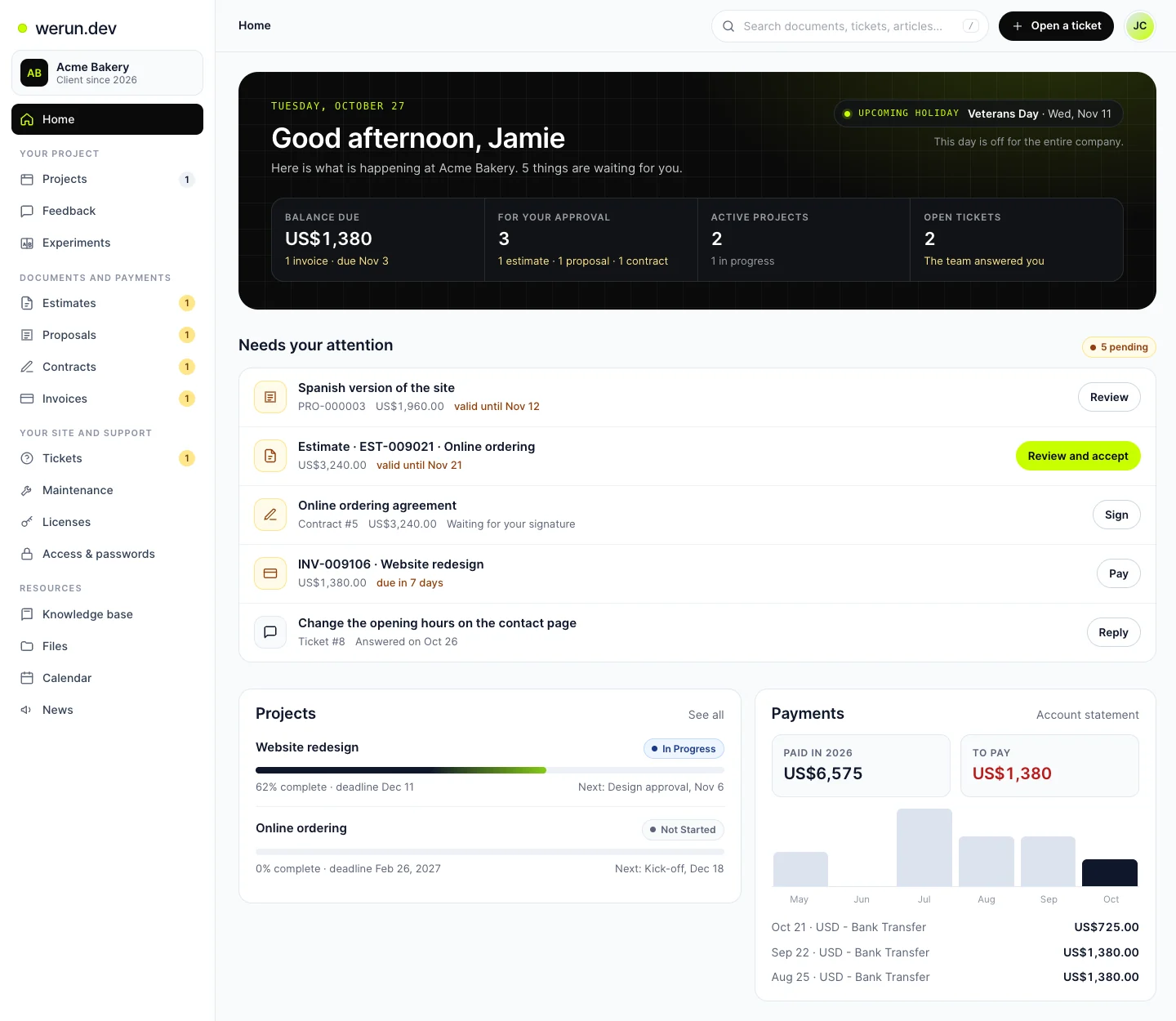
01Client Portal
Projects, requests, invoices, proposals and contracts in one place. Ask it a question and it answers from your own records.
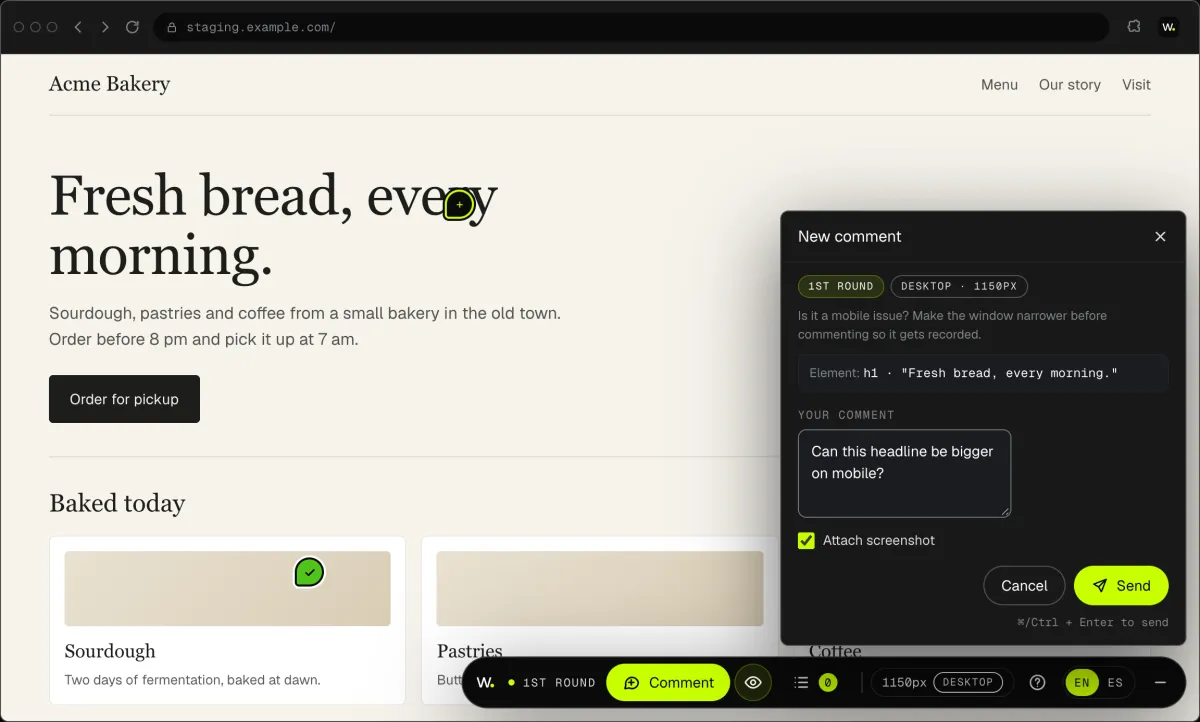
02Client Feedback
Click anything on your own site and say what you want. That's it: the team gets it as a task with a screenshot, and you watch it get solved.
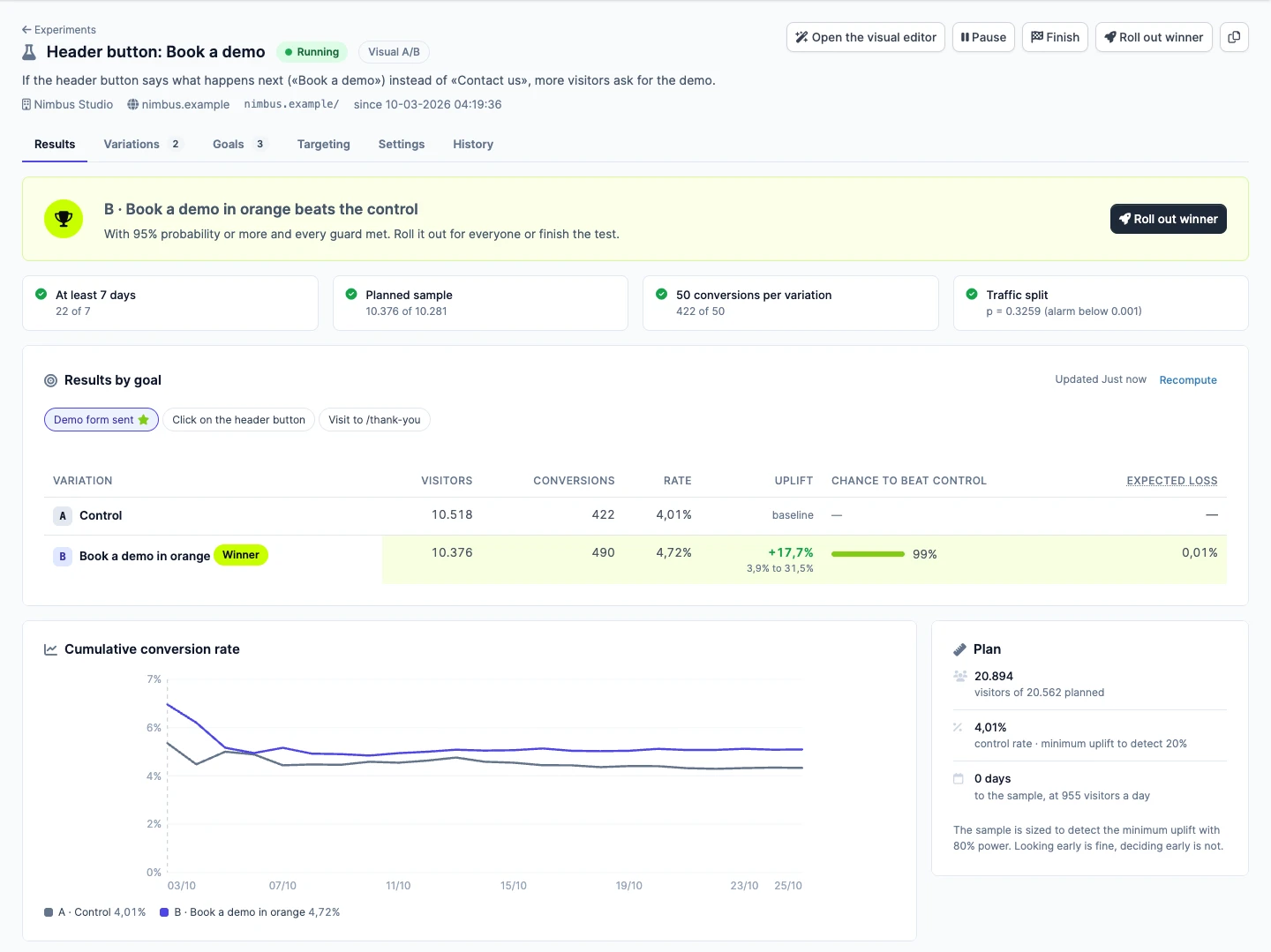
03werun.Experiments
Not sure which version sells more? Try both with real visitors. Tell us the idea in plain words and we set up the test. You watch the winner from your Client Portal.
What clients say
Teams like yours, in their own words.

“The client portal, the feedback extension and the WordPress security alerts have been very intuitive, pretty turnkey. Just this past week getting comfortable with it, it’s been really helpful. We’re rolling it out to our core team. Nice job.”
Multilingual store questions
How much does each extra language add to an online store?
25% of the development, for each language after the first. It covers the setup, the pairing for search engines and the layouts adjusted to that language. Because it is a share, a larger store costs more per language than a small one. The translation itself is priced apart from that figure.
Is translation included in the price of a multilingual store?
The translation is apart from the 25% figure. You can send us the text in each language, and we place it on every page. Or ask us to add the translation to the proposal as a line of its own. Either way, someone who speaks the language should read it before launch.
Is automatic translation in the browser enough to sell abroad?
Rarely, if you want buyers to find you in search. A translation made in the visitor’s browser is invisible to search engines, which see only your first language. A real page per language has its own address, its own title and its own place in search. It also lets each market show its own prices and content. For a small catalogue in one extra language, your platform’s translation app can be enough, and we say so.
How do search engines find each language of my store?
Each language is a real page with its own address, listed in your sitemap. Each page also names its translations with a tag called hreflang. That tag tells a search engine which version to offer each reader. A buyer searching in Spanish gets your Spanish page, and the language switch keeps them on the same product.
Can each market have its own prices and content?
Yes. Prices can be set per market in the store, or brought down from your ERP. Content can change per market too, such as shipping notes. On Shopify Plus, a market can also be a store of its own. Prices per market add hours, and the written estimate says how many.
Can you add a language to the store we already have?
Yes. We look at the store first and tell you in writing what a new language takes. That covers the pages, the addresses and any layout that breaks with longer words. The work is then estimated in hours at $120. Your live store keeps selling while the new language is built on a copy.
Should each language use a folder, a subdomain or its own domain?
A folder is the usual choice, and it is how this website works. Our Spanish pages live under /es, with Spanish words in each address. That keeps one store, one domain and one place to look after. On Shopify Plus, a market can also be a store of its own, on its own domain. The written proposal says which fits your markets.
What do we prepare before opening a new market?
Three decisions: which languages, which prices and which content each market gets. We write them down with you before anyone builds. Then send the text in each language, or ask us to add the translation as its own line. Shipping notes and anything else that changes per market go on the same list.
Which market do you want to sell to next?
Tell us your store, the languages and the markets. We reply within 2 hours on business days with what each one takes.